
Editorial infrastructure illustration for this article. Not an official Cloudflare asset or product screenshot.
AI agents email sounds boring until you realize what an address actually gives an agent: identity, a thread, attachments, timestamps, and an audit trail.
That is the part most chatbot demos never had.
On April 16, 2026, Cloudflare announced that Cloudflare Email Service is in public beta. The headline feature is not just sending email. The sharper signal is that Cloudflare now ties together inbound email, outbound email, the Agents SDK onEmail hook, an Email MCP server, Wrangler email commands, and the open-source Agentic Inbox reference app.
In plain English: the inbox is being treated like agent infrastructure.
Quick Navigation
- What is AI agents email? The agent pattern behind Cloudflare's launch.
- Timeline: How email, agent SDKs, MCP, and async execution converged.
- What We Know So Far: The public evidence and the limits of the claim.
- Why It Matters: What this means for AI builders, SaaS products, and trust.
- FAQ: Short answers for search-driven questions.
What is AI Agents Email?
AI agents email is the pattern of giving an AI agent a real email interface so it can receive requests, process context, take actions, and reply asynchronously through the inbox.
This is different from old email automation. A rules-based autoresponder reacts to subject lines or templates. An agent-backed inbox can inspect the message, look up state, call tools, wait for another step, ask for human approval, and respond later.
According to Cloudflare's public announcement, the new Email Service beta supports receiving messages through Email Routing, sending messages through Email Sending, processing inbound email with Agents SDK onEmail, and using an Email MCP server for integration. The company also points to Agentic Inbox as a self-hosted example running on Cloudflare Workers.
The important product shift is simple: an AI agent does not need to live inside a chat window. It can live where work already happens.
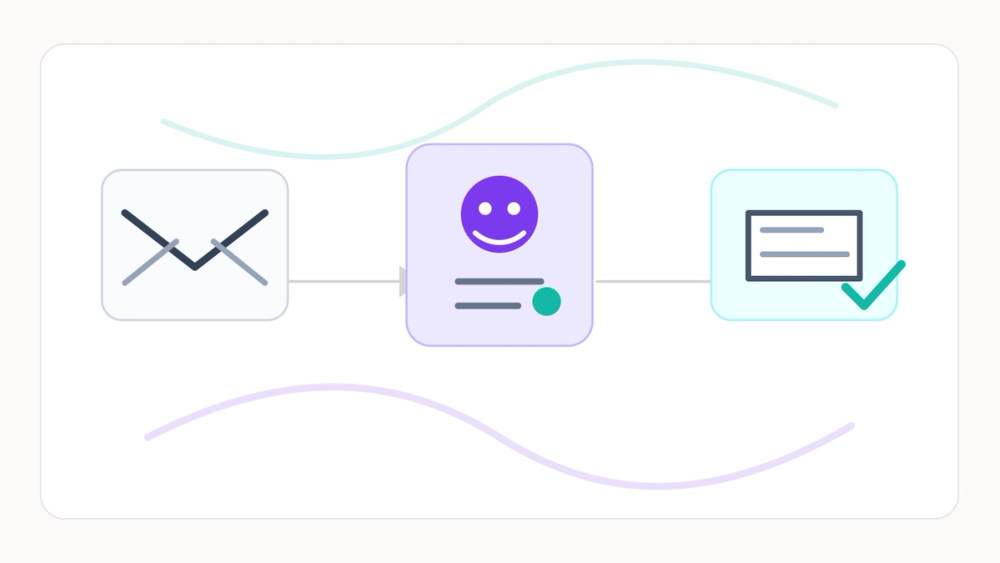
Workflow illustration. It explains the email-to-agent loop without showing a real product UI.
Timeline: How This Became a Thing
- November 2024: Anthropic introduced the Model Context Protocol, framing MCP as an open standard for connecting AI assistants to tools and data systems.
- April 9, 2025: Google announced Agent2Agent, an open protocol meant to help agents communicate across vendors and frameworks.
- April 16, 2026: Cloudflare put Email Service into public beta and positioned the inbox as a native channel for agents.
- April 20, 2026: Cloudflare's Agents Week recap grouped launches such as Agent Memory, AI Search, Browser Run, Managed OAuth/Auth for Access, Sandboxes, and related platform primitives under an "agentic cloud" umbrella.
- 2026: OpenAI's Background mode docs describe long-running tasks that execute asynchronously, while AWS presents Bedrock AgentCore as production infrastructure for agents.
Do not read that as one neat alliance. These companies are competing hard.
But they are all circling the same problem: once agents leave the demo box, they need triggers, state, tools, permissions, memory, browsers, logs, and safe ways to talk to people.
Email checks more of those boxes than people want to admit.
What We Know So Far
The public evidence is strong enough to support the trend: email is becoming a real interface layer for AI agents.
Cloudflare says Email Service is in public beta and describes inbound routing, outbound sending, Agents SDK onEmail, Email MCP, Wrangler email commands, and Agentic Inbox as part of the agent email story. The Agentic Inbox repository also shows the reference pattern: a self-hosted email client with an AI agent running on Cloudflare Workers, using Email Routing, Durable Objects, R2, and Workers AI.
The broader infrastructure shift is visible beyond Cloudflare. Anthropic's MCP focuses on connecting AI systems to tools and data. Google's A2A focuses on agent interoperability. OpenAI's Background mode supports long-running async work. AWS Bedrock AgentCore packages agent runtime, identity, memory, gateway, browser, and observability pieces for production use.
What is not public yet is just as important: audited adoption numbers, internal customer usage, and real-world failure rates. So the claim here is not "email agents have already won." The claim is narrower and more useful: the inbox is starting to look like production infrastructure for agents, not just a place to send notifications.
Why It Matters
1. Email has the boring primitives agents need
Most AI product teams still start with a chat interface because it demos well.
Email is less sexy, but it has things enterprise workflows already trust: sender identity, recipients, CC, attachments, timestamps, folders, thread history, forwarding, archives, compliance tooling, and a human expectation that not every task is instant.
That last part matters.
An AI agent that receives "review these invoices and reply when done" should not pretend it is a chatbot. It should behave like an async worker with a paper trail.
The inbox gives that worker a place to stand.
2. Async AI is becoming a real product pattern
The early AI product loop was simple: user asks, model answers, user waits.
That works for a writing prompt. It breaks down for tasks that touch multiple systems, require tool calls, need approval, or take longer than a loading spinner should exist.
OpenAI's Background mode is one signal here: the official docs frame it around long-running tasks that execute asynchronously. AWS AgentCore points in the same direction with long-running agent workloads and session isolation. Cloudflare's Email Service gives the pattern a familiar user interface.
The next useful agent may not say "here is your answer" in ten seconds.
It may say nothing for ten minutes, do the work, and then send you a reply with a trail you can audit.
3. The fight is moving from model quality to agent infrastructure
Models still matter. Obviously.
But the harder product question in 2026 is no longer only "which model is smarter?" It is "which platform can make an agent safe enough, connected enough, and durable enough to do real work?"
That is why the Cloudflare announcement is interesting beyond email. In the same Agents Week cycle, Cloudflare talked about memory, search, browser access, managed auth, sandboxes, networking, and developer tooling. AWS AgentCore uses a similar infrastructure vocabulary: runtime, gateway, identity, memory, browser, observability, and policy.
This is the stack forming underneath the shiny demos.
4. Agent identity is about to become a messy IAM problem
The more useful agents become, the less acceptable vague permissions become.
If an agent reads a customer email, calls a CRM, opens a billing tool, drafts a refund, and replies from a shared inbox, the important question is not "can it do that?" The question is: who authorized it, what was it allowed to touch, and where is the log?
Cloudflare's email post mentions standard email authentication such as SPF, DKIM, and DMARC, plus HMAC-SHA256 for secure reply routing. That is a hint of the real issue: agents need verifiable channels and tamper-resistant routing, not just clever prompts.
OWASP's agentic AI work is a useful warning label here. Prompt injection, tool misuse, goal manipulation, and permissions failures are not abstract risks when the agent has an inbox and real tools.
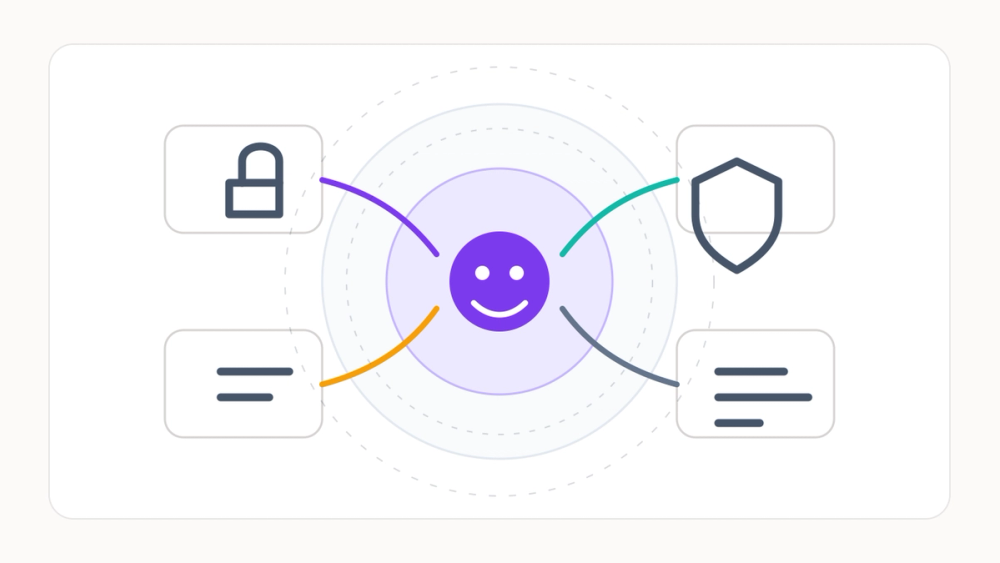
Editorial trust-layer illustration. It visualizes identity and audit controls, not a real security dashboard.
5. The web is slowly becoming machine-addressable
Email is only one interface.
MCP tries to standardize how AI systems connect to tools and data. A2A tries to help agents communicate with each other. Browser and computer-use tools let agents act through human-facing interfaces when no API exists. Background execution lets the work continue after the user stops watching.
Put those together and the direction is obvious: the internet is being retrofitted for machine users.
Not bots in the old spam sense. Agents that have delegated authority, recognizable identity, constrained permissions, and a job to finish.
That is why "give the agent an email address" is not a small idea.
It is one of the most normal ways to make an agent legible to the existing internet.
Quick Take
- Cloudflare Email Service enters public beta: Email is being treated as a native agent channel, not just a notification layer.
- Agentic Inbox is open source: Cloudflare wants developers to see the full reference pattern, not only an API endpoint.
- Background execution is becoming official: High-value agent tasks increasingly look async, durable, and inspectable.
- MCP, A2A, and AgentCore are spreading: The market is building protocols and runtime layers around agents.
- OWASP is naming agent-specific threats: Security and identity will decide which agent workflows make it into production.
The clean takeaway: the next AI interface may look less like a chatbot and more like a shared inbox with permissions.
FAQ
What is AI agents email? AI agents email means giving an AI agent an email interface so it can receive messages, process them with context and tools, and reply asynchronously. It is closer to an agent work queue than a traditional autoresponder.
What did Cloudflare launch for AI agents? Cloudflare announced that Email Service is in public beta. Public docs and announcements describe inbound email through Email Routing, outbound sending, an Agents SDK onEmail hook, an Email MCP server, Wrangler email commands, and the Agentic Inbox reference app.
Is this just email automation with AI attached? Not quite. Email automation usually follows rules or templates. An agent-backed inbox can use memory, call tools, handle multi-step work, ask for approval, and respond later. The difference is not the channel. It is the execution model behind the channel.
Why does email matter for AI agents? Email already carries identity, attachments, threads, timestamps, and audit history. That makes it a surprisingly good interface for agentic workflows where work is asynchronous, collaborative, and sometimes reviewed by humans.
What should AI builders learn from this? Stop assuming the agent interface must be a chat box. For many business workflows, the winning interface may be the one users already trust: inbox, ticket, document, calendar, or approval queue. The agent layer should fit the workflow, not force a new one.
Discover more AI tools, experiments, and product trends at AIToolHunt.
Sources
- Cloudflare: Email for agents, Cloudflare Email Service public beta
- Cloudflare: Agents Week 2026 recap
- Cloudflare Agentic Inbox repository
- OpenAI: Background mode
- Anthropic: Introducing the Model Context Protocol
- Google Developers Blog: Agent2Agent protocol
- AWS: Amazon Bedrock AgentCore
- OWASP GenAI Security Project: Agentic AI threats and mitigations