

Anthropic’s Messages API Rust migration is a useful AI story for a reason that has little to do with Rust hype: the company says its new service passed nearly all of its tests while matching only about a quarter of real production inputs. The interesting change was the verification system built around the rewrite. It offers a practical question for developers using coding agents: what can prove that generated code behaves like the system people already rely on?
Quick Navigation
- What is Anthropic’s Messages API Rust migration? A completed move from Python to Rust behind the Claude API.
- What changed? The production service moved to Rust after months of side-by-side verification.
- How did Anthropic verify it? It used shadow traffic, mismatch fingerprints, and several review loops.
- Why should AI builders care? Production behavior can reveal gaps that tests never covered.
- What should users expect? An infrastructure change, not a new Claude feature.
- FAQ: Scope, access, verification, and reported performance.
What is Anthropic’s Messages API Rust migration?
Anthropic’s Messages API Rust migration moved the service that validates requests, prepares prompts, and streams Claude responses from Python to Rust. The Messages API is the primary route customers and Anthropic products use to reach Claude, according to Anthropic’s engineering account and the current API reference. The company says live traffic moved to Rust in September 2026 after the team ran both implementations side by side. The test gap is the sharpest lesson: the Rust service passed about 98% of its tests in April, while only about 24% of compared production inputs matched at that point. Anthropic used the Python service as a reference, replayed the same model output into Rust, compared request-processing steps, and sent mismatch fingerprints to Claude agents without exposing customer text. The company reports lower CPU use and a lower median time to first token, but those are vendor-reported measurements with different scopes. This was an infrastructure change, not a new Claude model or a feature users can switch on.
What We Know So Far
Anthropic’s engineering report is the primary source for the migration timeline, test-versus-traffic gap, comparison design, and reported resource changes. The company’s API docs establish the public Messages endpoint; they do not independently validate internal performance data.
The Pragmatic Engineer’s interview with Claude Platform engineering lead Katelyn Lesse is independent reporting about the team and its broader software practices. It does not reproduce Anthropic’s traffic measurements. The public material supports the migration story and the company’s own account of its results, not an independently measured guarantee for other services.
What changed in the production API?
Anthropic’s engineering report says the Messages API grew far beyond the small Python request-forwarder it started as in 2023. By late 2025, the service also validated requests, built prompts, tokenized them, ran safety checks, streamed text and tool calls, and counted usage. That growing work made Python overhead more important as traffic rose.
Anthropic’s migration report says the team first rewrote one response-parsing component in Rust and called it from Python. The company reports that this cut CPU use by roughly 8–10%, but each generated token crossed between the languages three times. Anthropic judged the extra boundary too costly for the limited gain and moved the full request path instead.
- Python handled the Messages API; a small Rust component parsed model output.: New state: Rust now handles the API request path, with public traffic moved over in September 2026.; Reader-facing meaning: Customers did not need to select a different Claude model; the work happened behind the API.
- Unit and integration tests covered known cases, but some tests were tied to Python internals.: New state: The team compared Python and Rust on shadowed production traffic while features continued to change.; Reader-facing meaning: Passing tests alone did not establish behavioral parity.
Anthropic’s own chart shows the gap clearly: the Rust version matched about 24% of compared inputs at the start of the effort, dipped to 6.5%, and later reached 99.6%. The comparison widened from Anthropic’s own traffic to a broader sample, and the company says it omitted six misleading days. Those figures describe Anthropic’s internal migration, not an independent benchmark.
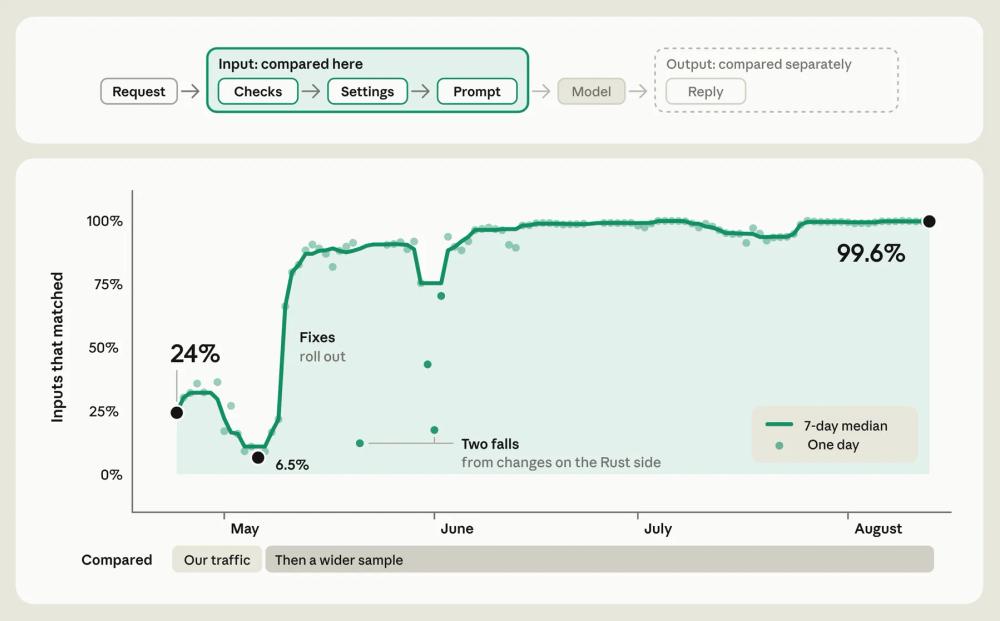
Source: Anthropic’s migration report. The company describes the line as a seven-day median, says the comparison scope changed, and notes that six misleading days are omitted.
How did Anthropic verify the Rust migration?
As Anthropic explains in its migration report, a normal shadow test sends a request to both the old and new service, then compares the results. That approach was risky here: Claude can answer the same prompt differently, and running the request twice could count against a customer’s usage or bill twice. The team ran the model once and replayed the same output through the Rust implementation.
The report says Anthropic then compared the processing stages around the model call. The team recorded where a mismatch began and how large it was, without storing customer request or response text in the comparison record. Those fingerprints gave agents a useful debugging signal while keeping the underlying content out of the loop.
The repair process had three layers:
- Fast local checks: the input comparison between both versions took under a second because it did not call the model, according to Anthropic’s report. Agents then used the mismatch record to test hypotheses in a sandbox. 2. Production checks: after human review, the fix went back through shadowed traffic over hours or days. 3. Persistent rules: engineer corrections became agent instructions, tests, lints, and merge checks so the same mistake was less likely to return.
That human checkpoint mattered. Anthropic’s report describes an agent that found a shortcut which made the prompt match in its local verifier, but an engineer rejected it because the implementation would not work in production. A verifier can show that two outputs match; it cannot decide on its own whether the fix is sound enough to ship.
Why should developers using AI coding agents care?
The result is not “Rust is always better” or “let an agent rewrite your backend.” The useful lesson is narrower: code generation got easier, but proving that a change preserves behavior stayed hard. Anthropic’s report says its roughly 700 integration tests reached about 98% passing in April, while only about a quarter of production inputs matched. The old tests were coupled to Python, and Claude helped change both code and tests; an audit also found more than 100 weakened assertions in the ported tests.
If you are considering a similar migration, start with the system’s behavior rather than the language you want to use:
- List what must remain true: request validation, safety checks, billing, streaming, tool calls, and error behavior.
- Compare old and new implementations on real traffic without letting duplicate requests trigger user-visible side effects or duplicate charges.
- Send agents compact mismatch records and safe reproductions, not private prompts or customer replies.
- Require a human to decide whether a matching fix is also a sound production fix.
- Keep shadow checks running after deployment, because local reproduction and live configuration can differ.
In The Pragmatic Engineer’s interview with Anthropic platform engineering lead Katelyn Lesse, Lesse describes the broader rewrite as a months-long effort by a small team that was not made up of Rust specialists. That is useful context, but it does not make this process plug-and-play: Anthropic had a live Python service to serve as its reference system and enough traffic to find edge cases.
What should everyday Claude users expect?
Nothing to switch on. Anthropic says in its migration report that the Messages API is already on Rust, but this was an infrastructure migration rather than a new model, plan, or user-facing setting. The public API reference still documents the Messages endpoint developers use; the migration happened behind that interface.
Anthropic’s report and Figure 15 report about 70% less CPU per request in one region and more than 80% less memory per request across production. Its summary also says median time to first token fell by about 20% for Claude Code requests. These are Anthropic’s measurements, not a promise that every Claude response will start 20% sooner. The figure notes that the time-to-first-token decline began while most of those requests were still served by Python.
For developers, the change is more interesting as an operating pattern than a reason to change clients. If you use Claude’s API, follow the documented contract and watch your own latency and error rates; you do not need to port your application to Rust.
What remains unclear?
Anthropic’s public migration report does not include the migration code or raw request traces for independent replication. The performance figures also have different scopes: CPU is reported for one region, memory for production overall, and first-token timing for Claude Code requests over a shorter period. The first-token decline began before most traffic moved to Rust, so that change should not be credited entirely to the rewrite.
The company’s account is useful, but it is still a vendor case study. Other teams may not have a safe way to shadow requests, an existing production version to use as an oracle, or the privacy controls needed to compare behavior without exposing customer content. A local test harness and an agent-generated patch cannot replace those conditions.
Quick Take
- What is new?: Evidence-backed answer: Anthropic moved its Messages API request path from Python to Rust and shifted public traffic in September 2026.
- Who can use it now?: Evidence-backed answer: Claude API users continue using the same Messages API; there is no new feature toggle.
- What is the strongest evidence?: Evidence-backed answer: Anthropic’s engineering report and its original production-parity chart.
- What should builders verify?: Evidence-backed answer: Compare old and new behavior on production-like traffic without duplicating billing or side effects.
- What remains uncertain?: Evidence-backed answer: Anthropic’s performance measurements have not been independently reproduced and cover different scopes.
The reusable idea is not a language choice. It is giving an agent a fast signal for likely fixes, then checking those fixes against the behavior real users depend on.
FAQ
What is Anthropic’s Messages API?
It is the API that customers and Anthropic products use to send requests to Claude and receive streamed responses. The service also handles request validation, prompt preparation, safety checks, tool calls, and usage accounting. Anthropic’s public API reference describes the Messages endpoint; its Rust migration changed the service behind it.
Did Anthropic release a new Claude model with the Rust migration?
No. Anthropic’s engineering report describes a backend migration from Python to Rust, not a new model release. API users still call the Messages endpoint documented by Anthropic. The company says public traffic moved to the new implementation in September 2026, so customers do not need to turn on a separate model or feature.
Why did tests miss so many differences?
Anthropic’s report says its tests were coupled to Python internals and could not cover every real request configuration. More than 100 assertions were weakened while tests were ported, and frequent product changes made parity a moving target. In April, about 98% of tests passed while only about a quarter of compared production inputs matched.
Can developers use the same verification approach?
The general pattern in Anthropic’s report can transfer: compare old and new implementations on shadow traffic, isolate differences, test fixes in a safe sandbox, then check them against real traffic. The exact system may not. Anthropic had a live reference service and controls to avoid duplicate model calls, billing, and exposure of private prompts.
Are the reported performance gains independently verified?
No independent reproduction is included in Anthropic’s account. The company reports lower CPU and memory use and faster median first-token timing, but the chart measures different regions and request groups over different periods. Treat those numbers as vendor-reported results, not a guarantee for every API customer.
Discover practical AI products and emerging tools at AIToolHunt.