Newsletter
Join the Community
Subscribe to our newsletter for the latest news and updates
A 27-billion-parameter model running locally on a phone sounds like a benchmark stunt. The interesting part is narrower and more practical: PrismML has published a 3.9 GB, 1-bit build with an iPhone runtime, while the model card exposes exactly where phone-sized AI still runs into memory and quality limits. Here is what the public evidence actually supports.
Bonsai 27B is PrismML’s multimodal, low-bit version of Qwen3.6-27B, released on July 14, 2026. Its phone-oriented build compresses the language weights to 1.125 effective bits each and about 3.9 GB, using binary values plus shared scaling factors. PrismML’s model card reports roughly 11 tokens per second on an iPhone 17 Pro Max through MLX Swift, while Decrypt separately reports running the model. That supports the narrow claim that a 27B-class model can generate locally on a phone; it does not prove cloud-frontier quality or all-day battery life. The model exposes a 262K-token context and an optional vision tower, but the full context needs far more memory than the phone-sized weight file. PrismML reports 89.5% retention of its full-precision benchmark average for the 1-bit build. That result comes from the vendor’s 15-test suite, not an independent benchmark reproduction, so it should be treated as directional rather than settled.
The underlying release details are documented in PrismML’s announcement and its 1-bit MLX model card. Decrypt reports running Bonsai 27B, while 9to5Mac deliberately describes the iPhone fit as PrismML’s claim.
The public evidence supports the release, downloadable Apache 2.0 weights, low-bit formats, memory tables, and a reported iPhone 17 Pro Max run. It does not independently establish PrismML’s full benchmark-retention percentages, sustained phone battery behavior, or the reliability of long agent workflows.
This is therefore a source-backed model explainer, not a hands-on AIToolHunt review. Device and benchmark numbers below remain labeled as PrismML measurements unless an independent report provides a separate observation.
The 1-bit variant is the actual phone story. PrismML’s technical card lists binary weights represented by negative one and positive one, 1.125 effective bits per weight, a 3.9 GB native language-model footprint, and an iPhone 17 Pro Max measurement of about 11 tokens per second. Its published MLX package is larger on disk because the current format stores extra group metadata and bundles the vision component.
The ternary variant is a different compromise. It uses negative-one, zero, and positive-one values at 1.71 effective bits per weight. PrismML calls 5.9 GB the ideal representation size, but the ternary model card says today’s package occupies roughly 7.2 GB because ternary values are stored in 2-bit slots. If you repeat only the 5.9 GB number, you hide the deployment cost developers actually face.
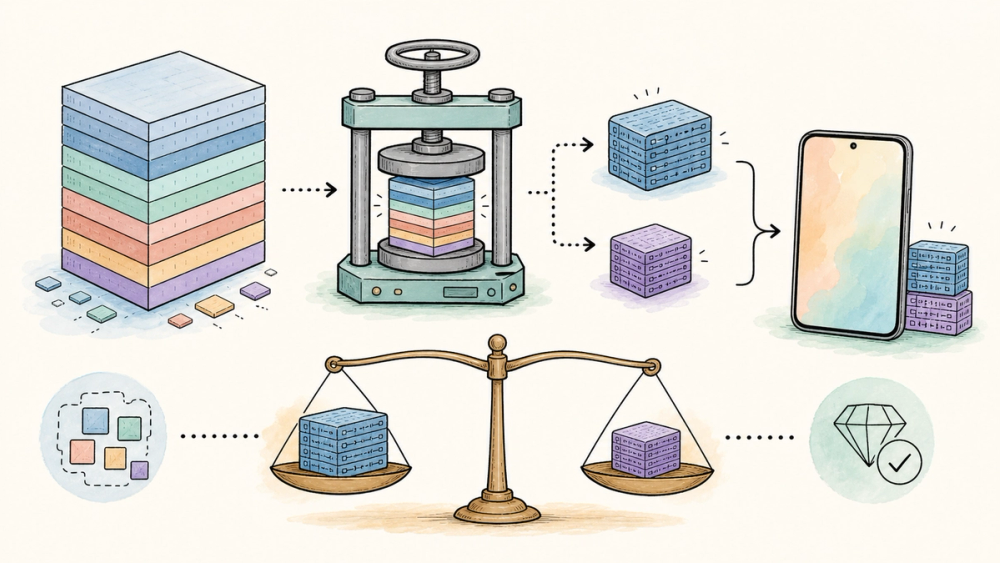
Most model weights are ordinary numerical values stored at relatively high precision. Bonsai reduces each language-model weight to a binary sign in the phone build, then shares one FP16 scaling factor across a group of 128 weights. That is how a nominal “1-bit” representation lands at 1.125 effective bits per weight, rather than exactly one bit.
PrismML says the low-bit format covers embeddings, attention projections, MLP projections, and the language-model head. The optional vision tower uses a separate 4-bit representation. Custom MLX Swift kernels consume the packed weights on iPhone; this is not simply a standard Qwen checkpoint that any mobile app can load unchanged.
The base architecture matters too. The model card describes Qwen3.6-27B as a hybrid-attention model with roughly three-quarters linear-attention layers, reducing how quickly the KV cache grows. Even so, context length remains a memory decision: PrismML’s own table puts the 1-bit build near 5.9 GB peak at 4K context in MLX and about 9.4 GB at the full 262K context with 4-bit KV-cache compression.
The practical integration path is model plus specialized runtime, not just model weights. PrismML publishes MLX/MLX Swift paths for Apple hardware and GGUF-related paths for its customized llama.cpp stack, while the release uses the Apache 2.0 license. Developers should reproduce peak memory, generation speed, thermals, and battery drain on their exact device before choosing it for a shipped feature.
The benchmark table also deserves a capability-level reading. PrismML reports a 76.11 overall average for 1-bit Bonsai versus 85.07 for its FP16 baseline, or 89.5% retained. But its own category results show larger drops in instruction following, tool calling, and vision than in math. A phone agent that invokes tools needs testing on the actual workflow, not the overall retention percentage.
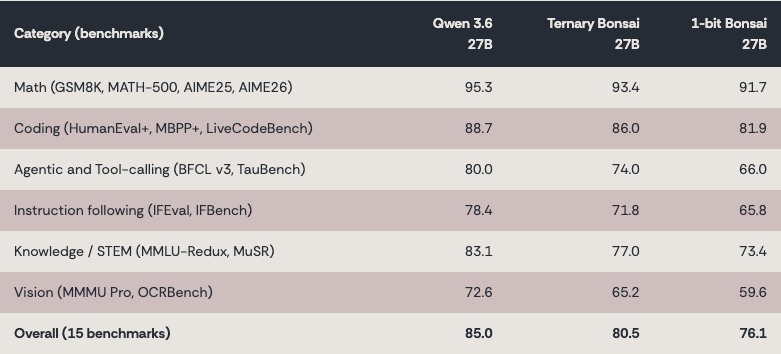
PrismML's original thinking-mode category table. Source: official Bonsai 27B release. These are vendor-reported results; the complete 15-test suite has not been independently reproduced in the sources reviewed here.
The compelling use case is not “a phone beats the cloud.” It is a private, offline-capable assistant that can handle useful local tasks without sending every prompt and intermediate result to a remote API. That could matter for personal notes, travel, local document lookup, or intermittent connectivity.
What you should not assume is parity with the best hosted models. Decrypt’s independent write-up says the model needed iteration for a coding task and produced more qualified creative-writing results. That is still useful evidence, but it points to a capable local model with visible tradeoffs, not a pocket-sized replacement for every frontier service.
✅ Best for: developers exploring private, offline, short-context assistants on recent Apple hardware, and enthusiasts willing to work with an early custom runtime.
🚫 Skip if: you need independently validated frontier quality, long-context operation inside a phone memory budget, or a polished consumer app with predictable battery behavior today.
My take: Bonsai 27B makes the phone claim concrete enough to investigate, but its best contribution may be teaching product teams to measure the whole local-AI memory stack instead of celebrating a weight-file size.
What is the Bonsai 27B phone AI model?
Bonsai 27B is PrismML’s low-bit, multimodal derivative of Qwen3.6-27B. The phone-oriented version represents language weights with binary values and shared scales, producing a native footprint of about 3.9 GB. PrismML provides an MLX Swift runtime path for recent Apple devices.
Can Bonsai 27B actually run on an iPhone?
PrismML’s model card reports about 11 tokens per second on an iPhone 17 Pro Max, and Decrypt reports running the released model. This supports local generation on that class of device. It does not establish performance on every iPhone, at maximum context, or under sustained battery-heavy use.
What is the difference between 1-bit and ternary Bonsai 27B?
The 1-bit version uses two weight values and targets phones at about 3.9 GB. Ternary uses three values and retains more of PrismML’s benchmark average, but its current deployed package is about 7.2 GB. PrismML positions ternary for laptops and GPUs rather than phones.
Does Bonsai 27B support a 262K-token context on a phone?
The model supports a 262K-token context, but that does not mean the complete window fits in the cited phone budget. PrismML’s memory table estimates about 9.4 GB peak at full context with a 4-bit KV cache, so phone deployments must use a much shorter working context.
Are Bonsai 27B benchmark claims independently verified?
Not comprehensively. PrismML publishes a 15-benchmark comparison and reports 94.6% retention for ternary and 89.5% for 1-bit against its FP16 average. Independent reports provide useful hands-on and release framing, but they do not reproduce the complete benchmark methodology across both variants.
Discover practical AI products and emerging tools at AIToolHunt.