
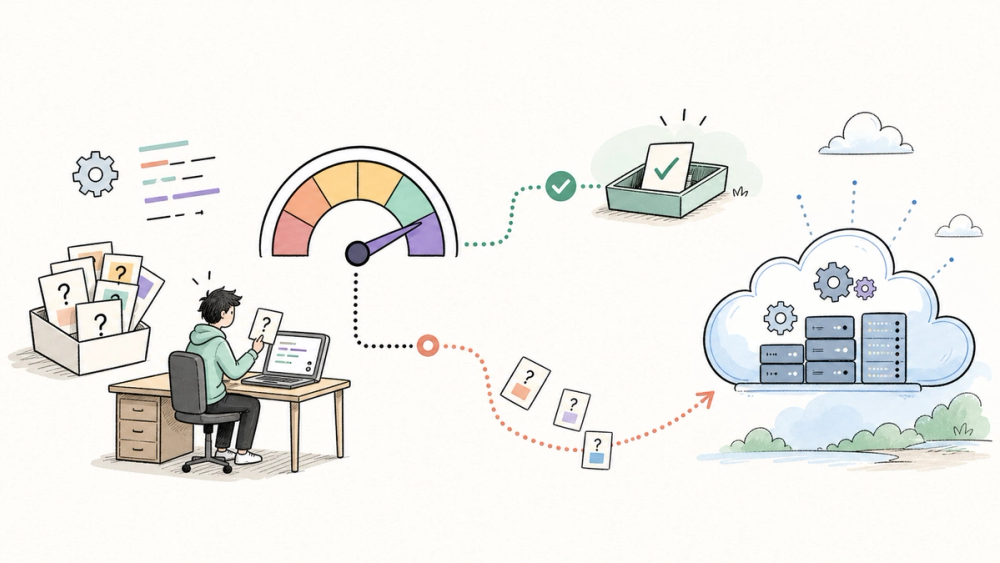
Cactus Hybrid is interesting because it does not ask a small model to pretend it is always right. It asks the model to return a confidence signal that software can route around.
Cactus Compute's July 2026 launch puts that idea into Gemma 4 E2B Hybrid. The practical question is simple: can a cheap, private, on-device model answer most routine prompts and hand off the uncertain ones before it creates damage?
Quick Navigation
- What is Cactus Hybrid? The plain-English definition.
- What changed in this launch? The confidence probe, weights, and routing claim.
- How does Cactus Hybrid know when to hand off? The mechanism and benchmark boundary.
- Who should test Cactus Hybrid now? Developer and product-user fit.
- What remains unclear? The caveats before production routing.
- FAQ: Five direct answers about confidence scores, Gemma 4 E2B, availability, benchmarks, and next steps.
What is Cactus Hybrid?
Cactus Hybrid is Cactus Compute's new confidence-routing layer for small on-device AI models: it adds a probe inside a Gemma 4 E2B checkpoint so each answer returns a structured confidence score from 0 to 1, then lets developers keep high-confidence responses local and send low-confidence prompts to a larger cloud model. The primary GitHub README says the first rollout is Gemma 4 E2B Hybrid with builds in a Hugging Face collection, plus Cactus, MLX, Transformers, and llama.cpp integration paths. The useful claim is narrow: Cactus says its probe can separate likely-wrong answers from likely-right ones across text, vision, and audio hold-outs, while a Hacker News launch post shows early developer interest rather than independent reproduction. Treat it as a routing experiment, not a magic self-awareness switch: the weights are available, the MIT code is public, and the benchmark numbers still need your own workload tests.
What changed in this launch?
- A small local model was usually either trusted or replaced by a bigger model.: New public information: Cactus adds a structured confidence field to the response path.; Why it matters: Apps can make a routing decision without parsing a self-rated prose answer.
- On-device AI was mostly a speed and privacy story.: New public information: The first Cactus Hybrid rollout targets Gemma 4 E2B Hybrid and cloud fallback.; Why it matters: The product idea becomes cost control: keep easy answers local, escalate uncertainty.
- Confidence often meant token entropy or another external heuristic.: New public information: Cactus reports a learned probe with higher AUROC than token entropy on its hold-outs.; Why it matters: The signal may be more useful than "the model sounded unsure," but it is still vendor-published evidence.
The technical shift is not that Gemma 4 E2B suddenly becomes a frontier model. The shift is that the app gets a number it can act on.
The Cactus README says the probe returns confidence as structured data, not text inside the answer. That matters because product code can use a threshold, log routing decisions, and run offline/cloud A/B tests without asking the language model to grade itself in another sentence.
Google's Gemma 4 model card is useful background here: Gemma 4 is designed as an efficient open-model family with edge and local deployment in mind. Cactus is trying to turn that local-model lane into a hybrid system rather than a yes-or-no choice.
What We Know So Far
The confirmed facts are modest but useful. The GitHub repository is public, the README includes integration examples, and the Hugging Face collection is the named home for the first Cactus Hybrid builds.
The vendor claims are bigger: Cactus says the confidence probe beats token entropy on its listed AUROC table and can make Gemma 4 E2B Hybrid competitive with Gemini 3.1 Flash-Lite on several benchmarks when some queries are handed off. I am treating those as primary technical claims, not independent reproduction.
The community evidence is narrower. The Show HN thread shows developer attention and author caveats; it does not prove the method is broadly calibrated. My inference is that Cactus Hybrid is worth a routing experiment for local-first apps, not that every small model can now safely judge itself.
How does Cactus Hybrid know when to hand off?
Cactus describes the mechanism as a small probe layer that reads hidden-state information during decoding and predicts whether the answer is likely wrong. Confidence is then 1 - p(wrong). If confidence falls below your threshold, your app can call a stronger remote model.
That is the important developer shape. A local model does the first pass, the app receives both text and confidence, and the routing policy decides whether the answer is good enough for the current task.
The benchmark claim is strong, but it needs careful framing. Cactus reports an average 0.814 AUROC for Cactus Hybrid versus 0.549 for token entropy across 12 hold-out benchmarks in the primary README. That supports "a better routing signal in Cactus' published tests," not "the model knows the truth."
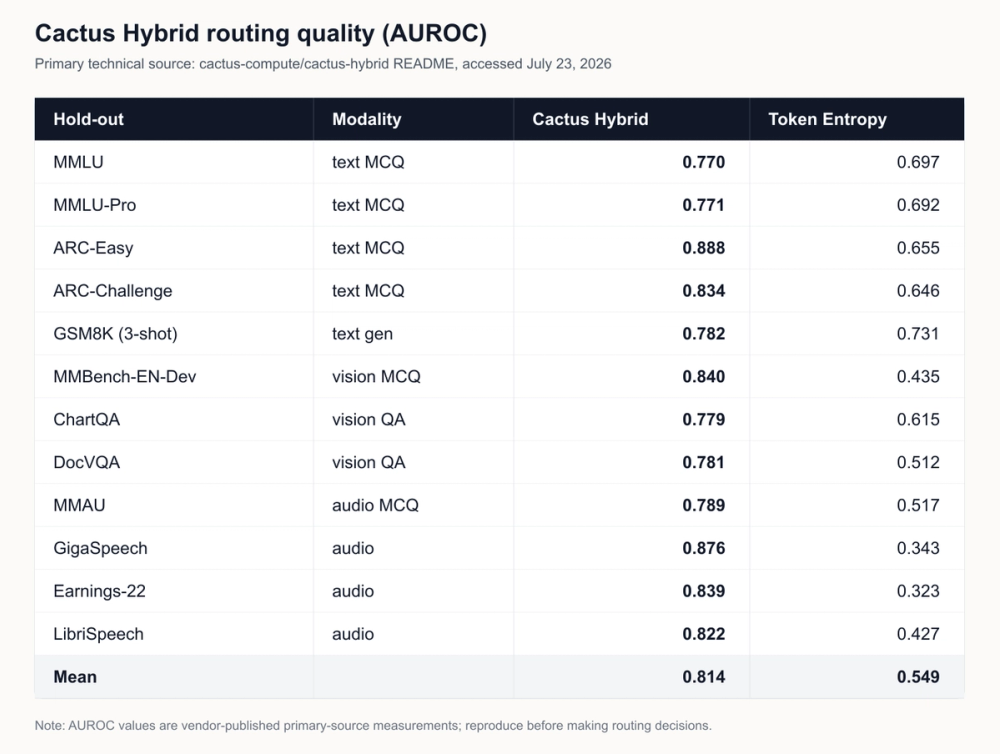
Rendered from the primary Cactus Hybrid README. These are vendor-published hold-out measurements, so reproduce them on your own prompts before routing production traffic.
The same README says Gemma 4 E2B Hybrid can match Gemini 3.1 Flash-Lite on most listed benchmarks by routing a minority of queries to Flash-Lite, with task-dependent handoff rates. That is the claim I would test first because it affects cost, latency, privacy, and failure handling at the same time.
Who should test Cactus Hybrid now?
Developers building local-first assistants should test it first. If your product already runs a small local model but escalates too often, a confidence score gives you a cleaner knob than hard-coded task categories.
The second good fit is privacy-sensitive mobile or desktop software. You can keep straightforward prompts on device and send only the uncertain cases to the cloud, assuming your policy and user disclosure make that handoff clear.
The third fit is agent infrastructure. A multi-step agent can route per task, not per token. That matters because Cactus' own Hacker News post says handoff works best when routing per task in a multi-step process.

Community signal only: the Show HN thread shows how the Cactus authors framed the launch and caveats. It does not prove broad model quality.
Ordinary AI users should care, but probably should not install this just to play with another model. The real consumer value appears when your app quietly decides, "this local answer is safe enough" or "this one needs a stronger model."
What do independent sources add?
The independent angle I found is more restrained than the launch copy, which is healthy. Remio's analysis frames routing as the real test: a confidence score matters only if it helps an application choose the right compute path.
That is the right bar. A number can be beautifully calibrated in a paper-like setup and still fail in a messy product with long context, tool calls, user typos, domain-specific jargon, and weird retries.
For builders, I would test four metrics before believing the headline: how often the model hands off, whether handoff catches the errors you care about, whether total latency stays acceptable, and whether the cloud calls you save are worth the integration complexity.
What remains unclear?
First, the benchmark tables are not independent reproduction. They are primary technical evidence from the Cactus repository, useful but not final.
Second, the probe is model-specific. The HN launch text says the technique is boutique for each model, which means this is not a universal confidence adapter you can bolt onto every open model tomorrow.
Third, production policy is still your problem. If an app sends only low-confidence prompts to the cloud, those prompts may be exactly the sensitive edge cases. Privacy messaging, audit logs, and user controls still matter.
Fourth, a confidence threshold can create its own failures. Set it too high and you erase the cost advantage. Set it too low and the local model may answer when it should have escalated.
Quick Take
- What is actually new?: Evidence-backed answer: Cactus Hybrid exposes a structured confidence score for Gemma 4 E2B Hybrid responses and uses it for cloud handoff decisions.
- Who can use it now?: Evidence-backed answer: Developers can inspect the GitHub repo and Hugging Face collection; production use still needs workload-specific tests.
- What is the strongest evidence?: Evidence-backed answer: The primary README's routing and AUROC tables, plus public weights and integration examples.
- What should developers verify?: Evidence-backed answer: Handoff rate, false-confidence failures, latency, cloud spend, and behavior on their own prompt distribution.
- What is still unknown?: Evidence-backed answer: Independent benchmark reproduction, calibration across domains, and whether the probe generalizes cleanly beyond each tailored model.
My practical take: Cactus Hybrid is worth testing if you already want local-first AI, but the benchmark number is only the start. The product value lives in your routing policy.
FAQ
What is Cactus Hybrid? Cactus Hybrid is a confidence-routing approach from Cactus Compute. Its first public rollout adds a probe to Gemma 4 E2B Hybrid so each response includes a structured confidence score that software can use before deciding whether to hand off to a larger cloud model.
Is Cactus Hybrid available now? Yes, the public materials point to a GitHub repository and a Hugging Face collection for Gemma 4 E2B Hybrid builds. That does not mean it is production-proven for your use case; treat it as something to benchmark against your own prompts and failure costs.
How is Cactus Hybrid different from token entropy? Token entropy is a heuristic based on model output uncertainty. Cactus says its learned probe reads intermediate hidden-state signals and reports a higher AUROC than token entropy across its listed hold-outs. That is a vendor-published result, so reproduce it before trusting it.
What should developers know before using Cactus Hybrid? Start with a shadow test. Log confidence, handoff decisions, final answer quality, latency, and cloud cost. Also test bad prompts, long prompts, domain jargon, and tool-call tasks, because routing failures often appear outside clean benchmark examples.
What is still unverified about Cactus Hybrid? Independent reproduction is the big gap. The primary repo reports strong AUROC and handoff numbers, and HN shows early interest, but neither proves broad real-world calibration. The technique also appears tailored per model, so generalization remains an open question.
Discover practical AI products and emerging tools at AIToolHunt.