
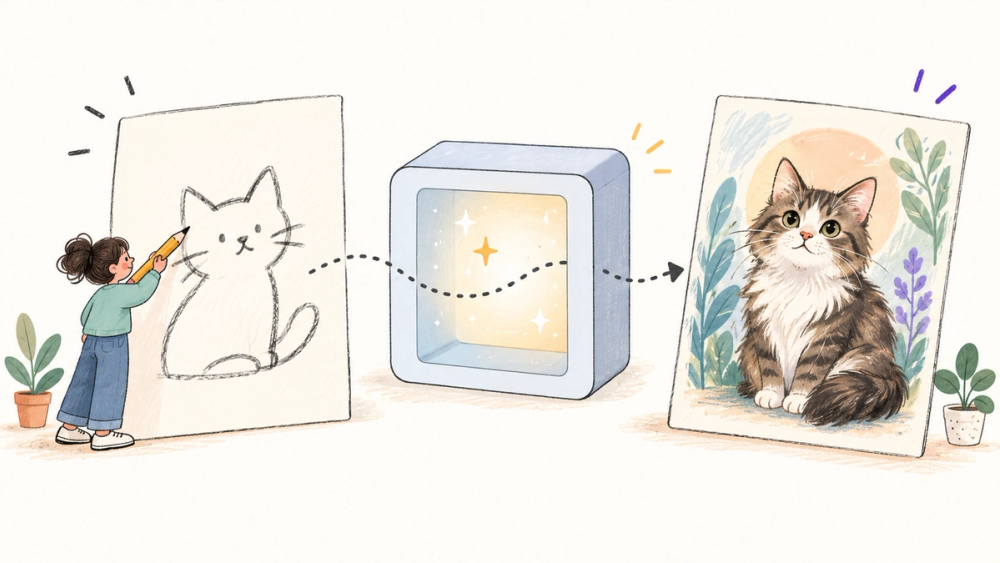
ChatGPT Images 2.5 adds something more useful than another quality adjective: a way to draw what words cannot place precisely. Sketch lets users make a rough visual prompt inside ChatGPT, while localized comments let them point at the part that needs changing.
The interesting question is not whether a doodle becomes pretty. It is whether visual intent and targeted feedback can reduce the frustrating loop of rewriting an entire prompt to fix one detail.
Quick Navigation
- What is it? How Sketch turns a rough drawing into part of a prompt.
- What changed? Visual input and localized comments join ordinary text instructions.
- How does it work? A simple sketch-to-generation-to-edit loop.
- Why should builders care? Better ways to collect spatial intent and review image changes.
- What remains unclear? Reliability, availability, pricing, and difficult-case behavior.
- FAQ: Five direct answers for users and developers.
What is ChatGPT Images 2.5 Sketch?
ChatGPT Images 2.5 Sketch is a new way to give ChatGPT a visual prompt: type @Sketch, draw a rough shape in a canvas, then describe the image you want. OpenAI's September 8 announcement officially says Images 2.5 can turn ideas, sketches, and reference photos into more personalized, polished images. The feature's concrete workflow was independently checked by The Verge: Jay Peters drew a cat with a mouse, asked for a realistic photo, and later used a localized comment to change its eye color. That test confirms the interface worked once for one editor; it does not establish how reliably the model preserves identity, composition, or text across harder projects. OpenAI also makes broader quality and speed claims, but this article does not treat those as independently measured results. The practical change is simpler: users can now express spatial intent with a rough drawing and direct image annotations instead of relying on prose alone.
What changed in ChatGPT Images 2.5?
- Describe layout and shapes in prose: New public workflow: Draw a rough visual reference with
@Sketch; Practical effect: Spatial relationships can begin in a picture instead of a long paragraph - Rewrite the prompt to fix one area: New public workflow: Leave a comment on a specific part of an image; Practical effect: The requested change has a clearer target
- Judge a first result as a whole: New public workflow: Continue editing across turns; Practical effect: Users can treat generation as an iterative review process
- Depend on vendor examples: New public workflow: Compare official claims with a real editorial test; Practical effect: One working case becomes visible, without implying universal reliability
What We Know So Far
This review uses OpenAI's dated RSS entry as the directly retrievable primary record, The Verge's hands-on Sketch report as independent product evidence, Simon Willison's developer note as one API example, and a small community video as a bounded demonstration. The OpenAI article body itself was not accessible during verification, so broader quality, speed, pricing, and rollout statements are treated as claims to verify rather than settled results.
OpenAI published the release on September 8, 2026. Its official RSS describes Images 2.5 as working from ideas, sketches, and reference photos. That is the primary-source boundary we could verify directly.
The Verge supplies the most useful independent detail. Peters reports that typing @Sketch opened a drawing window, and that his mouse-drawn cat became a realistic image according to his instructions. He then used a localized comment to change the cat's eye color. The page also includes the original doodle and result, so the report is more than a rewritten announcement.
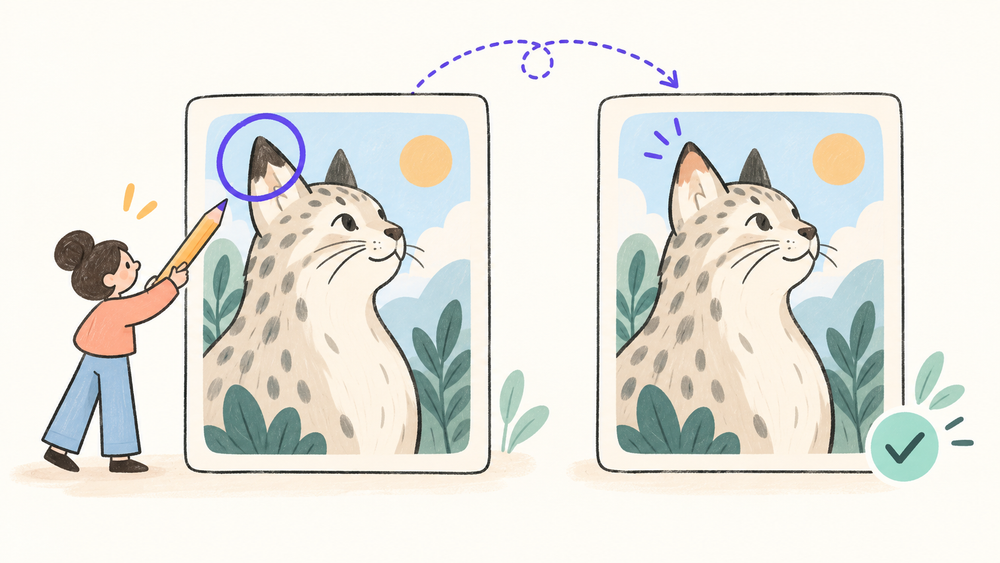
A workflow illustration of targeted feedback: identify one area, request one change, then check whether the rest stayed stable.
The same report repeats OpenAI's claims about richer textures, more natural lighting, better instruction following across multiple turns, and lower latency. Those remain vendor claims in this article. No independent, controlled comparison was available to show how often the improvements hold, so they should not drive a production decision yet.
How does Sketch change the image workflow?
Sketch adds a visual constraint before generation. A text prompt can say “put the subject behind the table and leave empty space on the left,” but a rough drawing can show those relationships immediately. The sketch does not need to be attractive; its job is to communicate placement, direction, scale, and emphasis.
The second change happens after generation. Localized comments create a review loop closer to how people already give design feedback: point to one region, state the correction, and inspect whether the rest of the composition stayed intact. The important success condition is not merely that the selected detail changes. It is that unrelated details do not drift.
A four-minute community walkthrough by AI CITY shows reference-photo, editing, and text examples. It is useful as a visible demonstration, not as an independent quality verdict. The channel was small when checked, the examples were selected by the creator, and the video does not provide a repeatable test suite.
AI CITY demonstrates ChatGPT Images 2.5 with reference photos, edits, and text; this single community test is illustrative, not independent proof of general quality.
Watch on YouTubeThat evidence is enough to say the workflow exists and has been demonstrated. It is not enough to claim that a particular face, product, logo-free layout, or block of text will survive every edit.
The developer view
For developers, the biggest lesson is about interaction design rather than model mythology. Image tools should capture three different inputs separately:
- Intent — what the final image is for and what it should communicate. 2. Spatial constraint — where subjects, empty space, and visual hierarchy belong. 3. Revision scope — which region may change and which regions should remain stable.
Simon Willison's developer note identifies two API model IDs, gpt-image-2.5-sunburst and gpt-image-2.5-flare, and shows one reference-image edit through his command-line tool. His interpretation is that Sunburst favors editing precision while Flare favors faster everyday generation. That is a useful implementation lead, but one example is not a migration guide.
Before changing an image pipeline, confirm the current OpenAI API documentation, model access, regional availability, input limits, output formats, pricing, and retention rules in the account that will run the workload. None of those operational details should be inferred from the ChatGPT interface alone.
A sensible evaluation stores the original input, sketch or mask, prompt, output, and every revision request. Reviewers should then score whether the requested region changed, whether protected regions drifted, and whether text or identity degraded. “Looks better” is too vague for a dependable product test.
The product enthusiast view
For ordinary users, Sketch is most promising when a request is visually simple but verbally awkward: a room layout, a poster hierarchy, the direction a character faces, the amount of empty space, or the position of an object. A rough diagram may communicate those constraints faster than five rounds of prose.
It will be less magical when the hard problem is consistency. Reference-photo identity, small typography, repeated characters, exact product geometry, and multi-turn edits can fail in ways a clean launch demo does not reveal. Keep the original file, make one change at a time, and compare the whole frame after every revision.
Why should builders care?
- Visual intent becomes an input, not an afterthought. A sketch can reduce ambiguity before the first generation, especially when layout matters more than style vocabulary. 2. Review can become region-specific. Localized comments create a clearer contract: change this area while preserving everything else. 3. Evaluation becomes easier to design. Teams can measure edit scope, unintended drift, identity preservation, text stability, and the number of attempts required to reach approval.
The best early use cases are low-risk creative drafts where a human already reviews every output: campaign concepts, storyboards, moodboards, rough product scenes, and layout exploration. High-stakes identity, regulated content, or exact brand production still needs stronger controls and human approval.
What remains unclear?
- Repeatability: One Verge test and one community walkthrough do not show failure rates across many prompts.
- Preservation: The accessible evidence does not quantify how well identity, composition, or typography survives multiple localized edits.
- Speed: OpenAI's latency statement was not independently measured in the material reviewed here.
- Availability: The Verge reports broad ChatGPT, ChatGPT Work, and Codex availability across desktop, mobile, and web, but account-by-account rollout behavior was not verified.
- API operations: The reviewed sources do not establish current pricing, limits, data retention, or regional access for every developer account.
- Safety and rights: Sketches and reference photos can still contain copyrighted, personal, or sensitive material; the new input method does not remove those obligations.
Quick Take
- What is actually new?: Evidence-backed answer: A built-in sketch input and localized image comments add visual and region-specific instructions to the generation loop.
- What did an independent test show?: Evidence-backed answer: A Verge editor turned a mouse-drawn cat into a realistic image and changed its eye color with a localized comment.
- What is the strongest evidence?: Evidence-backed answer: OpenAI's dated launch record plus The Verge's direct interface test.
- What should developers verify?: Evidence-backed answer: Whether edits change only the selected region without degrading identity, layout, or text.
- What is still unknown?: Evidence-backed answer: Repeatability, difficult-case quality, exact rollout behavior, and account-specific API operations.
ChatGPT Images 2.5 makes visual prompting more direct. Its value will be decided less by the prettiest first result than by how reliably it preserves everything users did not ask to change.
FAQ
What is ChatGPT Images 2.5 Sketch?
Sketch is a ChatGPT image feature that lets you type @Sketch, draw a rough visual reference, and combine it with a text instruction. OpenAI announced the release on September 8, 2026, and describes Images 2.5 as working from ideas, sketches, and reference photos.
Is ChatGPT Images 2.5 available now?
The Verge reports that OpenAI made it available to ChatGPT, ChatGPT Work, and Codex users across desktop, mobile, and web. Rollouts can vary by account and region, so check the actual image composer and current official documentation rather than assuming every surface has it immediately.
How is Sketch different from a text prompt?
A text prompt describes relationships; a sketch shows them. It can communicate rough placement, scale, direction, and empty space without requiring precise design vocabulary. Text still matters for subject, style, mood, and constraints, so the two inputs are complements rather than replacements.
What should developers test before using Images 2.5?
Test whether a localized edit changes only the requested region. Record the input, prompt, sketch, output, and revision. Then check protected regions, identity, typography, composition, latency, cost, and the number of attempts required before a reviewer accepts the image.
What is still unverified about ChatGPT Images 2.5?
The reviewed material does not establish reliable difficult-case performance, universal rollout, or account-specific API terms. OpenAI's broader claims about quality and speed were not independently reproduced here, while the public hands-on evidence consists of a small number of selected examples.
Discover practical image tools and emerging AI products at AIToolHunt.