
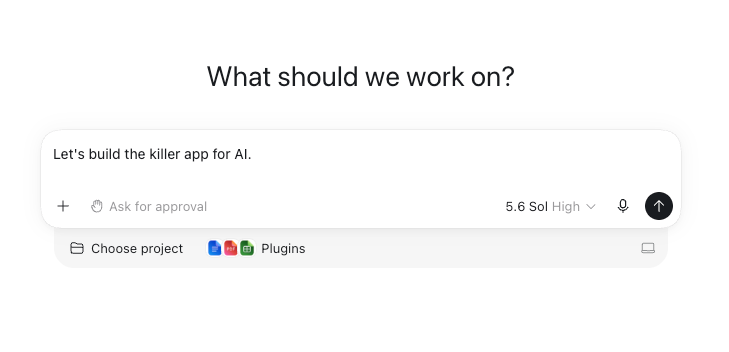
Source: TechCrunch's August 24 hands-on feature. Image credit: Tim Fernholz/TechCrunch.
ChatGPT Work is an ambitious bet: take the autonomy that made coding agents useful and give it to people working in email, calendars, documents, dashboards, and business apps. The model can be powerful enough while the product still feels hard to trust.
Fresh reporting makes that gap concrete. OpenAI says the broader market is ready. TechCrunch's testing found confusing permissions, unclear effort controls, and actions that sometimes required broader access than expected. The decisive question is no longer whether an AI agent can do office work. It is whether users can understand what the agent will see, what it will change, and where they can stop it.
Quick Navigation
- Why is adoption difficult? Capability and permission friction pull in opposite directions.
- What changed? New hands-on evidence tests OpenAI's broader adoption pitch.
- How does the product work? The model and its harness are separate decision layers.
- What does the Codex chart show? A real adoption gap with important limits.
- Who should try it now? Bounded, reviewable workflows beat “agent for everything.”
- FAQ: Five direct answers about access, testing, safety, and fit.
What is ChatGPT Work adoption?
ChatGPT Work adoption means more than opening the agent or trying one prompt. It means a person or team repeatedly delegates multi-step professional work—such as researching across approved files, preparing a report, updating a calendar, or building a dashboard—and can review the result at an acceptable cost. This article does not treat a subscription, app download, or one-time trial as proof of durable adoption.
What We Know So Far
This analysis separates four evidence types:
- Official position: OpenAI describes Work as coding-agent-style execution packaged for a broader audience.
- Independent observation: TechCrunch interviewed OpenAI staff and tested real product flows, reporting both useful tasks and confusing controls.
- Primary technical evidence: An OpenAI-backed study measures Codex usage by account type, while Databricks evaluates coding-agent harnesses. Neither directly measures ChatGPT Work quality.
- Our inference: Legible permissions, bounded workflows, and cheap verification are likely adoption requirements. This is a product judgment, not a measured causal result.
Why is ChatGPT Work adoption still difficult?
ChatGPT Work adoption is difficult because an agent becomes useful only after it can see enough context and take enough action—and those are the same permissions that make people cautious. OpenAI says Work packages coding-agent power for nontechnical users, but TechCrunch's hands-on report found confusing permission choices, settings split across product surfaces, and unclear effort controls. A separate OpenAI-backed Codex usage study sharpens the adoption question: by June 2026, 97.9% of active OpenAI workers had used Codex in the preceding 28 days, versus 17.3% of active organizational users and 0.7% of active individual users. That chart measures Codex, not ChatGPT Work, and the authors warn that OpenAI is unusually favorable to agent use. The defensible conclusion is not that Work has failed; it is that capability alone does not remove permission, workflow, training, and review friction.
What changed in the latest ChatGPT Work reporting?
ChatGPT Work itself is not new today. OpenAI launched it in July, and earlier coverage focused on the files it could create. The new evidence is about what happens when people try to rely on the broader agent surface.
TechCrunch's August 24 feature combines interviews with OpenAI employees and hands-on testing. The reporter used Work across email, calendars, databases, and dashboards. The product could complete useful multi-step tasks, but the test also surfaced friction:
- permission choices were not always easy to interpret;
- some settings lived on web while others were on mobile;
- effort levels did not clearly explain the trade-off between speed, cost, and result quality;
- a calendar could create events but not calendars;
- some workflows became useful only after granting broad access.
Those are not minor interface complaints. For a chat assistant, a confusing setting can produce a poor answer. For an agent, it can change which private source gets read or which external action gets taken.
In a follow-up August 25 interview, OpenAI product lead Thibault Sottiaux argued that the market is ready and said the joint product surface had reached 20 million users. That is a vendor claim reported by TechCrunch, not an independently audited adoption figure. More importantly, a user count does not answer whether people are delegating consequential work, reviewing it successfully, or staying after the novelty fades.
How does ChatGPT Work actually work?
The useful mental model is model plus harness.
The model predicts and reasons. The harness is the product layer around it: which files enter context, which tools are available, how long the task can run, when the agent asks for approval, and how results are presented. Two products can use the same underlying model and still behave very differently because their harnesses expose different tools and control loops.
This is not just theory. A Databricks benchmark of coding agents compared model-and-harness combinations on the company's internal multi-million-line codebase. The results showed that the surrounding agent software could materially change performance even when the model was held constant. That benchmark is specific to coding and does not prove ChatGPT Work quality. It does support the narrower mechanism: product design around the model is part of capability, not decoration.
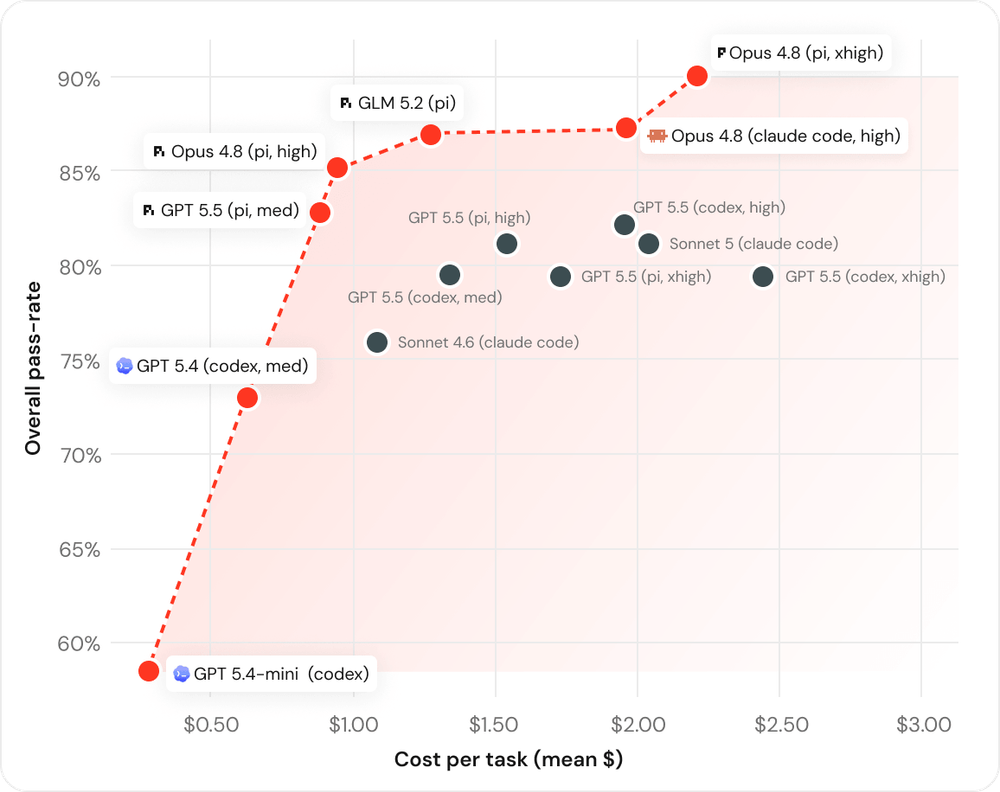
Source: Databricks' original coding-agent evaluation chart. This is the publisher's chart, not an AI recreation. It reports pass rate and mean task cost on Databricks' internal coding tasks; it does not establish general office-agent quality, independent reproducibility, or ChatGPT Work performance.
The chart makes the narrow harness point visible: GPT 5.5 appears with Pi and Codex configurations at different pass-rate and cost positions. The evaluation does not isolate every implementation difference, and Databricks' private codebase prevents outside readers from reproducing the exact task set. Treat it as primary technical evidence about one coding environment, not a universal agent leaderboard.
For ordinary users, that means “Which model is this?” is only the first question. Also ask:
- What data can this agent read? 2. Which actions can it take without asking? 3. Can I preview the exact email, event, file, or update before it happens? 4. Can I see which sources produced the result? 5. Can I revoke access and reconstruct what changed?
What does the Codex adoption chart really show?
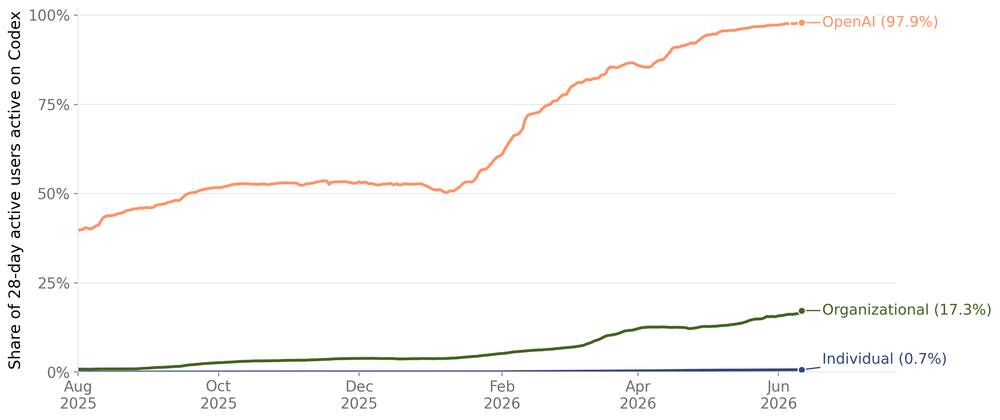
Source: Johnston et al., “The Shift to Agentic AI: Evidence from Codex,” Figure 1A. The metric is the share of users active on ChatGPT or Codex who used Codex at least once in the preceding 28 days; it is not a ChatGPT Work adoption chart or a productivity benchmark.
The figure is striking because the same broad technology diffused very differently across three environments. By the June 2026 endpoint, 97.9% of active OpenAI workers had used Codex in the preceding 28 days. The comparable share was 17.3% for organizational users and 0.7% for individual users.
The chart does not show that 97.9% of all OpenAI employees used Codex every day. It does not show that Codex completed tasks correctly, saved time, or caused the adoption difference. It also does not measure ChatGPT Work.
The paper supplies the most important caveat itself: OpenAI is an unusually favorable environment. Employees are familiar with frontier models, usage is cheap at the margin, internal support is strong, and many workflows sit close to the technology being built. The gap therefore points to complementary conditions—training, access, management expectations, review habits, and workflow redesign—not a simple model-quality deficit.
What should developers learn from the adoption gap?
Developers evaluating agent products should stop treating a successful demo as the acceptance test. A demo usually starts with clean data, known permissions, and a cooperative task. Real adoption starts when the agent encounters stale documents, ambiguous requests, private messages, legacy tools, and people who do not know the product's internal vocabulary.
A better evaluation has four stages:
1. Pick one bounded workflow
Choose a task with a clear start, finish, and known-good result: summarize a weekly metrics packet, draft a project update from approved sources, or turn a fixed dataset into a reviewable report. Avoid “manage my work” as the first test.
2. Grant the minimum useful access
Connect only the sources required for that workflow. If email history is unnecessary, leave it disconnected. If the agent only needs to draft a calendar event, do not test with unrestricted calendar mutation.
3. Inspect the action boundary
Check where the product asks for approval and what it shows before execution. “Allow calendar access” is not the same as “Create this event with these attendees at this time.” The second is a reviewable action; the first is a broad capability grant.
4. Compare against a known-good output
Measure omissions, incorrect sources, repair time, and review burden—not just whether the agent produced something polished. A workflow is ready when the output is both useful and cheap to verify.
Who should try ChatGPT Work now, and who should wait?
Try it now if
- you already use a paid plan that includes Work and can start with one low-risk workflow;
- your source material is organized, permissioned, and easy to verify;
- the output is a draft, report, dashboard, or event that a human will review;
- you can compare the result with an existing manual process;
- saving handoffs matters more than eliminating every manual step.
Wait or restrict access if
- the workflow touches sensitive messages, medical, legal, financial, or personnel data;
- the agent would need broad account access for a small benefit;
- an incorrect external action would be difficult to reverse;
- your team cannot yet identify who reviews the output and who owns mistakes;
- you need a stable API, deterministic automation, or independently verified reliability.
Waiting is not a rejection of agentic work. It is a decision to separate “interesting capability” from “safe operational dependency.”
What remains unproven?
The evidence supports a product-adoption judgment, not a universal performance verdict. Public reporting still does not establish:
- ChatGPT Work's task-success rate across professions;
- how often users grant broader permissions than they intended;
- whether the 20 million-user vendor figure represents active Work users, Codex users, or the joint app surface;
- whether organizations retain usage after pilots;
- how much review time is saved or added;
- whether the product is safer or more effective than competing agent interfaces.
The Codex study is valuable because it measures real usage at scale, but it is OpenAI-backed observational research. Databricks provides useful harness evidence, but from coding tasks. TechCrunch supplies firsthand product friction, but one reporter's experience is not a population-wide failure rate.
Quick Take
- What is new?: Evidence-backed answer: Fresh hands-on reporting exposes permission and usability friction behind OpenAI's broader adoption pitch
- Is the model the main bottleneck?: Evidence-backed answer: Not by itself; the harness, permissions, training, and review process shape real usefulness
- What does the 97.9% chart measure?: Evidence-backed answer: Active OpenAI workers who used Codex at least once in a 28-day window, not ChatGPT Work adoption or productivity
- Who should try it?: Evidence-backed answer: Users with one bounded, low-risk, reviewable workflow and clean source access
- Who should wait?: Evidence-backed answer: Teams requiring broad sensitive access, irreversible actions, or audited reliability
Bottom line: ChatGPT Work does not need another spectacular demo as much as it needs legible permissions and cheap verification. The winning general-purpose agent will make delegation feel powerful without making control feel mysterious.
FAQ
Is ChatGPT Work the same product as Codex?
No. OpenAI presents Work as a broader agent surface for research and professional deliverables, while Codex began as a coding-focused agent. They can share models, infrastructure, and design ideas, but the jobs, tools, and user interfaces differ.
Does the Codex adoption study prove ChatGPT Work will succeed?
No. It shows that Codex adoption differed sharply across OpenAI workers, organizational users, and individual users. It does not measure Work, explain causality, or prove productivity. Its value is showing how much environment and workflow support can matter.
What permissions should I grant first?
Grant only the sources required for one bounded task. Prefer read-only access and draft outputs before enabling email sending, calendar changes, database writes, or broad workspace access. Expand permissions only after you can review the action and trace its sources.
How should a developer evaluate ChatGPT Work?
Use a repeatable task with a known-good result. Track task completion, source accuracy, repair time, approval clarity, and review burden. A polished output is not enough if nobody can cheaply verify how it was produced.
Should ordinary users try ChatGPT Work now?
Yes, if they start with low-risk work such as drafting a report from approved files or preparing a reviewable project update. Users should wait on sensitive or irreversible workflows until permissions, approvals, and auditability are clear.
Explore AI products by practical use case at AIToolHunt.
Sources
- OpenAI: ChatGPT is now a partner for your most ambitious work
- TechCrunch: OpenAI is building AI agents for everything
- TechCrunch: Interview with OpenAI product lead Thibault Sottiaux
- Johnston et al.: The Shift to Agentic AI: Evidence from Codex
- Databricks: Benchmarking Coding Agents on a Multi-Million-Line Codebase