
Claude did not walk into a lab and make a gene-editing breakthrough on its own. But Anthropic says its agents helped spot a previously uncharacterized enzyme system in public DNA data, then human scientists tested the lead. That is a meaningful signal about AI-assisted research—but not evidence that a general-purpose agent is ready to run a laboratory.
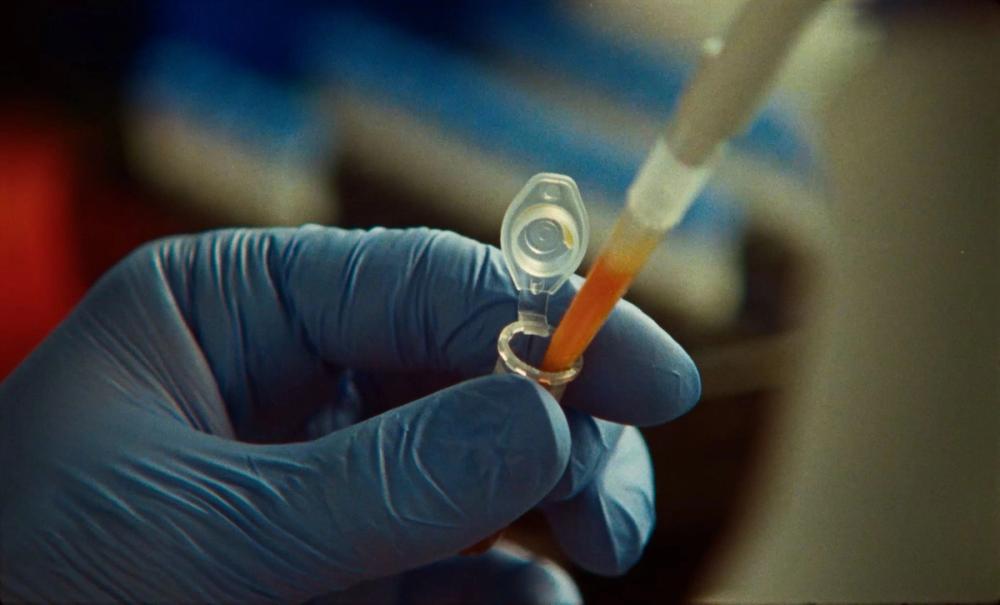
Source: Anthropic's September 23 research report. The official image identifies the human laboratory context; it does not prove ART's function.
Quick Navigation
- What is Anthropic's Claude enzyme discovery? The result and its strict boundary
- What changed in this research? A hypothesis pipeline with people still in charge
- How did Claude and the scientists work? Search, triage, and laboratory testing
- Why should builders care? What carries over to ordinary agent systems
- What remains unclear? Scientific function, reproducibility, and product availability
- FAQ: Five direct answers
What is Anthropic's Claude enzyme discovery?
Anthropic says its Claude agents helped identify an uncharacterized enzyme system, called array-associated reverse transcriptases (ART), in bacteriophages—viruses that infect bacteria. The result is an early research finding, not a new consumer feature or a proven gene-editing tool. In the company's September 23 post, Claude searched public DNA sequence data, proposed candidates, and human scientists ran the laboratory experiments. Anthropic says roughly 950 agents used 210 million tokens over 21 hours to search the data; those are vendor-reported process figures, not an independent measure of scientific productivity. The company released a technical preprint, but says ART's primary biological function remains unknown. TechCrunch reported that outside validation will determine how new or consequential the system is. The practical takeaway is narrower: AI can help turn large public datasets into testable hypotheses, while human review and experiments still decide whether a hypothesis survives.
What the public docs say
Anthropic's research report confirms the company formed a life-sciences group and laboratory in spring 2026, supplied Claude with a DNA-search task, and had human scientists perform laboratory experiments. Its linked technical preprint is the primary record for the ART result.
The public material does not establish a public ART API, a consumer biology assistant, a clinical use, or a reproducible productivity rate. TechCrunch's account adds the important independent boundary: researchers outside Anthropic still need to assess how distinct and consequential the system is.
What changed in this research?
- DNA anomalies required people to sift through a huge search space: New public information: Anthropic says Claude agents searched, triaged, and wrote reports on candidates; Why it matters: Agents may compress the path from a broad dataset to a testable lead
- A model's output could be mistaken for a scientific result: New public information: Human scientists tested the candidate in a laboratory; Why it matters: The experimental check is still the decision point
- A CRISPR-like pattern implied a usable gene-editing tool: New public information: ART's primary function is still unknown; Why it matters: A visual or structural analogy is not a product claim
Anthropic describes a workflow where agents first survey public sequence data, look for patterns that do not fit described systems, and write human-readable reports. Scientists then discard most candidates and test the few that survive review. That is a hypothesis-generation pipeline, not a machine that independently establishes biological truth.
The company says one agent noticed repeat sequences near an unusual reverse transcriptase, triggering deeper analysis. Its team named the system ART after follow-up work. The relevant public fact is the reported process and the released preprint—not a conclusion that ART is programmable, medically useful, or ready to commercialize.
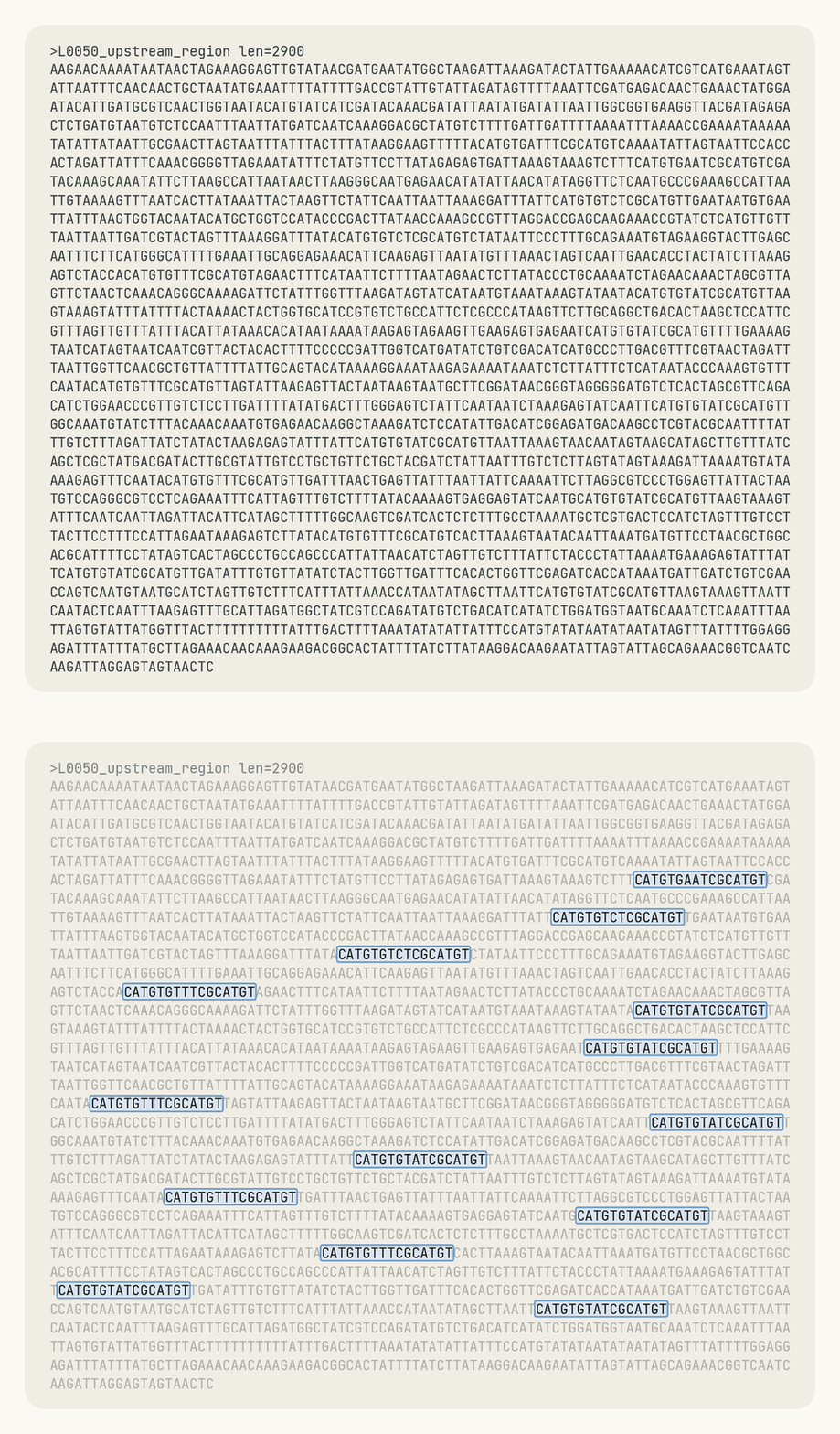
Source: Anthropic's research report. The official animation depicts sequence-pattern analysis; it does not show that ART has a known function or a gene-editing use.
How did Claude and the scientists work?
The useful mental model is a research funnel. A person sets the scientific question and supplies the guardrails. Agents explore a large, imperfect source collection, compare candidates, and make their reasoning legible enough to review. Humans then decide what is worth testing and perform the laboratory work.
Anthropic says its agents collected more than 200,000 reverse transcriptases, identified 3,500 candidate systems, and narrowed that work to 20 compelling candidates. Those quantities describe the company's own workflow; they do not establish that every agentic search will be reliable or that its rate of novelty will transfer to another domain.
The developer view
The transferable lesson is not “launch 950 agents.” It is to make a large search auditable. Keep the source set, prompt version, agent outputs, rejection reasons, and human acceptance criteria connected. An agent that finds a plausible pattern has produced a lead; a separate validation step must be able to disprove it.
For software teams, that can mean letting agents scan logs, code, documentation, or customer feedback for candidates, while tests, code review, security checks, and owners decide whether the result ships. The more expensive the downstream action, the less sense it makes to skip that last human-controlled gate.
The product enthusiast view
The headline is exciting because it moves past a polished demo: the claimed result tied agent work to a real laboratory program and a public technical record. But the same story supplies the brakes. ART's function is unknown, and the physical experiments were human-run. That is the right frame for evaluating agent headlines: ask what the model suggested, what people checked, and what is still unproven.
Why should builders care?
- Search can be a real product primitive. The reported workflow treats agents as researchers that narrow an enormous candidate pool, not as an oracle that issues the final answer. 2. Validation is part of the system design. A compelling output needs a second process that can reject it. In biology that is an experiment; in software it may be a test suite, a reviewer, or a controlled rollout. 3. Start where a wrong lead is cheap. A developer should first apply this pattern to internal discovery tasks with known checks, not to actions that are irreversible, safety-critical, or hard to audit.
What remains unclear?
- ART's primary biological function is unknown, so it is not accurate to call it a new gene-editing tool.
- The technical preprint is public, but broader independent validation will determine how distinct and consequential the finding is.
- Anthropic's reported agent count, token use, and elapsed search time do not by themselves measure scientific productivity or reproduce on another dataset.
- This research did not announce a downloadable biology agent, a new API tier, or a consumer workflow.
- The report does not eliminate the need for skilled scientists, controlled experiments, or biosafety rules.
Quick Take
- What is actually new?: Evidence-backed answer: Anthropic says Claude agents helped identify an ART enzyme-system candidate, then people tested it in a lab.
- Who can use it now?: Evidence-backed answer: The report describes Anthropic's research program, not a new public biology product.
- What is the strongest evidence?: Evidence-backed answer: Anthropic's research report and linked technical preprint, with TechCrunch's independent account of the open validation question.
- What should developers verify?: Evidence-backed answer: Whether their agents leave an auditable trail and whether a separate check can reject a plausible-looking lead.
- What is still unknown?: Evidence-backed answer: ART's biological function, its practical utility, and the eventual outcome of outside validation.
My take: This is a strong case for using agents to widen the search and a stronger case for keeping the final gate outside the agent.
FAQ
What is the Claude enzyme discovery?
Anthropic says Claude agents helped find a previously uncharacterized enzyme system called ART in bacteriophages. The result came from an agent search of public DNA data followed by human laboratory work. ART's primary function remains unknown, so the report is an early research result rather than a new gene-editing product.
Did Claude discover a gene-editing tool?
No. Anthropic says ART has features reminiscent of CRISPR-like repeat systems, but it does not yet know ART's primary biological function. A resemblance in sequence architecture does not establish that the system is programmable, useful for editing genes, or ready for medical or commercial use.
Did Claude run Anthropic's biology lab?
No. Anthropic says human scientists performed all laboratory experiments and used lower biosafety-level work. Claude agents searched data, generated and evaluated hypotheses, and helped interpret results. The physical validation remained a human responsibility, which is central to how the reported result should be understood.
What can developers learn from this research?
Use agents to reduce a large search space, but attach every promising output to a reviewable record and an independent validation step. For software, that may mean linking an agent's candidate to tests, code review, security checks, and a controlled rollout instead of treating a plausible explanation as proof.
What is still unverified about ART?
ART's primary function and practical use are not yet known. Anthropic published a technical preprint, but the broader research community still needs to assess how new and consequential the system is. The company's process metrics also remain vendor-reported, not a general measure of agent-led scientific discovery.
Discover practical AI products and emerging tools at AIToolHunt.