Newsletter
Join the Community
Subscribe to our newsletter for the latest news and updates
Source: Anthropic's official Fable 5.1 release. Unmodified official launch artwork.
Anthropic has released Claude Fable 5.1, and its most measurable product change is not a benchmark headline. It is a 75% discount on prompt-cache reads. That could materially lower the cost of long-running coding and research agents, but only when they reuse enough context. Ordinary input and output prices did not fall.
Claude Fable 5.1 cache pricing changes one narrow but important part of agent economics: reading previously cached prompt context now costs $0.25 per million tokens, 75% less than before. Anthropic's official Fable 5.1 release says ordinary input and output still cost $10 and $50 per million tokens, so the discount is not a blanket model price cut. It matters most when an agent repeatedly reuses a large repository, tool specification, policy set, or research corpus across many turns. Anthropic estimates about 25% lower cost for a typical workload and as much as 45% for a highly agentic one, using four weeks of observed usage. Those are vendor estimates, not independently reproduced savings. The practical test is therefore cost per accepted task: measure cache hits, uncached input, output, retries, tool calls, latency, and successful completion before switching production traffic.
claude-fable-5-1 as the API model identifier.Prompt caching lets an application store a stable prefix—such as a repository snapshot, tool definitions, policy instructions, or a long reference pack—and reuse it in later calls. The first write still has a cost. The discount applies when later requests successfully read that cached prefix.
For Fable 5.1, Anthropic lists cached reads at $0.25 per million tokens. Ordinary input remains $10 per million, and output remains $50 per million. That distinction matters because a chat with mostly fresh prompts may barely benefit, while an agent that rereads a 200,000-token codebase across many turns may benefit much more.
The discount can also disappear in practice when cache keys change, the cached segment expires, prompts are reordered, or an application keeps inserting volatile content into the reusable prefix. This is why invoice-level totals are more useful than a single line in a pricing table.
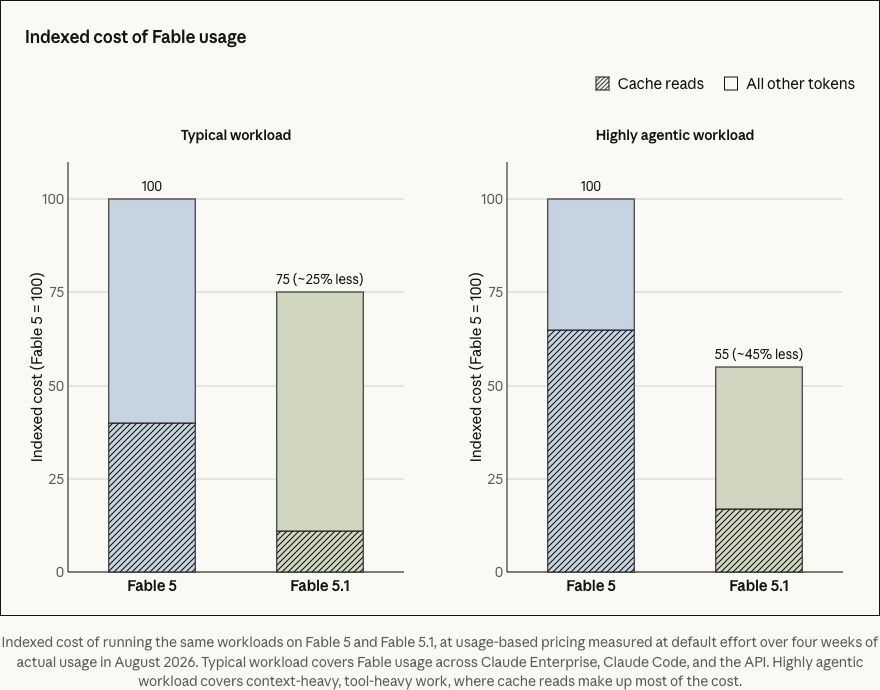
Source: Anthropic's official Fable 5.1 release. Official vendor estimate based on four consecutive weeks of observed usage; this is not an independent benchmark or an AI recreation.
Anthropic estimates roughly 25% lower cost for a typical workload and up to 45% for a highly agentic workload. Its release says the chart uses actual usage observed over four consecutive weeks. That is better than a purely hypothetical token mix, but it is still a vendor-run estimate. The sample composition, success criteria, and workload-by-workload distribution are not published in enough detail for outsiders to reproduce the percentages.
The ceiling is below 75% because cached reads are only one part of a run. Fresh instructions, tool results, generated code, explanations, retries, and failed branches still consume ordinary input or output. A model that produces longer answers or requires more repair turns can erase some cache savings. A model that finishes in fewer turns could improve total cost even if its listed prices are higher.
The right denominator is an accepted result, not a token. For coding, that may mean a patch that passes tests and review. For research, it may mean a sourced brief that survives fact-checking. For an operations agent, it may mean a completed workflow with no manual repair.
Start with a shadow evaluation on tasks you already understand. Send the same fixed repository context and task set to the current model and claude-fable-5-1. Keep tools, timeouts, prompts, and acceptance tests constant.
Record at least these fields per run:
Also log why the cache missed. A low hit rate may be a prompt-layout problem rather than a model problem. Put stable context first, isolate frequently changing instructions, and avoid invalidating a large cached prefix for a small edit. Then rerun enough tasks to see a distribution rather than celebrating one cheap example.
Fable 5.1 is most interesting for coding agents, research agents, and internal assistants that repeatedly revisit large stable context. The model switch is easiest to justify when your telemetry already shows high cache-read volume and a costly repeated prefix.
Do not treat the API identifier as a drop-in guarantee. Check SDK support, fallback behavior, prompt-cache semantics, rate limits, tool-use compatibility, latency, and the quality of your existing acceptance tests. A cheaper successful turn is valuable; a cheaper turn that creates a larger bad diff is not.
For ordinary Claude users, the cache line item may be invisible. The practical effect could show up as more viable long-running features rather than a lower subscription bill. Developers may be able to keep more project context available across a task without paying the previous read cost every time.
That does not mean every Claude session is 75% cheaper. Anthropic announced a specific API economics change, not a universal consumer discount. If you do not run API workloads or inspect token billing, the more sensible reason to try Fable 5.1 is its product behavior—not the cache price alone.
Try now if you operate a long-context agent, have stable prefixes that are read repeatedly, can observe cache hits, and already measure task success. Run a limited traffic slice first. The cache change gives you a clear hypothesis that can be confirmed or rejected with your own bill and acceptance tests.
Wait if most requests are short and fresh, your workload has little reusable context, or you cannot separate a successful task from a merely completed response. Also wait if your buying decision depends on independent proof of Anthropic's 25% to 45% workload savings; that reproduction is not available yet.
Most users should choose Fable rather than Mythos. Anthropic says both names refer to the same underlying model, but Mythos is a restricted-access variant for specific trusted cybersecurity and life-sciences programs. It is not a generally available “better” tier.
Bottom line: Fable 5.1 makes repeated context materially cheaper on paper. It earns a production trial when cached reads are already a major part of your workload. It does not earn a blind migration, because outputs, misses, retries, and task quality still determine the real bill.
Is Claude Fable 5.1 75% cheaper overall?
No. The 75% reduction applies to prompt-cache reads. Ordinary input and output prices remain $10 and $50 per million tokens, and total workload cost also depends on cache misses, retries, tool calls, and response length.
What does a Claude prompt cache store?
It stores a reusable prompt prefix, such as system instructions, tool definitions, a repository snapshot, or reference documents. Later calls can read that stable context at a lower price when the cache is valid and the prefix still matches.
How much does Anthropic say agents can save?
Anthropic estimates about 25% for a typical workload and up to 45% for a highly agentic workload. Those figures come from Anthropic's own analysis of four weeks of usage and have not been independently reproduced.
Should a Claude Code team switch immediately?
Run a controlled trial first. Compare cache-hit rate, total tokens, latency, retries, test results, review outcomes, and cost per accepted task against the model you use today.
Can anyone use Claude Mythos 5.1 instead?
No. Anthropic says Mythos 5.1 uses the same underlying model with different safeguards and is limited to trusted access programs in cybersecurity and life sciences. Fable 5.1 is the generally available version.
Discover more practical AI products and developer tools at AIToolHunt.