
AI-generated editorial illustration for this article. Not an official Anthropic asset or product screenshot.
Claude Fable 5 is the first Anthropic model in a while that made serious developers sound slightly unwell.
Not because the launch copy was dramatic. Every model launch is dramatic now. The interesting part is that the community reaction is unusually consistent: people are calling it slow, expensive, sometimes over-guarded, but also clearly more capable on long, messy, agentic work than prior Claude models.
Anthropic announced Claude Fable 5 on June 9, 2026, alongside the more restricted Claude Mythos 5. Fable launched as the general-use version; Mythos is the higher-trust version for vetted cybersecurity and biology use cases.
Anthropic then added a June 12, 2026 update saying access to both Fable 5 and Mythos 5 was temporarily unavailable while it worked to restore service.
If you follow AI News, this is the release to watch because it is not just another benchmark bump. It is Anthropic trying to bring Mythos-class capability into public workflows without fully opening the safety gates.
That tradeoff is the whole story.
Quick Navigation
- What is Claude Fable 5? Anthropic's newest widely available frontier model and how it differs from Mythos.
- Official Benchmarks: What Anthropic's own benchmark chart says.
- Community Tests: What early builders, Reddit, Hacker News, and YouTube reviewers are reacting to.
- Why It Feels Strong: The practical capability signals that matter.
- Watch Outs: Price, speed, safeguards, and data retention.
- Quick Take: The decision framework.
- FAQ: Short answers for search-driven readers.
What is Claude Fable 5?
Claude Fable 5 is Anthropic's newest flagship-class public model. At launch, Anthropic positioned it above the Opus/Sonnet/Haiku family for workloads that need its highest generally available capability.
The simple version: Fable 5 was introduced as the public Mythos-class Claude.
Anthropic says Claude Mythos 5 shares Fable's underlying capability but without the same public safety classifiers. Mythos is restricted through Project Glasswing and trusted access programs. Fable was initially the version developers could access through Claude surfaces, cloud marketplaces, and the Claude API.
Anthropic lists the API model ID as claude-fable-5, a 1M token context window, 128K max output, adaptive thinking, and launch pricing at USD 10 / USD 50 per million tokens for input/output. That is not cheap. But it is cheaper than Mythos Preview was, and Anthropic is clearly positioning it for harder work: multi-day agents, large codebases, complex knowledge work, vision-heavy document analysis, and long-horizon coding.
The current caveat is availability. As of June 13, 2026, Anthropic's June 12 update says access to Fable 5 and Mythos 5 is temporarily unavailable while the company works to restore service.
This is not the model I would use to summarize a meeting note.
This is the model I would try when a normal assistant keeps tapping out after three rounds and you still need the project finished.
What We Know So Far
The public evidence supports a narrow but exciting claim: Claude Fable 5 looks like a major jump for autonomous coding, complex reasoning, document-heavy workflows, and long-running agent sessions.
This read is based on Anthropic's public launch material, the official benchmark charts included below, Simon Willison's June 9 and June 11 writeups, the Hacker News thread, and public videos available on June 13, 2026. Anthropic's June 12 update says access is temporarily unavailable, so some launch claims should be read as launch positioning rather than something you can independently test right this minute.
Anthropic's own Fable page says the model can work for days in agent harnesses like Claude Code or Claude Managed Agents, plan across stages, delegate to sub-agents, and check its own work. Anthropic also says it is its most capable model for ambitious coding projects, including large migrations and multi-day autonomous sessions.
The official docs matter here because the community reaction lines up with them.
Simon Willison spent the first launch day pushing Fable through real coding and tool-work tasks. His short verdict was that it felt like "a beast": slow, expensive, and able to keep chewing through hard tasks. In another post after two days, he described Fable as "relentlessly proactive." That phrase is useful because it captures what the launch numbers do not: Fable does not just answer better. It appears more willing to keep moving.
That can be wonderful.
It can also be terrifying if your agent harness is too permissive.
Official Benchmarks: The Chart Anthropic Wants You to See
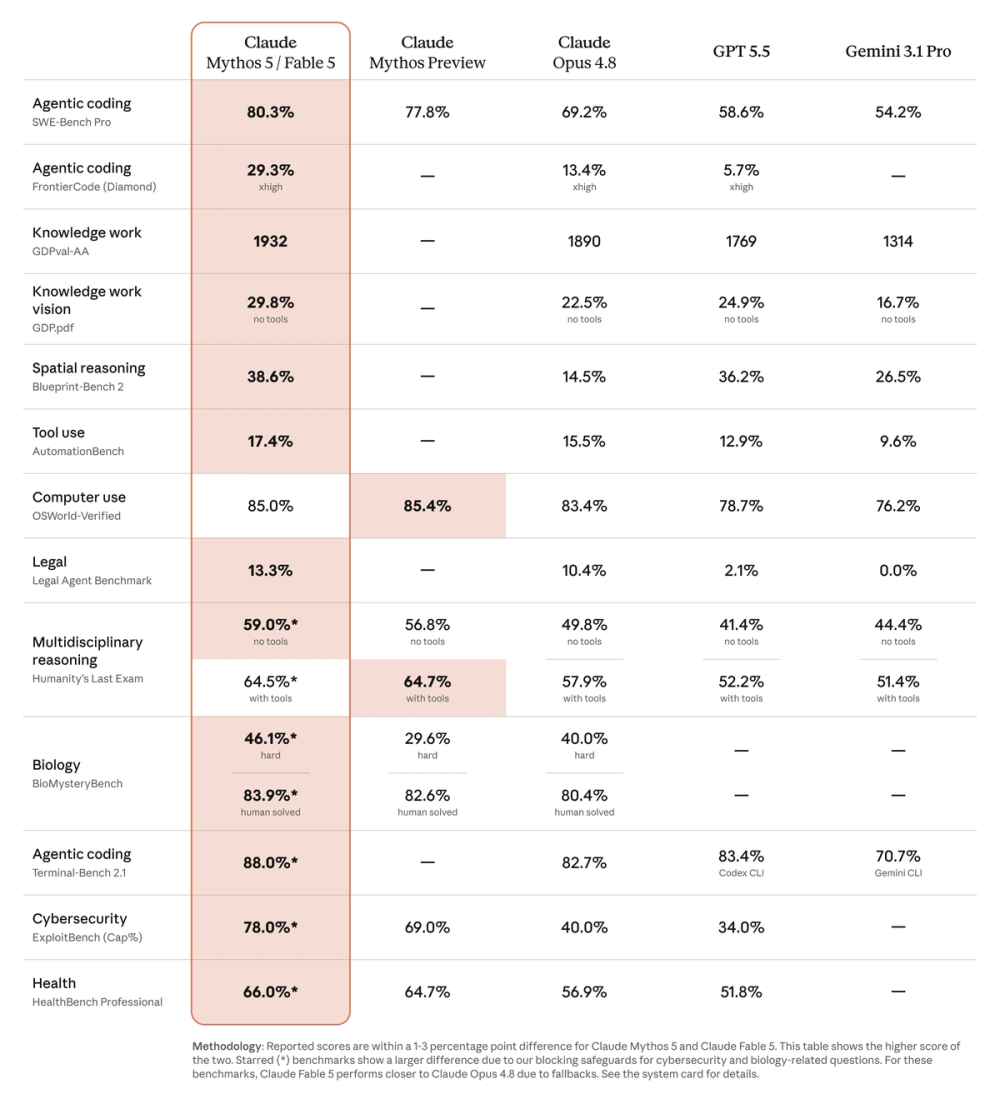
Source: Anthropic's Claude Fable 5 launch page. Official benchmark values are shown as published by Anthropic.
Anthropic's official benchmark table is the cleanest way to understand why people are paying attention.
The headline: Fable 5 beats Claude Opus 4.8 across the rows Anthropic chose to publish, and Mythos 5 is even stronger.
The safest way to summarize Anthropic's launch charts is row by row, because the company mixes percentage scores, raw task scores, and starred safeguard-sensitive benchmarks in the same graphic.
In the main comparison chart included here, Anthropic shows Claude Mythos 5 / Fable 5 at:
- SWE-Bench Pro: 80.3%
- FrontierCode (Diamond): 29.3% xhigh
- GDPval-AA: 1932
- GDP.pdf: 29.8% without tools
- Blueprint-Bench 2: 38.6%
- AutomationBench: 17.4%
- OSWorld-Verified: 85.0%
- Humanity's Last Exam: 59.0% without tools and 64.5% with tools
- BioMysteryBench: 46.1% hard and 83.9% human solved
- Terminal-Bench 2.1: 88.0%
- ExploitBench (Cap%): 78.0%
- HealthBench Professional: 66.0%
Anthropic notes that the starred benchmarks are affected by safeguard fallbacks in cybersecurity and biology. For those rows, Fable 5 scores closer to Opus 4.8 because flagged prompts may route away from Fable.
I would not treat any single benchmark as gospel. Vendors choose what to show, and the gap between leaderboard tasks and your repo is always real.
But the shape of the table is hard to ignore. Fable is not merely "a little better Opus." It is a new capability tier in Anthropic's lineup.
The coding story gets sharper in Anthropic's second chart.
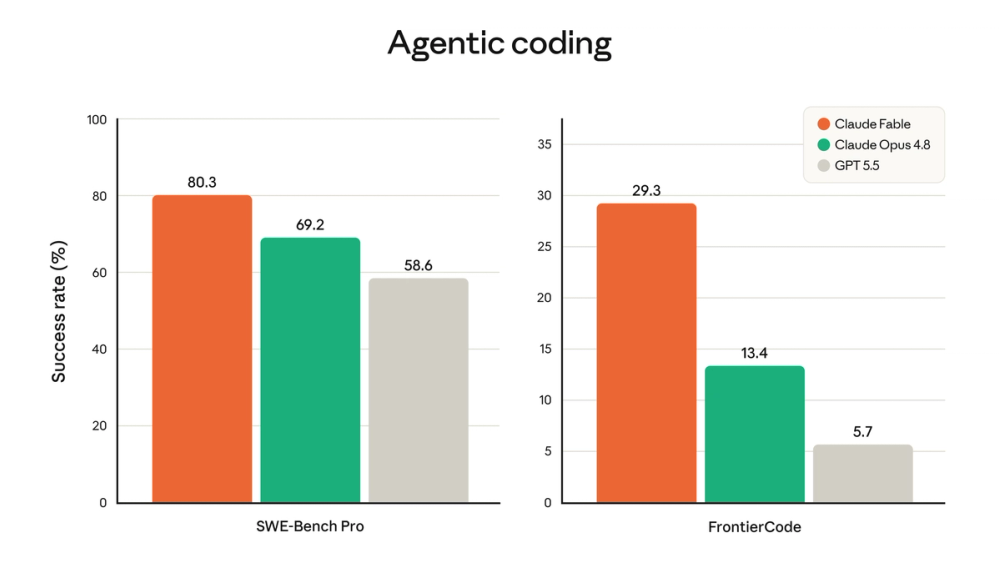
Source: Anthropic's official agentic coding benchmark chart for Claude Fable 5.
The separate agentic coding chart is cleaner and easier to quote. It shows Fable at 80.3% on SWE-Bench Pro versus Opus 4.8 at 69.2% and GPT 5.5 at 58.6%, plus 29.3% on FrontierCode versus Opus 4.8 at 13.4% and GPT 5.5 at 5.7%.
Anthropic also highlights Cognition's FrontierCode evaluation, which tests whether models can complete difficult coding tasks at production-codebase standards.
That is the part builders care about. Nobody needs another chatbot that writes a passable function. The frontier is whether a model can handle the ugly middle of software work: repo context, tests, design intent, dependency weirdness, partial failures, and review loops.
What the Community Is Actually Saying
The community reaction is not a single clean cheer.
It is more useful than that.
1. Developers are excited because it keeps working
The strongest positive signal comes from people using Fable on real code, not from launch-thread vibes.
Simon Willison reported that Fable helped turn a stretch goal in Datasette Agent into changes across the underlying llm library, with tests, API design, documentation, and release notes. That is exactly the kind of work that exposes weak coding models. A model can fake competence on a small function. It has a harder time faking judgment across library design, backwards compatibility, and tests.
The Hacker News launch thread had the same energy. The top discussion includes early users pushing Fable through hard problems in Claude Code and Claude.ai. The useful pattern: people are not only saying "the answer was smarter." They are saying the model stayed with the task longer.
That is the real upgrade.
2. YouTube coverage is amplifying the agent story
YouTube coverage is already noisy, but the useful signal is where reviewers are aiming their tests: coding agents, long-context work, safety routing, and whether Fable can stay useful after the first prompt.
Early community videos include Anthropic Just Dropped Fable 5 And It's Terrifying, Claude Fable 5 IS INCREDIBLE! Greatest AI Model Ever, We Tested Anthropic's Fable 5 for a Week, and Claude Fable 5: No Hype Full Breakdown & Testing. I would not treat titles or thumbnails as evidence; the value is in the actual task traces, failures, and side-by-side comparisons inside each video.
That distinction matters. YouTube thumbnails are not evidence; the actual tests inside the videos are.
Taken together with Simon Willison's writeups and the Hacker News launch thread, the reviewer frame is shifting from "Anthropic shipped another model" to "what happens when a more autonomous coding agent becomes broadly available?"
That is a much bigger frame.
3. Security people are focused on the split between Fable and Mythos
The Reddit cybersecurity discussion is especially useful because it is less impressed by launch language and more interested in deployment risk.
The core point from that thread: Fable and Mythos appear to share the same underlying capability class, but Fable routes or blocks risky cybersecurity and biology requests, while Mythos is reserved for vetted defensive work.
One comment captured the practical security angle nicely: "Fixing them still runs on human time." That is the uncomfortable gap. If models accelerate bug discovery faster than teams can patch, defenders get power, but attackers get pressure too.
This is why Fable matters beyond normal AI productivity. The same capability that helps a developer migrate a giant codebase can also stress the security ecosystem.
4. The backlash is about transparency, not just capability
There is also a trust wrinkle.
Anthropic's Fable page says queries in cybersecurity and biology domains may route to Opus 4.8 if flagged by safeguards. Using Fable also requires 30-day data retention for safety monitoring.
That is already a real adoption constraint for some teams.
Then the community reaction intensified around invisible or unclear safeguards. Business Insider, Wired, and The Verge all reported on Anthropic walking back an earlier guardrail approach after backlash from researchers and developers. The complaint was not simply "the model refuses." The complaint was "users need to know when they are no longer getting the model behavior they think they are getting."
That criticism is fair.
If a model costs more because it is the best available model, users need visible boundaries when it is being routed, downgraded, refused, or constrained. Frontier capability without clear telemetry turns into expensive confusion.
Why Claude Fable 5 Feels So Strong
1. It is built for long-horizon work
Most model upgrades are easy to describe and hard to feel. The answer is more fluent. The math is a little better. The benchmark moved.
Fable's pitch is different: give it a bigger mess.
Anthropic talks about days-long agent work, large migrations, complex implementations, and enterprise workflows where the user reviews completed work instead of babysitting every turn.
That is the use case that actually changes how teams operate. A model that can sustain context, plan stages, run checks, revise its assumptions, and keep going is not a writing assistant. It is closer to an async teammate you supervise.
Do I trust that blindly? Absolutely not.
But if the early reports are even half right, Fable belongs in the category of "models you test on your hardest backlog item," not "models you use for nicer prose."
2. It appears better at self-checking
Anthropic's product page emphasizes that Fable can write tests, validate its own work, and use vision to compare outputs against goals.
That matters because agent failures usually do not come from a lack of syntax. They come from missing the point, overfitting the wrong fix, forgetting a side effect, or stopping before the boring verification step.
The best community reports point to the same thing: Fable is useful when the task has multiple hidden traps.
That is why coding agents are such a good test. The repo does not care about vibes. The tests pass or they do not. The UI lines up or it does not. The migration breaks production or it does not.
3. The context window is finally product-relevant
A 1M token context window is easy to turn into marketing.
The practical question is: can the model use it without turning mushy?
Fable's early value seems to come from exactly that. It can take in more project state, keep more constraints alive, and work through tasks that would previously need repeated restarts or manual compression.
For builders, this changes the workflow. You can ask for a repo-wide plan, feed in design references, include failing logs, attach screenshots, and still leave room for the model to operate.
The risk is cost. Long context plus a premium model can quietly become an expensive habit.
4. It raises the bar for coding-agent UX
The model is only half the product.
Claude Code, Claude Code for web, Claude.ai's container environment, and agent harnesses matter because Fable needs tools. A model that wants to keep going is only useful if it can inspect files, run commands, test output, and recover from failure.
This is where the community tests are more persuasive than the benchmark chart. Developers are not just asking Fable toy prompts. They are letting it touch actual projects.
That is the correct test.
Watch Outs Before You Switch Everything
1. It is expensive enough to change behavior
At USD 10 / USD 50 per million tokens, Fable is a premium model. Simon Willison's first-day cost tracking is a good reminder: serious agent work can consume a surprising amount of tokens.
That does not mean "do not use it."
It means use it where the task value is obvious: migrations, hard bugs, complex product implementation, analysis over large private corpora, legal/finance document reasoning, and multi-stage workflows where cheaper models keep failing.
If the task is a quick rewrite, use something cheaper.
2. The safeguards are a product surface now
The Fable/Mythos split is not a footnote. It is the product.
For ordinary coding and knowledge work, the safeguards may not matter. For cybersecurity, biology, chemistry, AI research, or edge-case developer tasks that look adjacent to restricted domains, they may matter a lot.
Teams should test their real workflows before making Fable a default.
3. 30-day data retention will block some enterprise use
Anthropic says using Fable requires 30-day data retention for safety monitoring.
That may be fine for many teams. It may be unacceptable for teams with strict vendor compliance, regulated data, security-sensitive source code, or zero data retention requirements.
The model can be excellent and still fail procurement.
4. "Relentlessly proactive" is a double-edged sword
The most exciting behavior is also the risk.
A model that keeps trying, uses tools aggressively, and finds workarounds is exactly what you want for hard tasks. It is also exactly why sandboxing, approval gates, repo permissions, secret handling, and test isolation matter.
If you give Fable a wide-open agent harness, do not act surprised when it uses the room.
Quick Take
- Is Claude Fable 5 Anthropic's latest flagship?: Practical answer: Yes. It is Anthropic's newest flagship-class public model, but Anthropic said on June 12, 2026 that access to Fable 5 and Mythos 5 was temporarily unavailable.
- Is it stronger than Opus 4.8?: Practical answer: Official benchmarks and early community tests point to a clear jump, especially on long-horizon coding and agent work.
- Is Mythos 5 stronger?: Practical answer: Anthropic's chart shows Mythos ahead on many benchmarks, but access is restricted. Fable is the public path.
- Who should test it first?: Practical answer: Once access returns, developers with hard repo tasks, teams running coding agents, enterprise analysts, and anyone doing large multi-step knowledge work should be first in line.
- Who should wait?: Practical answer: Teams that need low cost, low latency, zero data retention, or predictable behavior around restricted domains.
My read: Claude Fable 5 is the model you try when a task is too large for your usual AI workflow.
It is not cheap. It is not frictionless. And the safeguards story still needs trust.
But the core capability signal is strong: Fable seems better at staying oriented inside real work.
That is what the next generation of AI tools will be judged on.
FAQ
What is Claude Fable 5? Claude Fable 5 is Anthropic's newest widely available frontier model. It is positioned for long-running coding, agentic workflows, complex knowledge work, vision-heavy documents, and difficult reasoning tasks. Anthropic describes it as a Mythos-level model with additional public safeguards.
When did Anthropic release Claude Fable 5? Anthropic announced Claude Fable 5 and Claude Mythos 5 on June 9, 2026. Fable 5 initially launched through Claude surfaces, the Claude API, cloud marketplaces, and supported platforms, but Anthropic posted a June 12, 2026 update saying access to Fable 5 and Mythos 5 was temporarily unavailable while it worked to restore service. Mythos 5 remains restricted to vetted partners and trusted access programs.
How strong is Claude Fable 5 on benchmarks? Anthropic's official launch charts show Fable/Mythos ahead of Claude Opus 4.8 on the rows included here, including SWE-Bench Pro, FrontierCode, GDPval-AA, GDP.pdf, Blueprint-Bench 2, AutomationBench, OSWorld-Verified, Humanity's Last Exam, BioMysteryBench, Terminal-Bench 2.1, ExploitBench, and HealthBench Professional. The separate coding chart makes the SWE-Bench Pro and FrontierCode gaps especially clear.
What are people in the community saying about Claude Fable 5? Early reactions from builders are unusually strong. Simon Willison called it slow and expensive but also described it as a model that keeps working through difficult tasks. Hacker News and early YouTube coverage are focused on autonomous coding, long-horizon workflows, and the new guardrail tradeoffs.
What are the biggest Claude Fable 5 limitations? The main watch outs are price, speed, safety routing, possible false positives in restricted domains, and the 30-day data retention requirement. Teams handling sensitive workloads should test policy behavior and vendor requirements before adopting it broadly.
Discover more AI tools, model launches, and builder workflows at AIToolHunt.
Sources
- Anthropic: Claude Fable 5 and Claude Mythos 5
- Anthropic: Fable and Mythos access update
- Anthropic: Claude Fable 5 product page
- Anthropic docs: Models overview
- Anthropic: Claude Fable 5 & Claude Mythos 5 System Card PDF
- Simon Willison: Initial impressions of Claude Fable 5
- Simon Willison: Claude Fable is relentlessly proactive
- Hacker News: Claude Fable 5
- Reddit r/cybersecurity: Anthropic released Claude Fable 5 yesterday
- YouTube: Anthropic Just Dropped Fable 5 And It's Terrifying
- YouTube: Claude Fable 5 IS INCREDIBLE! Greatest AI Model Ever
- YouTube: We Tested Anthropic's Fable 5 for a Week
- YouTube: Claude Fable 5: No Hype Full Breakdown & Testing
- Business Insider: Anthropic says it made the wrong tradeoff in new model guardrails
- Wired: Anthropic walks back policy affecting researchers using Claude
- The Verge: Anthropic apologizes for invisible Claude Fable guardrails