Newsletter
Join the Community
Subscribe to our newsletter for the latest news and updates
Anthropic launched Claude Opus 5.5 with a claim coding-agent teams will notice: lower token prices, fewer tokens per job, and more than 30% faster output than Opus 5. The honest answer is less tidy than “upgrade everything.” Opus 5.5 looks like a strong replacement for Opus 5 at default effort, but the cheapest model depends on how much reasoning effort and rework your tasks consume.
Source: Anthropic’s official Opus 5.5 communication comparison. This is a vendor-selected example, not a broad independent writing evaluation.
Claude Opus 5.5 is Anthropic’s September 22, 2026 flagship model for agentic coding and knowledge work, and the practical change is cost structure rather than a clean benchmark knockout. Anthropic lists API prices of $4 per million input tokens, $20 per million output tokens, $0.20 for cache reads, and $5 for cache writes, while saying typical workloads at default effort cost 40% less than Opus 5. The model is available as claude-opus-5-5 across Anthropic’s platform, AWS, Google Cloud, and Azure. But “cheaper” is workload-dependent: Artificial Analysis reports materially different cost-per-task results across effort settings, and Anthropic itself says benchmark margins are becoming less reliable guides to real-world differences. So the sensible upgrade test is not price per token alone. Compare completed-task cost, retry rate, latency, review time, and fallback behavior on your own agent traces. Teams already paying for Opus 5 should test now; teams using cheaper models should wait for workload-specific evidence.
This is a release analysis, not a hands-on review. The confirmed facts are the September 22 launch, listed API rates, model ID, platform availability, and Anthropic’s published evaluation setup. The 40% typical-workload cost reduction, 30% speed increase, and most benchmark results remain vendor-reported.
TechCrunch independently confirmed the release and price change while attributing performance to Anthropic. The Verge focused on safeguard routing. The Decoder added independent evaluator context showing why effort level matters to cost.
The biggest economic change is not the 20% headline cut. It is the combination of lower list prices and Anthropic’s claim that the model uses fewer tokens on typical tasks. That is how the company gets from a 20% rate reduction to a 40% task-cost claim.
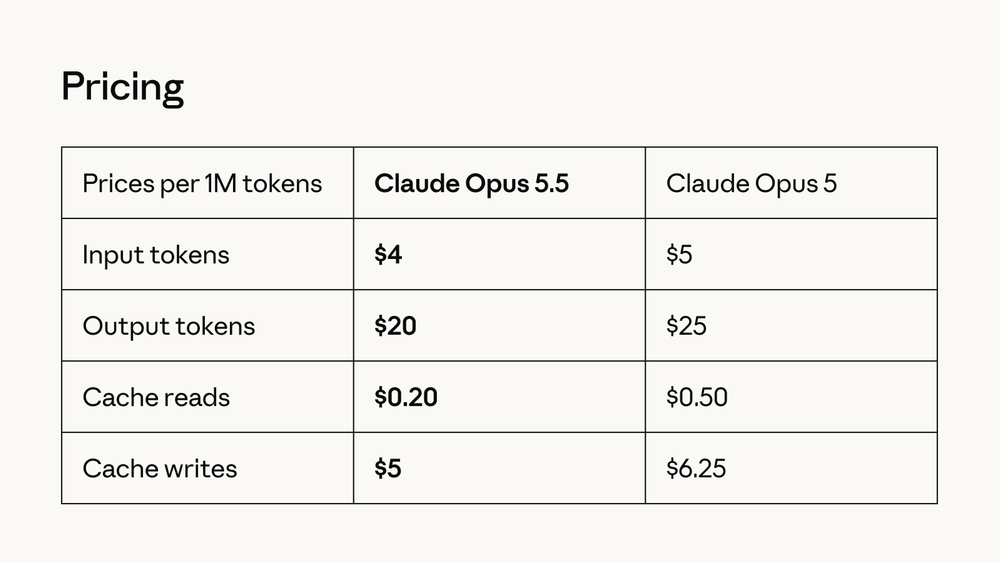
Source: Anthropic’s official pricing post, published September 22, 2026. These are list prices, not a guarantee of lower total spend.
There is also a faster option. Anthropic says fast mode can run up to 2.5 times faster in Claude Code and the Claude Platform, but it costs $8 per million input tokens and $40 per million output tokens. That is a latency purchase, not the default bargain.
The model is available now through Anthropic, AWS, Google Cloud, and Microsoft Azure under the API model ID claude-opus-5-5. For some cybersecurity, biology, and frontier-model-development requests, Anthropic says safeguards may route work to another Claude model. That matters if your evaluation assumes every prompt stays on one model.
Agent cost has four moving parts: input tokens, output tokens, cache economics, and how many attempts it takes to finish. A model with a higher sticker price can win if it needs fewer retries; a cheaper rate can still lose if high effort produces long traces.
Anthropic’s case is strongest for cache-heavy, long-running coding agents. Cache reads fell from $0.50 to $0.20 per million tokens, and the company says typical default-effort jobs use fewer tokens. But “default effort” is doing a lot of work in that sentence. Artificial Analysis’s effort-specific pages show that cost per evaluated task changes materially as reasoning effort changes.
The official benchmark table is useful as a map of what Anthropic tested, not as a universal ranking. It mixes harnesses, effort levels, safety fallbacks, partner evaluations, and competitor-reported figures. Anthropic even notes that benchmark margins can overstate real-world differences.
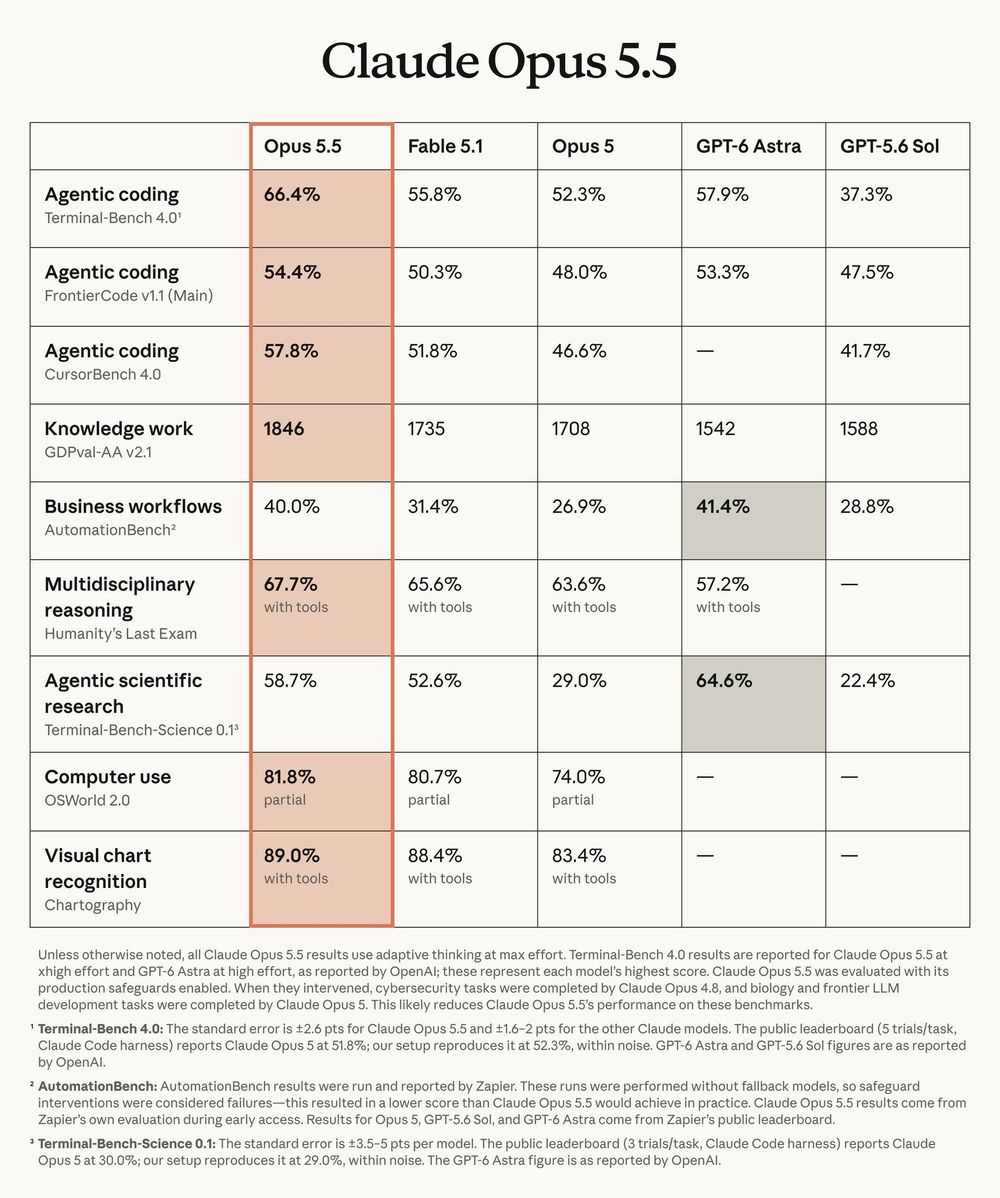
Source: Anthropic’s official Opus 5.5 benchmark post. Scores are vendor-run or partner-reported under the visible harness and effort notes; they have not been independently reproduced as a single cross-model study.
Start with a shadow test, not a fleet-wide model swap. Replay a small set of real tasks against Opus 5 and Opus 5.5 at the same effort setting. Track total tokens, cache reads and writes, wall-clock time, retries, test failures, human review minutes, and any fallback routing.
The clean migration case is a team already using Opus 5 for repository-wide changes, audits, or long agent sessions. The harder case is a team using Sonnet, Luna, MiMo, or another lower-cost model successfully. Opus 5.5 may be better, but this release does not prove it is cheaper than every alternative.
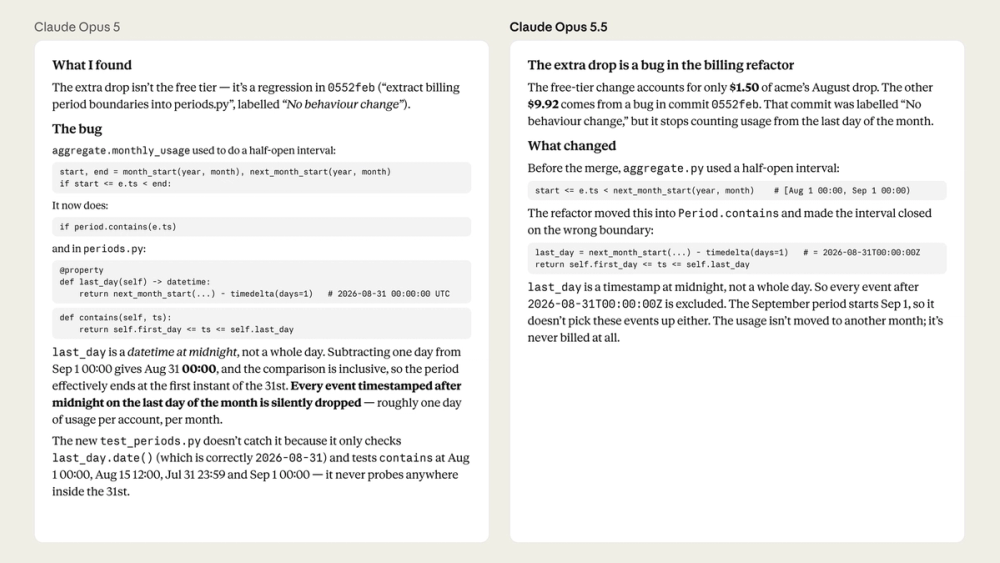
The most visible change may be less “Claudish” writing: shorter answers, important information earlier, and closer adherence to style instructions. Anthropic’s side-by-side example is promising, but it is vendor-selected. Normal users should judge whether fewer corrections and clearer summaries survive their own prompts.
The upgrade is available now, so curiosity is cheap if your plan includes it. What is not cheap is reorganizing a workflow around one release-day comparison.
A useful decision threshold is boring: switch only when Opus 5.5 lowers cost per accepted task, not merely cost per token or time to first answer.
claude-opus-5-5 model IDMy take: Opus 5.5 is a credible Opus 5 replacement candidate, not a blank check to replace every coding model.
What is Claude Opus 5.5?
Claude Opus 5.5 is Anthropic’s flagship model released on September 22, 2026 for agentic coding and knowledge work. It is available through Anthropic and major cloud platforms under the model ID claude-opus-5-5.
How much does Claude Opus 5.5 cost?
As of September 22, 2026, Anthropic lists $4 per million input tokens, $20 per million output tokens, $0.20 per million cache-read tokens, and $5 per million cache-write tokens. Fast mode costs $8 input and $40 output per million tokens.
Is Claude Opus 5.5 really 40% cheaper than Opus 5?
Anthropic says typical workloads at default effort cost 40% less because rates are lower and the model uses fewer tokens. Treat that as a vendor claim until your own agent traces confirm total cost, retries, and review time.
Should developers replace Opus 5 with Opus 5.5?
Developers already using Opus 5 should run a controlled shadow test now. Keep effort settings and tasks constant, then compare accepted-task cost, latency, retries, test results, review minutes, and any safety fallback behavior before changing the default.
What is still unverified about Claude Opus 5.5?
The published benchmark set is not one uniform independent study, and launch-day examples cannot prove production reliability. It is also unclear how broadly the 40% typical-workload saving holds across maximum-effort agents and specialized workloads.
Discover practical AI products and emerging tools at AIToolHunt.