

Claude Opus 5 is not just another model name in Anthropic's lineup. It is the model Anthropic is trying to make usable every day: close to Fable 5 on many agentic coding tasks, cheaper to run, and less disruptive when safety filters kick in.
That is worth testing. It is not a reason to rewrite your whole model stack before you measure cost per finished task.
Quick Navigation
- What is Claude Opus 5? The release, pricing, and access status.
- What We Know So Far: Which claims are confirmed and which are still vendor-reported.
- What changed in this release? The practical delta for Claude Max, Pro, API, and coding agents.
- How does Claude Opus 5 work for agents? Effort settings, context, verification, and fallbacks.
- Why should builders care? The test-now / wait-later decision.
- FAQ: Five direct answers for AI product watchers and developers.
What is Claude Opus 5?
Claude Opus 5 is Anthropic's July 24, 2026 Opus-tier model for everyday coding agents, research work, and professional tasks. Anthropic says in its official launch note that it approaches Claude Fable 5 intelligence at half the price, becomes the default model on Claude Max, and is the strongest model on Claude Pro. The same page says developers can call claude-opus-5 through the Claude API at $5 per million input tokens and $25 per million output tokens, with a Fast mode that runs about 2.5 times the default speed at twice the base price. That is the confirmed release shape. The narrower reader decision is whether to test Opus 5 for long-running coding and agent workflows now, while treating Anthropic's benchmark charts and partner quotes as vendor evidence until independent tests catch up inside real developer projects.
What We Know So Far
The confirmed facts come from Anthropic's launch page, the Claude Opus 5 System Card, and the Claude blog post on new context-engineering rules. The independent layer comes from TechCrunch and The Decoder, both of which frame Opus 5 as a cheaper, less restrictive alternative to Fable 5 rather than a clean replacement for every task.
The public evidence is strong enough for a serious trial. It is not strong enough for a blind migration.
What changed in this release?
- Opus 4.8 was the high-end Opus option.: New public information: Anthropic says Opus 5 keeps Opus 4.8 API token pricing while improving coding and professional-work results.; Why it matters: Developers get a better candidate for long-running agents without jumping straight to Fable-level token rates.
- Fable 5 carried stronger frontier positioning but heavier constraints.: New public information: TechCrunch reports Opus 5 is cheaper and less restrictive than Fable 5, while still retaining cyber safeguards.; Why it matters: Privacy-conscious and security-adjacent users get a more usable default, but not an unrestricted model.
- Prompt-heavy Claude Code guidance could overconstrain newer models.: New public information: Anthropic says it removed over 80% of Claude Code's system prompt for newer Claude 5 models without measurable coding-eval loss.; Why it matters: Agent builders should spend more time designing tools, memory, and progressive disclosure, not stuffing every rule into one prompt.
The benchmark story is the part that needs discipline. Anthropic reports records on several coding and knowledge-work evaluations, but those charts are still Anthropic-run evidence. I would use them to decide what to test first, not to declare a winner.
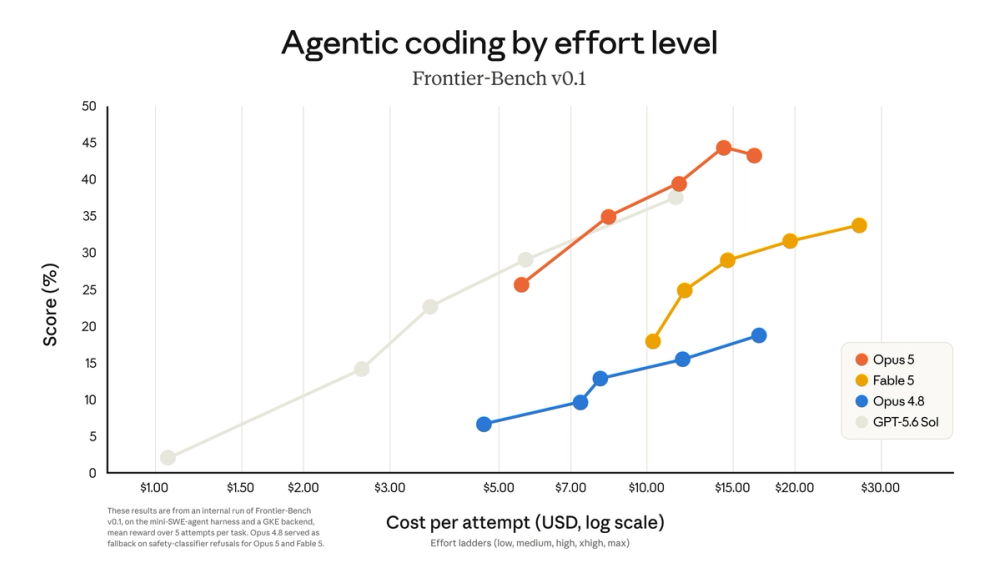
Source: Anthropic's Claude Opus 5 launch note. Boundary: Anthropic labels the Frontier-Bench v0.1 results as an internal run on the mini-SWE-agent harness with mean reward over five attempts per task; this is not independent benchmark replication.
The most interesting nuance is that more effort is not always better. The Decoder notes that Opus 5 can score worse at max effort than at a lower effort setting on some coding benchmarks because extra surrounding refactors may count against the task. That is exactly the kind of thing a real engineering team should catch in its own eval harness.
How does Claude Opus 5 work for agents?
The mechanism is not one magic trick. It is a bundle of product decisions around a more capable model: effort settings, tool use, safety fallbacks, and a lighter approach to context.
For developers, effort settings are the first knob. Anthropic says Opus 5 supports low, medium, high, xhigh, and max effort, and the launch page shows that cost and score move together imperfectly. My practical read: start with medium for everyday work, use xhigh for hard coding-agent tasks, and treat max as a measured choice rather than a badge of seriousness.
Context is the second knob. In the companion Claude context-engineering post, Anthropic says newer Claude 5 models handled a much shorter Claude Code system prompt without measurable coding-eval loss. The lesson for your own agent is uncomfortable but useful: fewer global rules, better tool descriptions, smaller skills, and more targeted references may beat a giant instruction wall.
Safety fallbacks are the third knob. Anthropic says Opus 5 allows source-code vulnerability research but blocks higher-risk exploit-generation paths, and TechCrunch highlights the new Automatic Fallbacks beta for API requests that trip classifiers. That is not a loophole; it is an operational feature for keeping a workflow from hard-failing when a prompt crosses a policy line.
The developer view
If you build coding agents, Opus 5 belongs in your eval matrix today. Test it on feature work, migrations, bug sweeps, frontend visual QA, and repo-specific code review. Measure finished-task cost, not just input and output tokens.
The failure mode I would watch is overwork. The Decoder's benchmark note is a useful warning: a model can solve the core task and still lose points by changing too much around it. If your product values tight diffs, add a "minimum necessary change" metric before you roll Opus 5 into production.
The product enthusiast view
For normal AI users, Opus 5 matters because it may move stronger agent behavior into a more everyday tier. Anthropic says it is the default on Claude Max and the strongest model on Claude Pro, which means more paid users can try the new model without treating Fable 5 as the only serious option.
Still, I would not judge it from launch demos alone. Try messy documents, multi-step spreadsheet work, long coding prompts, and tasks where you care about the model admitting uncertainty. The useful question is not "is it smarter?" It is "does it finish the work with fewer retries and fewer weird side quests?"
Why should builders care?
- Cost per finished task may improve - the headline token rate is lower than Fable 5, but the real number is task completion after retries, tool calls, and review. 2. Claude Code guidance is changing - Anthropic's 80% system-prompt reduction is a signal that newer models may need cleaner interfaces more than longer rules. 3. Safety fallbacks become product infrastructure - if your app touches security, compliance, or regulated work, routing behavior matters as much as raw model quality.
My take: Opus 5 is the kind of release you should test this week if your product depends on coding agents. If your use case is casual chat, lightweight copy, or cheap batch summarization, it may be overkill.
What remains unclear?
The first gap is independent reproduction. Anthropic's official chart is useful because it shows the original claim, but most teams should wait for third-party tests across their own languages, frameworks, codebase sizes, and review policies.
The second gap is effort tuning. A higher setting can spend more tokens and still produce less desirable behavior if the task rewards minimal changes. That makes Opus 5 a tuning problem, not just a model-selection problem.
The third gap is availability details by product surface. Anthropic states the API model name and paid-plan positioning, but actual quota, latency, and fallback behavior can vary by plan, region, and traffic. Recheck official pricing and usage pages before making a budget commitment.
The fourth gap is safety routing. The System Card and launch page give the policy frame; your app still needs logs, user messaging, and tests for what happens when a prompt is routed away from Opus 5.
Quick Take
- What is actually new?: Evidence-backed answer: Claude Opus 5 is a new Opus-tier model positioned as a cheaper, more everyday alternative near Fable 5 performance on several tasks.
- Who can use it now?: Evidence-backed answer: Anthropic says it is available on paid Claude plans and the Claude API as
claude-opus-5as of July 24, 2026. - What is the strongest evidence?: Evidence-backed answer: Anthropic's official benchmark charts and system card, with TechCrunch and The Decoder confirming the release framing and caveats.
- What should developers verify?: Evidence-backed answer: Finished-task cost, effort setting, diff size, fallback behavior, latency, and performance on their own repositories.
- What is still unknown?: Evidence-backed answer: Independent benchmark breadth, plan-specific quotas, real-world effort tuning, and whether the partner quotes generalize to smaller teams.
The short version: test Claude Opus 5 now if you run serious coding-agent workflows, but make the migration decision from your own evals, not the launch chart.
FAQ
What is Claude Opus 5?
Claude Opus 5 is Anthropic's newest Opus-tier model, announced on July 24, 2026. It targets coding agents, professional work, and research tasks, with Anthropic positioning it near Fable 5 performance at lower token rates.
Is Claude Opus 5 available now?
Yes. Anthropic says Claude Opus 5 is available on paid Claude plans and through the Claude API as claude-opus-5. As of July 25, 2026, the official launch page lists API pricing at $5 per million input tokens and $25 per million output tokens.
How is Claude Opus 5 different from Fable 5?
Anthropic positions Opus 5 as cheaper and more everyday than Fable 5, while still close on many coding and knowledge-work tasks. Fable 5 remains the more expensive frontier option, and Mythos 5 remains stronger for some sensitive dual-use domains.
What should developers know before using Claude Opus 5?
Developers should test effort settings, not just the model name. Start with representative coding-agent tasks, measure finished-task cost, inspect diff size, and verify how Automatic Fallbacks behave when safety classifiers route a request away from Opus 5.
What is still unverified about Claude Opus 5?
The main open issue is independent reproduction. Anthropic's benchmark charts and partner quotes are useful primary evidence, but teams still need third-party tests and workload-specific evals before replacing a stable production model.
Discover more practical AI products and emerging tools at AIToolHunt.