Newsletter
Join the Community
Subscribe to our newsletter for the latest news and updates
Source: Cloudflare's official Cloudflare Computer launch article.
Cloudflare Computer is not a tiny virtual machine with a cute name. It is a different bet: keep an agent's files persistent, then choose a lightweight isolate or a full Linux container task by task.
That is useful architecture, especially for coding agents. It is also an alpha-quality preview whose own repository says not to use it in production.
Cloudflare announced the early preview on August 3, 2026, and the source is available in an MIT-licensed public repository. IT Home independently reported the release, but it did not independently test the runtime.
The strongest evidence is therefore the code and its warnings, not Cloudflare's scale narrative. The repository documents implemented backends, runnable examples, and an explicit production prohibition. This article explains that public surface; it does not claim hands-on testing or independent performance results.
Cloudflare Computer is an early-preview agent runtime that gives an AI agent one persistent workspace while letting each task run in a lightweight isolate or a full Linux container. Cloudflare's official launch post says the workspace centers on a virtual filesystem, and the public repository shows the authoritative state stored in SQLite inside a Durable Object. Three backends ship today: a container with a real FUSE mount, an isolate shell powered by just-bash, and isolate JavaScript running in a Dynamic Worker. They share files through the same workspace instead of treating each execution environment as a separate disposable machine. The important limit is equally clear: the repository labels the package preview-only, says its APIs can change, and states that it is not suitable for production. So this is a concrete architecture to prototype, not a production platform to adopt on faith.
workspace.runtime.exec surface accepts a backend selection; Why it matters: The routing decision becomes explicit and inspectableThis is not a general-purpose laptop in the cloud. The current package manifest identifies version 0.1.0-alpha.1 and uses an unreleased publish tag, while the repository README calls the API unstable and unsuitable for production.
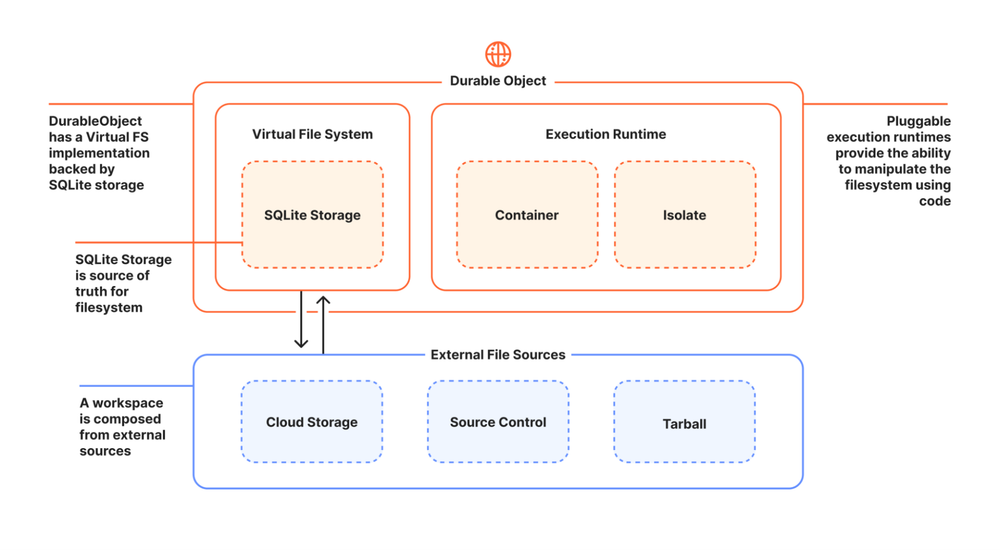
Source: Cloudflare's official architecture diagram. It shows the vendor's implemented design boundary, not an independent validation of scale, security, or cost.
The center is a workspace: a virtual file system whose authoritative state lives in SQLite inside a Durable Object. External sources such as a repository, cloud storage, or an archive can populate it.
Execution is pluggable. The container backend mounts workspace state through FUSE and provides a full Linux userland and real binaries. The isolate-shell backend runs just-bash in a Dynamic Worker. The isolate-JavaScript backend evaluates an ECMAScript module in a fresh Dynamic Worker with workspace-backed file access.
All three meet behind the shared workspace.runtime.exec method, with the backend passed as an option. The model or application chooses that backend, and the README says backends connect lazily on first use.
The cleanest first trial is a disposable repository task. Ask an agent to clone a small project, inspect files in the isolate shell, make one change, and invoke a container only for a tool that genuinely needs Linux. Log every backend choice, file mutation, outbound request, exit code, and human correction.
Do not evaluate the metaphor. Evaluate the boundary: can you explain where state lives, which runtime handled each command, what credentials were available, and how you would recover after a partial failure?
The interesting product idea is not “an AI gets a computer.” Coding agents already receive shells and files. The new idea is that one persistent workspace can survive while the execution engine changes underneath it.
That could make long-running agents less wasteful and easier to audit. For now, “could” is the honest word: the public code is a preview, and independent production evidence does not exist yet.
My call: test Cloudflare Computer if you are designing agent infrastructure and can tolerate churn. Wait if you need a stable SDK, production support, portable deployment, or a security contract your organization can approve.
The production boundary is the largest unknown. The repository explicitly says “not suitable for production,” but the criteria for leaving preview are not public.
Security also needs workload-level proof. Builders still need to define credential scopes, network policy, malicious repository handling, dependency execution, human approval, and incident recovery.
Portability is another open question. The library's core abstraction is useful beyond one cloud, but its current implementation depends on Cloudflare-specific primitives including Durable Objects, Dynamic Workers, and Containers.
Finally, there is no independently verified operating-cost model. The right question is not whether isolates are cheaper in theory; it is whether routing plus storage, synchronization, container startup, and observability reduce total cost for your workload.
Cloudflare Computer is worth studying because the abstraction is sharp. It is worth testing only if your prototype is disposable.
What is Cloudflare Computer?
Cloudflare Computer is an early-preview agent runtime built around a persistent virtual workspace. Its public repository documents container, isolate-shell, and isolate-JavaScript backends that can operate on the same SQLite-backed file state inside a Durable Object.
Is Cloudflare Computer available now?
The source repository and examples are public, and Cloudflare's launch article includes an installation path. However, the package manifest reports an alpha version with an unreleased publish tag, so developers should follow the current repository instructions rather than assume a stable registry release.
Can Cloudflare Computer be used in production?
No, not according to its own README as of August 4, 2026. The repository says the package is preview-only, its APIs are unstable, its design may change, and it is suitable for experiments, exploration, and prototypes rather than production use.
How should a developer test Cloudflare Computer?
Use one disposable repository task with objective acceptance checks. Record which backend handled every command, whether file state stayed consistent, what credentials and network access were exposed, how partial failures recovered, and whether a human could audit the full sequence.
Does Cloudflare Computer remove the need for containers?
No. It treats a container as one backend for work that needs Linux, packages, native binaries, or system tools. Lighter file, shell, and JavaScript tasks can use isolates, but the application or agent still needs a safe routing policy.
Discover practical AI products and emerging tools at AIToolHunt.