Newsletter
Join the Community
Subscribe to our newsletter for the latest news and updates
Official Kitesurf launch artwork. Source: Cloudflare's technical announcement.
Cloudflare Kitesurf is not trying to become your next desktop browser. It takes a different, Workers-native route from Chromium and omits human-browser features that AI agents do not need. The useful question is not whether it can replace Chrome everywhere. It is whether your agent workflow is simple enough to benefit from the trade.
This is an evidence review, not a hands-on compatibility test. Cloudflare has published the architecture, a public playground, a Web Platform Test coverage matrix, and explicit beta limits. TechCrunch independently confirmed the launch, but the test count still comes from Cloudflare rather than outside reproduction.
Cloudflare Kitesurf is a beta browser engine for AI agents that need to read, render, and interact with websites without carrying all of Chromium's human-facing features. Cloudflare released it through Browser Run on August 6, 2026, and says access is free during the beta. Kitesurf runs on Workers, exposes Chrome DevTools Protocol compatibility, and can be selected by existing Puppeteer, Playwright, CDP, or MCP clients. The tradeoff is compatibility: Cloudflare's technical launch post reports more than 215,000 passing Web Platform Tests, but it also tells teams to keep Chromium for video, WebGL, real-TLS bot challenges, and long authenticated sessions. That test count is vendor-reported and is not proof of full production-site compatibility. Kitesurf is therefore a test-now option for bursty extraction, screenshots, and compatible agent workflows, not a drop-in replacement for every browser session. TechCrunch independently confirmed the launch and agent-browser positioning the following day.
browser=kitesurf; Why it matters: Existing CDP tooling gets a second engine without a new control modelCloudflare also reports more than 215,000 passing Web Platform Tests. That shows broad standards work, but it does not prove that every production site, authentication flow, visual layout, or bot-defense handshake behaves like Chromium.
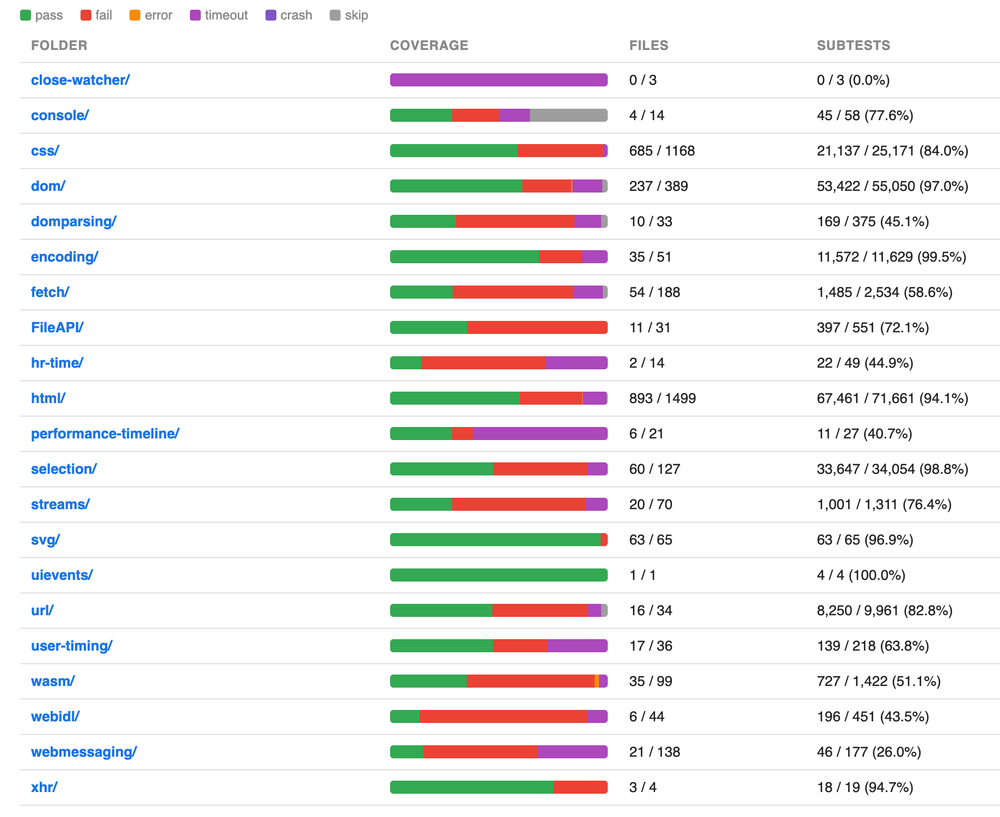
Cloudflare's original Web Platform Test coverage table shows where Kitesurf passes and fails standards tests. Source: Cloudflare's Kitesurf announcement. The result is vendor-reported and does not establish full Chromium or production-site compatibility.
Kitesurf keeps the Chrome DevTools Protocol as its front door, so clients do not need to learn a proprietary action language. The Engine holds session state and exposes CDP over WebSocket and REST. PageScript parses HTML, CSS, JavaScript, and WebAssembly inside a clean isolate, while PageRenderer turns the computed page into screenshots, PDFs, or frames.
Network access is deliberately narrow. A SandboxOutbound worker fetches documents, scripts, styles, images, and fonts, enforces CORS, filters responses, and keeps cookies in a page-specific jar. Other components cannot reach the network directly.
The design is mostly stateless outside the Engine. If a renderer stalls, the Engine can kill it and replay the request rather than recover a long-lived browser process. That makes sense for short, bursty jobs, but it also explains why durable ten-minute login sessions are not the product's strong suit yet.
The clean experiment is a route, not a rewrite. Send a fixed corpus of extraction, screenshot, and form tasks to Kitesurf, record success rate, wall time, CPU or billable usage, output differences, and fallback frequency, then run the same corpus through Chromium. A lower per-run footprint is irrelevant if retries erase the savings.
Keep Chromium as the fallback for video, WebGL, precise screenshot comparisons, bot challenges that depend on real TLS fingerprints, and persistent authenticated sessions. Pin the Browser Run API behavior you tested, because Kitesurf is a young beta and its CDP coverage is still expanding.
Kitesurf points to a bigger product shift: AI agents may need browsers designed around tokens, context, and safe disposable execution rather than tabs and polished scrolling. If that architecture lowers completed-task cost in production, it could bring browser-using agents to more ordinary workflows.
But a lighter browser is not automatically a better agent. Website compatibility, prompt-injection defenses, task planning, and recovery still decide whether the job finishes correctly. For a normal user, Kitesurf matters indirectly through faster or cheaper agent products, not as software you should install on your laptop.
My decision rule is simple: test Kitesurf when the browser is a disposable tool call; wait when the browser is the user's durable workspace. That keeps the beta behind a reversible routing decision rather than making it a new dependency for every web task.
Those gaps are normal for a newly public beta. They are also the reason a developer should measure completed tasks, not only architecture claims.
My take: Kitesurf is a credible second engine for bounded agent jobs, not evidence that Chromium is obsolete. Test it behind a fallback and let completed-task economics decide.
What is Cloudflare Kitesurf?
Cloudflare Kitesurf is a beta browser engine for AI agents. It runs on Cloudflare Workers, uses a subset of the Chrome DevTools Protocol, and focuses on machine-readable content, isolation, and lower resource use rather than the full feature set and visual fidelity of Chromium.
Is Cloudflare Kitesurf available now?
Yes. Cloudflare says Kitesurf is available through Browser Run and free during the beta as of August 8, 2026. Developers can select it with the browser=kitesurf parameter in supported CDP or quick-action endpoints. Account limits still apply.
Can Kitesurf replace Chromium?
Not across every workload. Cloudflare explicitly keeps Chromium as the recommended option for video, WebGL, real-TLS bot challenges, and long authenticated sessions. Treat Kitesurf as a routed second engine and measure completed-task cost, output quality, and fallback frequency in your own workload.
What should developers test before using Kitesurf?
Run a fixed task corpus through both engines and record completion, output fidelity, latency, compute or billable usage, and Chromium fallback frequency. Include authentication, JavaScript-heavy pages, screenshots, and failure recovery. Keep the engine choice behind a reversible routing flag.
What is still unverified about Kitesurf?
Independent teams have not yet reproduced broad production-site compatibility at scale. Prompt-injection resistance, final pricing, open-source timing, and performance for durable authenticated sessions remain unclear. Cloudflare explicitly recommends Chromium for several unsupported workloads.
Discover practical AI products and emerging tools at AIToolHunt.