
Source: Cursor’s official Origin Code Hosting launch.
Cursor just put repositories, pull requests, code browsing, and agents inside the same product. That sounds like a GitHub replacement. The safer reading is narrower: Cursor Origin is an early-beta mirror worth testing on a low-risk repo, not a new system of record to trust by default.
Quick Navigation
- What is Cursor Origin? The product, access, and current scope
- What changed? The move from editor to code-hosting platform
- How does it work? Native repos, GitHub sync, PRs, agents, and integrations
- Can it replace GitHub? Why the mirror is more useful than the migration story
- Who should try it? A practical test-and-wait decision
- FAQ: Five direct answers about access, sync, security, CI, and adoption
What is Cursor Origin?
Cursor Origin is an early-beta code-hosting service built into Cursor, available across paid plans as of August 17, 2026, except for enterprise organizations whose administrators have opted out. It supports Origin-native repositories, pull requests, code browsing, a command-line workflow, and synchronized copies of selected GitHub repositories. For a repository imported from GitHub, Cursor says GitHub remains the source of truth: pushes still go to GitHub, while comments, reactions, reviews, and repository updates appear in Cursor within seconds. Agents can answer questions about the open code, modify files, update a pull request, or push a branch from the same surface. The important limitation is that this is still a beta convenience layer, not a proven replacement for established source-control governance. Developers should test it with a non-sensitive repository and a reversible GitHub sync before considering broader adoption, while security-conscious teams should wait for clearer documentation on data handling, residency, retention, auditability, and exit paths.
What the Public Docs Say
This analysis uses Cursor’s launch page and launch post, VentureBeat’s independent reporting, and Cursor’s original product images. It does not claim hands-on use, production reliability testing, or an independent security audit. Product facts, Cursor’s positioning, independent reporting, and the adoption recommendation are separated throughout the article.
What changed with Cursor Origin?
Cursor used to sit beside a code host. Origin lets it own more of the loop between an agent’s change and a human’s approval.
- Code and PR state live mainly in GitHub: Origin’s early-beta workflow: Selected repos and PR activity appear inside Cursor; Practical consequence: Less switching during review and agent supervision
- An agent hands work back to an external forge: Origin’s early-beta workflow: Agents can change code, update PRs, or push branches in the repository view; Practical consequence: Faster iteration, but more trust concentrated in one vendor
- Trying another host usually implies migration work: Origin’s early-beta workflow: GitHub can remain authoritative while Cursor maintains a synchronized copy; Practical consequence: Teams can run a reversible trial before discussing migration
- CI and preview tools attach to the existing host: Origin’s early-beta workflow: Vercel, Depot, and Buildkite connect to Origin; Practical consequence: Existing deployment and CI workflows may be reusable
The official changelog says the beta includes the essentials—repositories, pull requests, code browsing, and GitHub sync—while more agent-native features are still coming. That last detail matters. Origin’s strategic pitch is ahead of its documented feature set.
VentureBeat’s independent report frames the launch as a new governance and procurement decision, not just another editor feature. That is the right level of caution: hosting proprietary code changes the risk model more than adding a new coding assistant does.
How does Cursor Origin work?
Origin supports two repository paths. You can create an Origin-native repository from Cursor’s Codebase tab and use the provided CLI commands to clone or push it. Or you can connect a GitHub organization, choose repositories, and let Cursor maintain synchronized copies.
The second path is the practical one for most teams. Cursor says imported repositories remain anchored to GitHub, permissions follow the GitHub read/write model, pushes continue to GitHub, and pull-request discussion syncs both ways. If the trial disappoints, the team can disconnect the mirror without first moving its source of truth.
Every repository includes pull-request views for timelines, commits, checks, changed files, comments, and merges. Cursor also places agents in that view, so a reviewer can ask about code, request a change, update a PR, or push a branch without moving to a separate interface.
The developer view
The best test is not “Can Origin clone my repo?” It is “Does Origin reduce review friction without weakening our controls?” Pick a non-sensitive repository, keep GitHub authoritative, and measure review completion time, sync delay, missing events, permission mismatches, CI behavior, and the number of times reviewers still open GitHub.
Do not start with a monorepo that controls production or contains regulated data. A beta can be useful before it is suitable for the code that defines your company’s security boundary.
The AI product enthusiast view
Origin shows where AI coding products are heading: the editor is turning into a development platform. The interesting change is not another chat panel. It is the attempt to put the agent, repository, review conversation, and deployment feedback in one loop.
That does not make GitHub obsolete. It shows why the place where agents work may become as strategically important as the model they use.
Can Cursor Origin replace GitHub today?
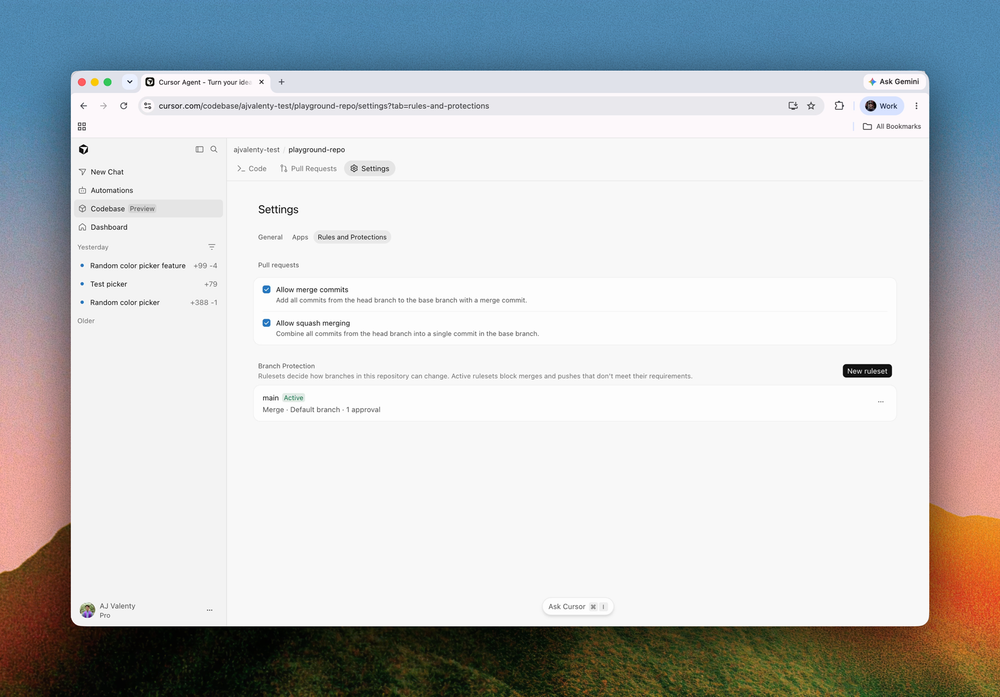
Source: Cursor’s official Origin launch page. The screenshot shows repository settings, merge options, and branch-protection rules in the early-beta product.
Not for most teams. Origin can host code, but code hosting is more than storage and pull requests. Mature adoption depends on branch protections, identity, audit logs, retention, residency, incident response, backups, integrations, compliance evidence, and a credible exit plan.
The launch materials show a real settings and rules surface, which is stronger evidence than a concept mockup. They do not answer every enterprise question. VentureBeat notes that the launch post leaves several security, data-handling, pricing, and migration details unpublished. Teams should ask for those answers in contract and product documentation rather than infer them from the interface.
Origin’s GitHub sync is therefore its strongest feature, not an admission of weakness. A synchronized trial lets a team test the new review surface while GitHub continues to hold authoritative state. That separates a product experiment from a source-control migration.
Who should try Cursor Origin now, and who should wait?
- Try it now if your team already pays for Cursor and spends heavily on agent-generated PRs. The review loop is the clearest potential win. 2. Try it now if you can use a non-sensitive repository. A reversible mirror is a reasonable beta test. 3. Wait if your repository is regulated, business-critical, or subject to strict residency rules. The public launch materials do not yet answer enough governance questions. 4. Wait if your workflow depends on uncommon GitHub Apps or policy controls. Cursor lists Vercel, Depot, and Buildkite, but not the full ecosystem you may need. 5. Do not migrate because of launch-day excitement. Keep GitHub authoritative until Origin proves sync reliability, control coverage, and a clean exit on your own repositories.
A useful two-week pilot has three acceptance gates: no missing repository or PR events, no permission surprises, and a measurable reduction in review friction. If one gate fails, disconnect the mirror and keep the lesson.
What remains unclear?
- Data policy at the repository layer: The launch post does not spell out retention, training use, residency, or subprocessors for hosted code.
- Operational maturity: No independent reliability record exists for the early beta.
- Security depth: The public screenshots show rules and protections, but not the full audit, recovery, and incident-response model.
- Integration coverage: Three launch partners are useful, but teams need to inventory their complete GitHub App and CI dependency graph.
- Exit behavior: GitHub sync is reversible in principle; teams should verify what is deleted, retained, or exportable after disconnecting.
Quick Take
- What is actually new?: Evidence-backed answer: Cursor can now host repositories and place code, PRs, and agents in one product.
- Who can use it now?: Evidence-backed answer: Paid-plan users in the early beta, except enterprise organizations whose admins opt out.
- What is the safest test?: Evidence-backed answer: Mirror one non-sensitive GitHub repository while GitHub remains authoritative.
- What is the strongest evidence?: Evidence-backed answer: Cursor’s detailed launch page and original product screenshot, backed by independent reporting.
- What is still unknown?: Evidence-backed answer: Production reliability and several enterprise security, data, and migration details.
My take: Origin is worth a controlled mirror test because it attacks the real bottleneck created by coding agents—reviewing and integrating more changes. It has not yet earned a source-of-truth migration.
FAQ
Is Cursor Origin available now?
Yes. Cursor says Origin began rolling out in early beta on August 17, 2026, across all paid plans. Enterprise organizations are included unless their administrators opt out. Availability does not imply that every team should enable repository hosting before reviewing its security requirements.
Does Cursor Origin replace GitHub?
It can host Origin-native repositories, but the lower-risk path is GitHub sync. For synchronized repositories, GitHub remains the source of truth and pushes continue there. Treat Origin as a review and agent-work surface until it proves the controls and reliability your team requires.
How does GitHub sync work in Cursor Origin?
Teams connect a GitHub organization and select repositories. Cursor says it updates the Origin copy in real time, mirrors existing read/write access, sends pushes to GitHub, and synchronizes pull-request comments, replies, reactions, and reviews in both directions within seconds.
Which CI and deployment tools work with Cursor Origin?
Cursor lists Vercel, Depot, and Buildkite at launch. Vercel can create preview deployments, while Depot and Buildkite can run existing GitHub Actions workflows; Buildkite also supports its native pipelines. Verify every required integration before moving a production workflow.
Should a security-conscious team use Cursor Origin?
Only in a bounded pilot for now. Use a non-sensitive repository, keep GitHub authoritative, test permissions and event sync, and ask for written answers on retention, residency, training use, audit logs, recovery, subprocessors, and deletion before hosting critical proprietary code.
Discover practical AI products and developer tools at AIToolHunt.