

Long context sounds useful until an AI agent repeatedly rereads a repository, a document set, or a long action history. Then the bill is shaped by more than the model's price per token. Memory, input processing, output generation, retries, and the amount of cached attention state all matter.
DeepSeek V4.1-Flash is interesting because its release targets those costs directly. DeepSeek describes it as a faster, more efficient multimodal model, while an independent technical summary points to a 1M-token context window, asymmetric compute for input and output, and a much smaller attention cache.
That is a promising architecture story. It is not yet proof that every agent will become cheaper or more reliable.
Quick Navigation
- What is it? The release, context window, and evidence boundary.
- What changed? Separate compute paths for reading and answering.
- How could it save memory? KV reuse, FP4 cache, and Engram in plain English.
- What changed with API price? The official off-peak discount.
- Who should test now? Long-input, human-reviewed workloads.
- Who should wait? Teams that need proven quality, predictable hosting, or mature tooling.
- FAQ: Direct answers for users and developers.
What is DeepSeek V4.1-Flash?
DeepSeek V4.1-Flash is the smallest model in DeepSeek's new architecture family and includes native visual understanding, according to the company's September 10 release post. An independent technical summary describes a 1M-token context window, a 552B-parameter backbone plus 196B Engram parameters, and different active parameter counts for reading prompts and generating answers. That design targets the expensive parts of long-context serving: processing a large input, storing attention history, and repeatedly decoding an answer. DeepSeek also links an open model card and a technical report. Their bodies timed out on the network used for this review, so the architecture quantities here are attributed to the independent summary rather than presented as directly inspected primary evidence. The release is therefore worth testing today, but its real agent reliability, memory footprint, and finished-task cost still require workload-specific measurement.
What changed in DeepSeek V4.1-Flash?
The most useful change is not simply “more parameters.” It is that the model reportedly spends different amounts of active compute on two phases of inference.
- Prefill: What happens: The model reads the prompt, files, images, or agent history; Reported V4.1-Flash behavior: About 8B parameters active per token; Why it matters: A lighter input path can reduce the cost of ingesting very long context
- Decode: What happens: The model generates the answer or next action; Reported V4.1-Flash behavior: About 16B parameters active per token; Why it matters: More compute can be reserved for the stage where reasoning and output quality matter
- Attention memory: What happens: The service keeps information needed to attend to prior tokens; Reported V4.1-Flash behavior: Cross-layer reuse and an FP4 KV cache; Why it matters: Less duplicated state can reduce memory pressure during long sessions
- Factual recall: What happens: The model retrieves learned patterns and knowledge; Reported V4.1-Flash behavior: Additional Engram parameters; Why it matters: Memory-like lookup can be separated from the main reasoning path
These are architecture descriptions reported from the technical material. They are not a guarantee that a particular cloud endpoint, GPU setup, or agent framework will realize the same savings.
What We Know So Far
DeepSeek's official launch thread establishes the release date, the model's place in a new architecture family, and native visual understanding. Another official post says new API pricing took effect at 04:00 UTC on September 10 and keeps peak and off-peak pricing, with off-peak rates at half the peak rate.
The release thread also links the DeepSeek V4.1 Technical Report. That report and the model card were not retrievable from the network used for this review, despite repeated attempts. MarkTechPost's public article was accessible and summarizes the report's main architecture numbers, including the 1M context window and a global KV cache footprint of 890 bytes per token.
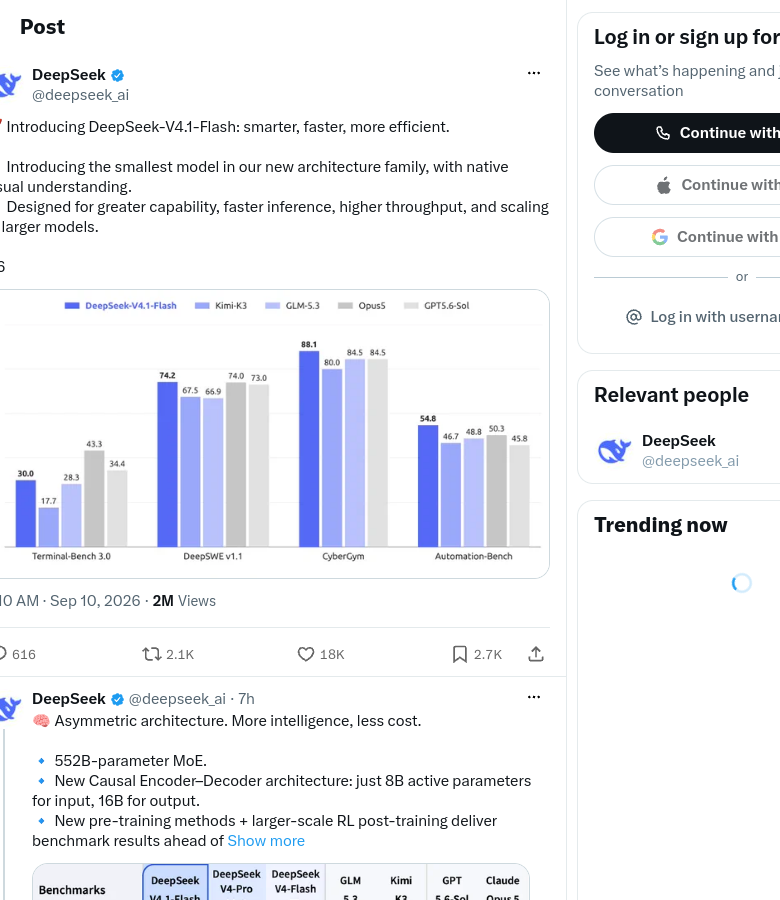
DeepSeek's official launch post includes a comparison chart. It confirms how the company positions V4.1-Flash, but the scores are vendor-reported and were not independently reproduced for this article. View the original post.
The strongest conclusion is narrow: DeepSeek has shipped a model and API update designed around long-context efficiency. The public material reviewed here does not independently establish the chart's scores, production throughput, multimodal accuracy, or end-to-end agent success rates.
How could the architecture lower long-context cost?
An AI agent with a long history pays several different costs. It first processes the input, then retains attention state, then generates a response. Treating those phases as one number hides where the bottleneck lives.
1. Asymmetric prefill and decode
Prefill is the reading phase. If an agent receives 300,000 tokens of code and logs but produces a 2,000-token answer, most tokens belong to the input. MarkTechPost reports that V4.1-Flash activates about 8B parameters per token during prefill and 16B during decode.
The design makes intuitive sense for input-heavy agents: use a lighter path while absorbing context, then spend more active compute while deciding and writing. Whether it wins in practice depends on prompt length, batch size, hardware, quantization, and how often the same context is processed again.
2. Cross-layer KV reuse
The key-value cache, usually shortened to KV cache, stores attention information from prior tokens so the model does not recompute everything for every new output token. Long contexts make that cache large.
Cross-layer reuse means multiple layers can share or reuse parts of that attention state instead of each storing a completely separate copy. MarkTechPost's summary reports a global footprint of 890 bytes per token. That figure is useful as an architecture target, but teams still need to measure actual accelerator memory, host memory, cache movement, and concurrency in their own serving stack.
3. FP4 cache storage
FP4 stores cache values with very low precision. In plain language, each stored number uses fewer bits. This can cut memory and bandwidth, but lower precision may also affect output quality or stability in ways that only a real workload reveals.
Do not evaluate FP4 by asking whether one answer looks correct. Test long conversations, retrieval-heavy prompts, tool use, repeated planning, and the exact failure modes that matter to the product.
4. Engram parameters
Engram is presented as a memory-oriented component. The independent summary describes 196B additional Engram parameters alongside a 552B backbone. The practical idea is to route some recall-like work through a specialized memory mechanism rather than force the active reasoning path to carry everything.
Large total parameter counts still affect storage and deployment. A low active-parameter count does not mean the complete model is small, cheap to download, or easy to self-host.
What changed with the API price?
DeepSeek says its new pricing began at 04:00 UTC on September 10, 2026. The company keeps peak and off-peak periods and says off-peak rates are 50% of peak rates.
That matters for flexible workloads such as nightly document processing, repository indexing, batch evaluation, and non-urgent research agents. It matters less for an interactive product whose requests arrive when users choose.
The discount is only one part of finished-task cost. A useful comparison is:
finished-task cost = input tokens + output tokens + retries + tool calls + cache and hosting overhead
A cheaper token can lose if the model retries more often, calls unnecessary tools, or produces work that needs extensive human repair. A more expensive token can win if it finishes the task in fewer attempts.
Who should test it now?
DeepSeek V4.1-Flash is a reasonable early test for teams with input-heavy, human-reviewed workloads:
- Repository analysis where the agent reads far more code than it writes. 2. Document review across large collections with short structured outputs. 3. Multimodal inspection where images and text share one context. 4. Batch jobs that can move into off-peak pricing windows. 5. Evaluation harnesses that already record retries, latency, memory, and human acceptance.
For those teams, the question is not “Does it support 1M tokens?” The useful question is “At the context length we actually need, how much work does it finish correctly per dollar and per gigabyte?”
Who should wait?
Wait for more evidence if the product depends on any of these conditions:
- Stable, independently measured quality across long agent trajectories.
- A mature self-hosting recipe for the hardware and concurrency you can afford.
- Proven visual accuracy for documents, charts, screenshots, or fine spatial details.
- Strong safety, privacy, or regulatory documentation for sensitive data.
- Predictable availability through the framework and provider you already operate.
The model card and technical report should also be inspected directly before a production decision. The network limitation in this review leaves open details about supported formats, serving flags, licensing terms, and evaluation methodology.
How should developers evaluate it?
Use a fixed set of real tasks and compare V4.1-Flash with the current production model. Record at least six measurements:
- Completed-task rate: Did the agent meet the acceptance criteria without manual repair? 2. Total input and output tokens: Long context support is not useful if prompts grow without improving results. 3. Retries and tool calls: Count loops, invalid actions, and unnecessary searches. 4. Time to accepted result: Include queueing, prefill, decoding, tool latency, and review. 5. Peak memory and concurrency: Measure the actual serving stack, not only a bytes-per-token claim. 6. Finished-task cost: Combine API or hardware cost with retries and reviewer time.
Test several context lengths instead of jumping directly to 1M tokens. Many systems perform best when retrieval selects the right 20,000 tokens rather than dumping 500,000 tokens into the prompt.
What remains unclear?
- Independent quality: The official comparison chart was not reproduced in this review.
- Real memory use: A reported global KV footprint does not include every serving-layer overhead.
- Long-horizon reliability: A 1M window says how much input can fit, not whether the agent will use it well.
- Visual performance: Native vision is official, but difficult document and screenshot tasks still need direct tests.
- Deployment requirements: Total model storage, sharding, bandwidth, and concurrency requirements were not verified from the primary report.
- Price applicability: Off-peak scheduling helps flexible jobs, not necessarily interactive traffic.
Quick Take
- What is actually new?: Evidence-backed answer: A new multimodal architecture with asymmetric input/output compute, long context, cache reuse, and new API pricing.
- What is the clearest practical benefit?: Evidence-backed answer: Input-heavy agents may reduce memory and processing cost, especially for flexible off-peak jobs.
- What is the strongest evidence?: Evidence-backed answer: DeepSeek's dated release and pricing posts, plus an independent technical summary of the report.
- What is not proven?: Evidence-backed answer: Independent score replication, real production memory, visual reliability, and end-to-end agent success.
- What should developers measure?: Evidence-backed answer: Completed-task rate, tokens, retries, latency, peak memory, concurrency, and finished-task cost.
DeepSeek V4.1-Flash is not compelling because “1M” is a large number. It is compelling because the architecture separates reading, remembering, and answering into different cost decisions. That is exactly what long-context agents need developers to measure.
FAQ
Does DeepSeek V4.1-Flash really support 1M tokens?
MarkTechPost's technical summary reports a 1M-token context window and links the official model card and report. Those primary pages timed out on the network used for this review, so confirm the current model card, serving configuration, and provider limits before relying on the full window.
What are prefill and decode?
Prefill is the phase where a model reads and processes the input. Decode is the phase where it generates output one token at a time. V4.1-Flash reportedly activates less compute during prefill than decode, which could suit agents that read much more than they write.
What is KV cache reuse?
The KV cache stores attention information from earlier tokens. Cross-layer reuse lets layers share more of that stored state, which can reduce duplicated memory. Actual savings depend on the implementation, hardware, context length, and number of concurrent requests.
Is DeepSeek V4.1-Flash cheaper than other models?
DeepSeek says off-peak API rates are half its peak rates, but a cross-model cost comparison needs current price tables and task-level measurements. Count retries, tool calls, latency, hosting overhead, and human repair instead of comparing token prices alone.
Should I replace my current agent model with it?
Not without a controlled test. Start with representative, reversible tasks and compare completed-task rate, finished-task cost, latency, and memory against the current model. Keep the existing provider as a fallback until results are stable.
Discover practical AI agents, infrastructure tools, and model platforms at AIToolHunt.