
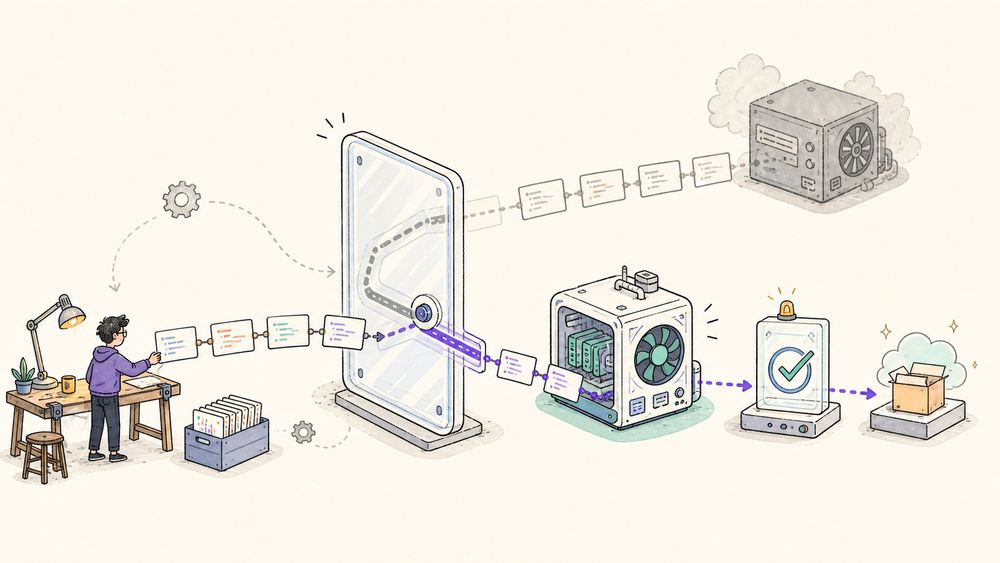
DeepSeek V4 Flash 0731 is more than a quiet model refresh. The July 31 release gives developers a public-beta API, native Responses API support, a Codex-oriented path, and downloadable MIT-licensed weights. That makes it one of the clearest low-cost coding-agent trials of the week—but not an automatic production switch.
The strongest case is access and economics. The weakest case is independent reliability evidence for long, tool-heavy software work.
Quick Navigation
- What is DeepSeek V4 Flash 0731? The release, access routes, and evidence boundary.
- What changed from the preview? API, weights, compatibility, and unchanged surfaces.
- How does it fit a coding-agent stack? Hosted API versus self-hosting.
- Who should test it now, and who should wait? A practical migration rule.
- What remains unclear? Reliability, harness transparency, and pricing changes.
- FAQ: Five direct answers about access, cost, Codex, weights, and production use.
What We Know So Far
DeepSeek's official changelog confirms the new API version and limits the scope: V4 Flash changed, while V4 Pro and the consumer web and app models did not.
The official 0731 model card confirms a separate downloadable checkpoint, MIT licensing, dedicated message encoding code, and vLLM and SGLang recipes. Artificial Analysis independently flagged the open-weight release, but its quick public signal is not a substitute for workload-level reproduction.
This article is based on public documentation and third-party reporting. It does not claim hands-on testing.
What is DeepSeek V4 Flash 0731?
DeepSeek V4 Flash 0731 is the official, re-post-trained release of DeepSeek's smaller V4 agent model, and the practical change is access: developers can call it through the public-beta API or download MIT-licensed weights. DeepSeek's July 31 changelog says the API keeps the deepseek-v4-flash model ID, adds native Responses API support, and is adapted for Codex; the company also says the web app, mobile app, and V4 Pro API were not changed. The official pricing page lists a one-million-token context window, a 384,000-token maximum output, and $0.14 per million cache-miss input tokens plus $0.28 per million output tokens as of August 1, 2026. The model card provides the open-weight checkpoint under an MIT license. Those are confirmed release facts. Claims that 0731 is broadly better at coding agents remain vendor-reported until independent tests reproduce them with comparable tools, reasoning budgets, and task sets.
What changed from the V4 Flash preview?
- V4 Flash preview: July 31 public information: 0731 is the official re-post-trained release; Practical meaning: Existing prompts need regression testing even though architecture and size are unchanged
- Chat Completions and Anthropic-compatible routes: July 31 public information: Native Responses API support for V4 Flash; Practical meaning: Codex-style integrations no longer need the same translation layer
- Preview checkpoint: July 31 public information: Separate
DeepSeek-V4-Flash-0731open-weight repository; Practical meaning: Builders can evaluate hosted and self-hosted routes against the same named release - V4 family rollout: July 31 public information: Only the V4 Flash API changed; Practical meaning: Do not assume the web app, mobile app, or V4 Pro behavior changed
The unchanged API model ID matters. A request using deepseek-v4-flash now reaches the latest hosted version, so teams should treat July 31 as a model change even if their code did not change. Pin evaluation records to the observed version and date.
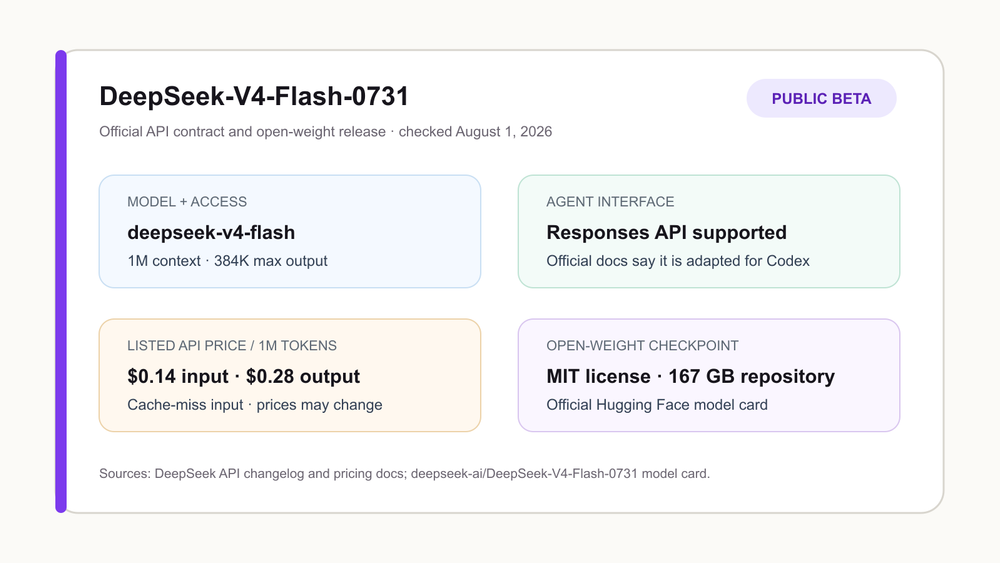
Sources: DeepSeek API changelog, current pricing page, and the official 0731 model card. This card transcribes current source facts; it is not a DeepSeek-designed graphic or a performance result.
The listed API price is unusually aggressive: $0.14 per million cache-miss input tokens and $0.28 per million output tokens. Cached input is listed at $0.0028 per million. DeepSeek also warns that pricing may change and says a future peak/off-peak policy will double all billing items during specified Beijing-time windows, but no effective date is stated on the page.
How does DeepSeek V4 Flash 0731 fit a coding-agent stack?
There are two paths, and they solve different problems.
The hosted API path is the fastest trial. The model ID remains deepseek-v4-flash, the base URL remains DeepSeek's API, and Responses API support reduces integration friction for agent clients that expect OpenAI's newer request shape. Public beta still means you should expect behavior and service terms to move.
The open-weight path offers control, not simplicity. The official repository is roughly 167 GB and includes 48 weight shards. DeepSeek's vLLM example targets a single four-GB300 node, which makes the real point clear: “open weights” does not mean “runs on a laptop.” Self-hosting shifts API spend into hardware, serving, observability, security, and operations.
The release also has format-specific work. The model card says there is no Jinja chat template; instead, DeepSeek provides a dedicated encoding folder for turning OpenAI-compatible messages into model input and parsing output. A team evaluating local serving should validate this layer before measuring model quality.
The developer view
Start with one repository workflow that has hard acceptance checks: a failing test repair, a small refactor, or a tool-calling task with a known end state. Compare 0731 against your current worker model on completion rate, retries, human corrections, token use, wall-clock time, and tool-call errors.
Do not start with your hardest architecture task. The release is most interesting as a cheaper worker for bounded jobs, while a stronger model or human reviewer handles ambiguity and final acceptance.
If you use Codex or another Responses API client, verify multi-turn tool calls, cancellation, structured output, and error recovery. “Adapted for Codex” is an official compatibility claim, not proof that every extension, proxy, or agent loop behaves correctly.
The product enthusiast view
The immediate appeal is simple: a high-context model with a very low listed API price and an open-weight escape hatch. That combination creates more choice than a closed, API-only release.
The caveat is equally simple. DeepSeek's consumer app did not change in this update, and the 0731 checkpoint is far beyond normal consumer hardware. Most people will experience the release through a hosted API or a third-party provider, not by downloading it.
Who should test it now, and who should wait?
Test it now if you already run coding agents, can measure completed-task quality, and want a lower-cost worker for repeatable repository jobs. The hosted API is the sensible first route because it avoids a large serving project.
Evaluate the weights now if data control, custom serving, or provider independence matters enough to justify serious GPU infrastructure. Compare the official checkpoint with the hosted API before assuming they behave identically under your harness.
Wait if your product cannot tolerate public-beta changes, you lack fallback routing, or your acceptance criteria are mostly subjective. Also wait if your plan depends on the announced future pricing policy; its start date is not yet published.
My call: DeepSeek V4 Flash 0731 deserves a bounded coding-agent trial. It has not earned a blind production migration.
What remains unclear?
Independent evidence for 0731 is still thin. DeepSeek publishes strong task-result claims, but its own notes say the minimal harness used for public code-agent tasks has not been released yet and two of the listed task sets are internal. That limits reproducibility.
The release also needs real failure analysis: long tool loops, malformed calls, patch quality, repository-scale context selection, prompt-injection resistance, and recovery after partial execution. None of those can be inferred from a launch table.
Finally, the pricing page announces a future time-based multiplier without an effective date. A cost model built today should include that uncertainty instead of treating current list prices as permanent.
Quick Take
- What is actually new?: Evidence-backed answer: The official 0731 API release, native Responses API support, Codex adaptation, and a named open-weight checkpoint.
- Who can use it now?: Evidence-backed answer: API developers in public beta and teams able to serve the 167 GB checkpoint.
- What is the strongest evidence?: Evidence-backed answer: DeepSeek's changelog, pricing page, and official Hugging Face model card.
- What should developers verify?: Evidence-backed answer: Tool-call reliability, retries, completed-task cost, message encoding, and fallback behavior.
- What is still unknown?: Evidence-backed answer: Independent 0731 reliability, broad harness reproducibility, and the future pricing-policy start date.
The release is compelling because it improves choice—hosted or open-weight—not because one vendor table settles the coding-agent race.
FAQ
Is DeepSeek V4 Flash 0731 available now?
Yes. DeepSeek says the hosted deepseek-v4-flash API is in public beta as of July 31, 2026. The separate DeepSeek-V4-Flash-0731 checkpoint is also available from DeepSeek's official Hugging Face account under an MIT license.
How much does the DeepSeek V4 Flash 0731 API cost?
As of August 1, 2026, DeepSeek lists $0.14 per million cache-miss input tokens, $0.0028 per million cached input tokens, and $0.28 per million output tokens. The page warns prices may change and previews a future peak-hour multiplier without an effective date.
Does DeepSeek V4 Flash 0731 work with Codex?
DeepSeek says the model natively supports the Responses API and is adapted for Codex. That should remove a major protocol mismatch, but developers still need to test multi-turn tools, structured output, cancellation, and error recovery in their specific Codex setup.
Can I run DeepSeek V4 Flash 0731 locally?
The weights are downloadable, but this is not a laptop model. The repository is roughly 167 GB, and DeepSeek's documented vLLM recipe targets a four-GB300 node. Smaller quantizations may emerge, but they are separate artifacts with their own quality and compatibility tradeoffs.
Should I replace my current coding-agent model with it?
Run a bounded comparison first. Use representative repository tasks and measure completion rate, human corrections, retries, tool-call errors, latency, and total cost. Keep a fallback model until 0731 proves reliable on your workload rather than relying on vendor claims.
Discover practical AI products and emerging tools at AIToolHunt.