
Official artwork from DeepSeek's V4 Flash Vision release.
DeepSeek V4 Flash Vision gives developers a new experimental way to send screenshots, charts, and other images into DeepSeek's API. The feature set is practical: familiar request formats, reusable uploaded files, and image tokens billed at the Flash model's input rates. The harder question is whether those conveniences are enough to trust the model in a real product.
Quick Navigation
- What is DeepSeek V4 Flash Vision? The release, API surface, and current evidence boundary.
- What changed? How image inputs and Files API reuse alter a developer workflow.
- How does it work? Formats, request paths, and image-token billing.
- Who should test it now? A bounded evaluation plan for developers and AI enthusiasts.
- What remains unproven? Benchmark limits, reliability, safety, and production readiness.
- FAQ: Five direct answers about access, inputs, pricing, comparisons, and timing.
What is DeepSeek V4 Flash Vision?
DeepSeek V4 Flash Vision is an experimental multimodal API model that adds image understanding to DeepSeek's Flash line while keeping a developer-facing text-and-tool workflow. As of August 21, 2026, the official release says developers can call deepseek-v4-flash-vision-exp through Chat Completions, Messages, or Responses APIs. The Vision guide documents JPEG, PNG, GIF, and WebP input for describing pictures, reading text from screenshots, and analyzing charts. Images can arrive as base64, external URLs, or reusable Files API references. IT Home independently confirms that the experimental endpoint is live, but its report repeats DeepSeek's performance claims rather than reproducing them. DeepSeek's own chart places the model near Opus-4.8 on selected multimodal-agent tests; that is vendor-reported evidence, not a neutral ranking. The practical reason to test now is bounded visual-agent prototyping through documented request formats. The reason to wait is equally clear: independent quality, reliability, and safety evidence is still missing.
What changed for visual AI workflows?
The main change is not a new chat interface. It is a developer API that can combine images with text and tools. DeepSeek documents three request families—Chat Completions, Messages, and Responses—and three ways to provide an image: encode it directly, point to a URL, or upload it through the Files API.
The reusable file path is the most operationally useful addition. A developer can upload an image once, receive a file_id, and refer to that ID in later requests. That can simplify workflows that repeatedly inspect the same screenshot, chart, product image, or document page. It also creates a clear evaluation target: compare the reusable-file path with direct image input for latency, failure handling, and total input-token cost.
The official Vision guide says the endpoint can describe images, read text from screenshots, and analyze charts. Those are documented capabilities, not proof that it will read every dense interface correctly or reason reliably about every graph. A production test still needs representative images and answer-level checks.
How does DeepSeek V4 Flash Vision work?
The API combines a text prompt with one or more supported image inputs. DeepSeek says it accepts JPEG, PNG, GIF, and WebP, and detects the actual file format from the content. The service resizes and tokenizes images before inference, so image size and detail affect the number of input tokens.
Image tokens use the V4 Flash input rates listed on DeepSeek's pricing page. Those rates vary by cache status and peak period, and DeepSeek says pricing can change. That gives teams a documented cost model for a prototype, but a headline token price is not a finished-task cost. Developers should record how many retries, enlarged images, tool calls, and verification passes a useful answer requires.
For a first test, keep the workflow narrow:
- Choose 20 to 50 real screenshots or charts from one product task. 2. Define the facts that a correct answer must extract before calling the model. 3. Run the same set through direct image input and Files API reuse. 4. Record input tokens, latency, format errors, missed details, and false claims. 5. Require a human or deterministic check before any action based on the output.
This evaluates the product you would actually ship, not just whether a polished example can produce one convincing response.
What does the official benchmark actually show?
DeepSeek published a comparison table covering text evaluations and multimodal-agent tasks. The image below is the original official graphic, not an AI recreation.
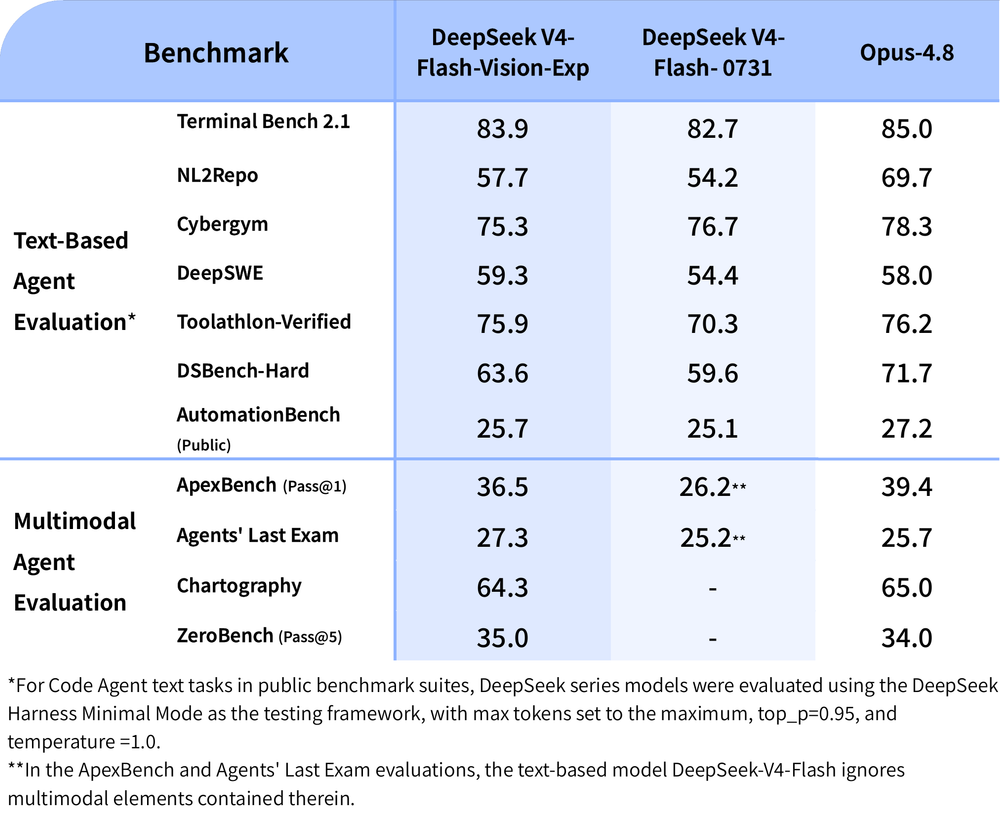
Source: DeepSeek's official release. The table reports DeepSeek's selected results for its stated model and evaluation setup. It has not been independently reproduced and should not be read as a universal leaderboard.
The chart supports a limited statement: in DeepSeek's reported comparison, Vision Exp lands near Opus-4.8 on selected multimodal-agent tests. It does not prove equal performance across visual question answering, OCR, coding from screenshots, browser use, safety, latency, or your own application. The release page is the primary source for the model result, while the independent report confirms the launch but does not rerun the evaluation.
That distinction matters because agent benchmarks depend on more than model weights. Tool definitions, prompts, retry policies, environment setup, scoring rules, and task selection can all move the result. Until an independent team publishes reproducible runs, the chart is a reason to test—not a reason to migrate.
Who should try it now, and who should wait?
The developer view
Try it now if you already use an API-based vision model and can run a bounded comparison. Screenshot support agents, chart-extraction tools, visual QA pipelines, and browser-agent prototypes have obvious test cases. The request formats and Files API give these teams a manageable integration surface.
Do not switch a production workload based on the release chart alone. Keep your current provider as a baseline, test representative failures, and measure finished-task cost. If images contain sensitive customer or company data, complete your own privacy, retention, access-control, and compliance review before uploading them. The public release evidence does not answer those deployment questions for your organization.
The AI product enthusiast view
This release is interesting if you like testing visual assistants through developer tools or small apps. It gives developers a documented API path for prototyping screenshot explanation, chart questions, and image-plus-text experiments. But DeepSeek announced an API model, not a fully evaluated consumer experience. Ordinary users who want dependable visual help without building an integration should wait for applications to expose it and for independent comparisons to appear.
A practical decision rule
- Test now: you have a specific visual workflow, a labeled evaluation set, and a safe fallback.
- Wait: you need proven OCR accuracy, regulated-data assurances, predictable production reliability, or independently reproduced benchmark results.
- Skip for now: your task is text-only, or your current model already meets the cost and quality target.
What the public docs say—and what is still missing?
The public evidence confirms that the experimental endpoint is live, identifies its model ID, documents supported image types and request paths, explains reusable Files API input, and ties image-token billing to V4 Flash rates. DeepSeek also publishes its own comparison chart. IT Home independently confirms the launch and the broad product description.
The evidence does not establish:
- independently reproduced accuracy or agent success rates;
- stable latency, uptime, or error behavior under production load;
- performance on your screenshots, charts, languages, or image quality;
- a neutral comparison with Opus-4.8 or other vision models;
- organization-specific privacy, retention, security, or compliance suitability;
- long-term compatibility for an endpoint explicitly labeled experimental.
There is also no verified community case in this evidence package strong enough to represent typical results. That absence is useful information. For now, the responsible story is an API launch with a promising test surface—not a settled performance winner.
Quick Take
- What is new?: Evidence-backed answer: An experimental DeepSeek Flash API model that accepts text and images
- What can developers send?: Evidence-backed answer: JPEG, PNG, GIF, or WebP through base64, URL, or reusable Files API references
- What is the strongest practical feature?: Evidence-backed answer: Upload-once file reuse for repeated visual requests
- What does the benchmark prove?: Evidence-backed answer: Only DeepSeek's reported result on its selected evaluations, not independent superiority
- Who should test first?: Evidence-backed answer: Teams with a narrow visual workflow, labeled examples, and a fallback model
Bottom line: DeepSeek V4 Flash Vision is worth a controlled developer test because its API surface is practical and testable. It is not ready for an evidence-free production migration.
FAQ
Is DeepSeek V4 Flash Vision available now?
Yes. DeepSeek says deepseek-v4-flash-vision-exp became available on its API platform on August 21, 2026. It is explicitly labeled experimental, so availability should not be confused with a production-stability guarantee.
What image formats and input methods does it support?
The official guide lists JPEG, PNG, GIF, and WebP. Images can be encoded in the request, provided through an external URL, or uploaded to the Files API and reused by file_id.
How is DeepSeek V4 Flash Vision priced?
DeepSeek converts images into input tokens and bills them at its listed V4 Flash input rates. The rate varies by cache status and peak period. Measure total task cost because retries, image detail, and verification can matter more than the base rate.
Is it really as capable as Opus-4.8?
That has not been independently established. DeepSeek's official chart reports nearby results on selected multimodal-agent evaluations, but the public independent source did not reproduce the benchmark. Treat the comparison as a test hypothesis.
Should I replace my current vision model with it?
Not without a workload-specific evaluation. Compare both models on the same labeled images, track errors and total cost, and keep a fallback. Teams that require mature reliability or compliance evidence should wait.
Discover more practical AI developer tools at AIToolHunt.