Newsletter
Join the Community
Subscribe to our newsletter for the latest news and updates
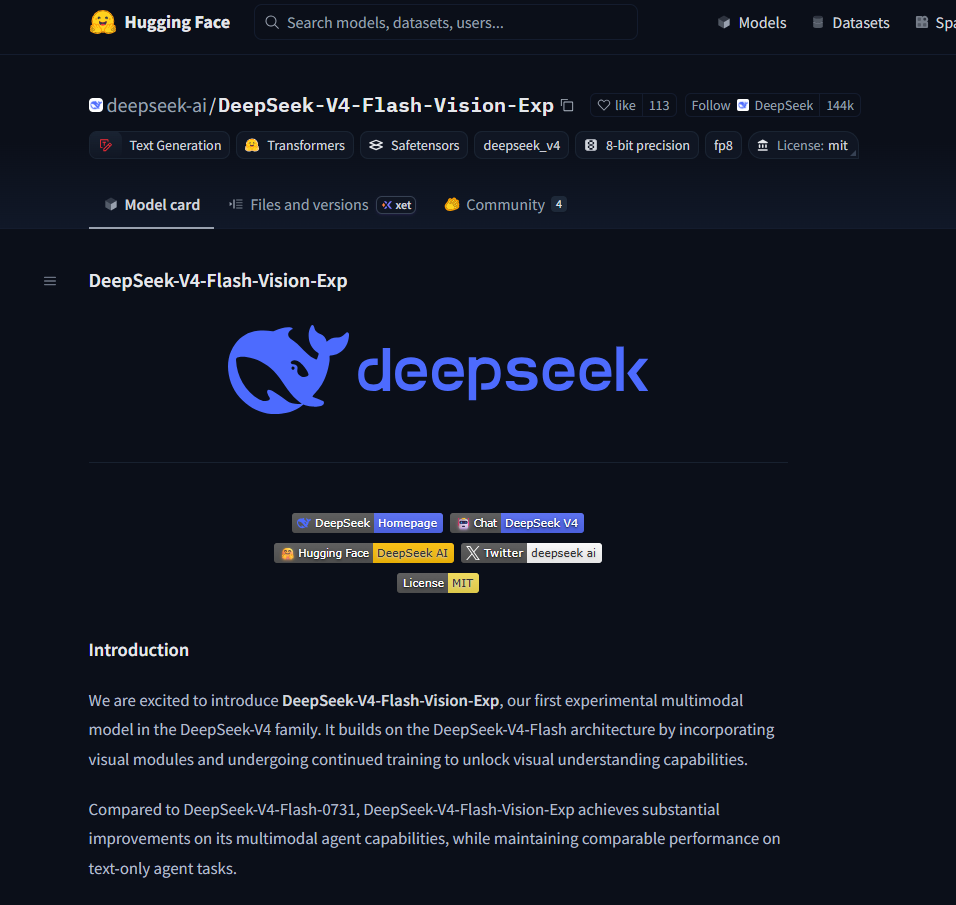
Source: DeepSeek's official Hugging Face model card, captured in IT Home's August 31 report. This is the public model page, not a simulated interface.
DeepSeek V4 Flash Vision open weights change the decision from “Should I call the API?” to “Can my team operate this model?” The August 31 release includes an MIT-licensed checkpoint, prompt encoding, and readable inference code. It does not include a turnkey production server, and one major serving project says its support is still being built.
DeepSeek V4 Flash Vision open weights are the public checkpoint and reference code for DeepSeek-V4-Flash-Vision-Exp, the experimental image-and-text model that first appeared through DeepSeek's hosted API on August 21. On August 31, the official Hugging Face repository exposed 48 Safetensor shards, an MIT license, message encoding, and a minimal PyTorch inference path. That makes inspection, modification, and self-managed deployment possible; it does not make production serving automatic. DeepSeek's own inference guide calls the runtime a readable reference rather than a production engine, while SGLang says its support and updated cookbook are still in progress. The repository also includes prompt tests and paired text/JSON examples, which help teams verify encoding before they spend on serving infrastructure. The practical conclusion is narrow: capable inference teams can begin evaluating the real package now, but application developers who need stable serving should wait for framework support and measured deployment guidance.
The release is real and technically useful, but “open weights” is not the same as “easy local model.”
The August 21 release gave developers a hosted model name. The August 31 repository gives infrastructure teams the actual package they can inspect and operate.
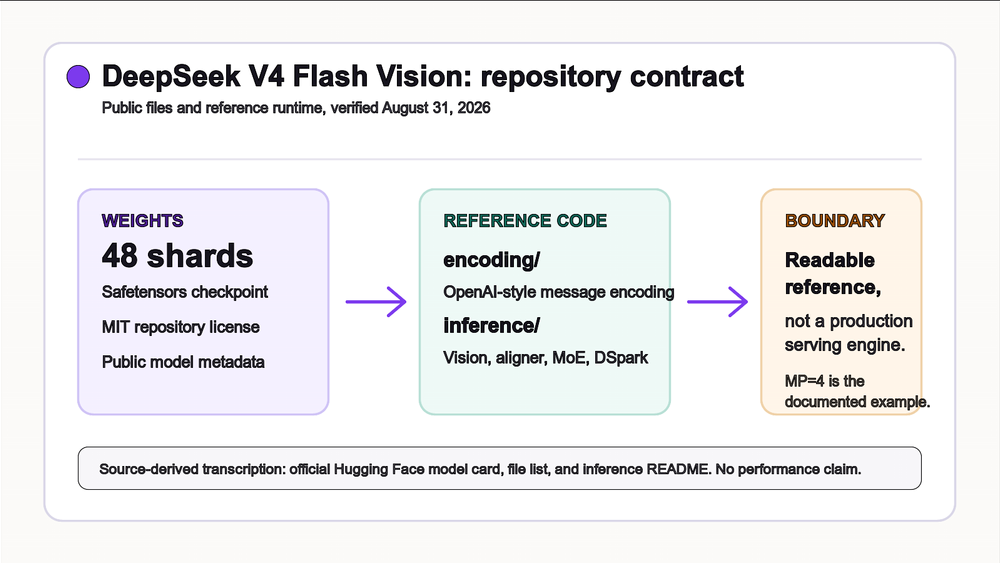
Source: official model card and file list plus the official inference README. The card is a direct transcription of those public fields and makes no performance claim.
The important shift is control. A hosted API lets you send requests; a checkpoint lets you choose where weights live, how requests are queued, and which serving stack owns latency, batching, and access controls. That freedom also transfers the operational burden to you.
The repository separates prompt formatting from execution. The encoding/ directory converts OpenAI-style messages into the model's expected text-and-image sequence. It supports multi-turn conversations, tool calls, thinking modes, and interleaved image content without importing the inference code.
The inference/ directory is the readable execution path. DeepSeek says it covers the vision encoder and aligner, DFlash attention, mixture-of-experts routing, Hyper-Connections, and the DSpark forward path. A conversion script turns the Hugging Face checkpoint into one file per tensor-parallel rank; the documented example sets model parallelism to four.
That example is not a hardware recommendation. The guide does not name a minimum GPU, memory target, production batch size, or expected throughput. Treat MP=4 as a reproducible reference for the code path, not evidence that four ordinary GPUs will meet your workload.
The new encoding reference may be the most immediately useful part for application developers. It shows exactly how image blocks, text, tool calls, and reasoning settings become model input. That makes it easier to compare hosted behavior with a self-managed runtime and catch prompt-format mismatches before blaming the model.
The hard part is serving. If your stack depends on SGLang, its August 31 status says support and a cookbook are still coming. Do not assume an existing DeepSeek text deployment can accept the vision checkpoint without new image preprocessing, conversion, scheduling, and observability work.
For a normal user, the open-weight release does not suddenly create a laptop app. The hosted API remains the simpler way to try image understanding. The new package matters because researchers, tool makers, and infrastructure teams can now inspect the real implementation rather than infer behavior from a remote endpoint.
That can lead to private deployments, custom serving, and faster ecosystem support. It can also produce a week of incompatible launch-day recipes. “Downloadable” is a meaningful milestone; “boring to operate” is a different milestone that has not arrived yet.
Try it now if your team already runs large checkpoints, can reserve a multi-rank environment, and wants to evaluate multimodal agent workflows under its own data and access controls. Start with the provided two-image examples, verify prompt encoding, record peak memory and latency, and keep the test isolated from production.
Wait for framework support if you mainly build applications and need a stable server, documented capacity planning, or a one-command deployment. The reference runtime is valuable for inspection, but it deliberately does not solve batching, admission control, recovery, autoscaling, or production monitoring.
Use one decision rule: self-host only when control over weights, data path, or serving behavior is worth owning the operational work. If your goal is simply to test the model's image input, the hosted API is still the lower-friction route.
Bottom line: The release makes DeepSeek V4 Flash Vision inspectable and self-manageable, not turnkey. Infrastructure teams have enough to start a bounded evaluation; everyone else should watch the serving frameworks, not the download button.
What are the DeepSeek V4 Flash Vision open weights?
They are the public checkpoint and reference implementation for DeepSeek-V4-Flash-Vision-Exp. The repository includes 48 Safetensor shards, tokenizer files, prompt encoding, image-processing code, tests, and a minimal inference path under an MIT license.
Is DeepSeek V4 Flash Vision fully open source?
The published repository is MIT-licensed and includes weights plus meaningful reference code. “Open source” can carry different definitions for training data and the complete training process, which the repository does not provide. “Open weights with MIT-licensed code” is the precise description.
Can DeepSeek V4 Flash Vision run locally?
It can be self-managed on infrastructure capable of running the checkpoint, but the official guide does not promise consumer-hardware operation. Its documented conversion example uses four-way model parallelism, and no minimum GPU memory or production capacity target is published.
Does SGLang support the open-weight model?
Not as a finished launch-day recipe on August 31. The SGLang project publicly said it was working on support and an updated cookbook. Teams depending on SGLang should verify the current implementation before planning a production migration.
Who should wait before self-hosting it?
Wait if you need a supported one-command server, published capacity planning, predictable throughput, or minimal operations work. The hosted API remains the simpler evaluation path while inference teams test conversion, image preprocessing, batching, monitoring, and recovery.
Discover practical AI products and emerging developer tools at AIToolHunt.