
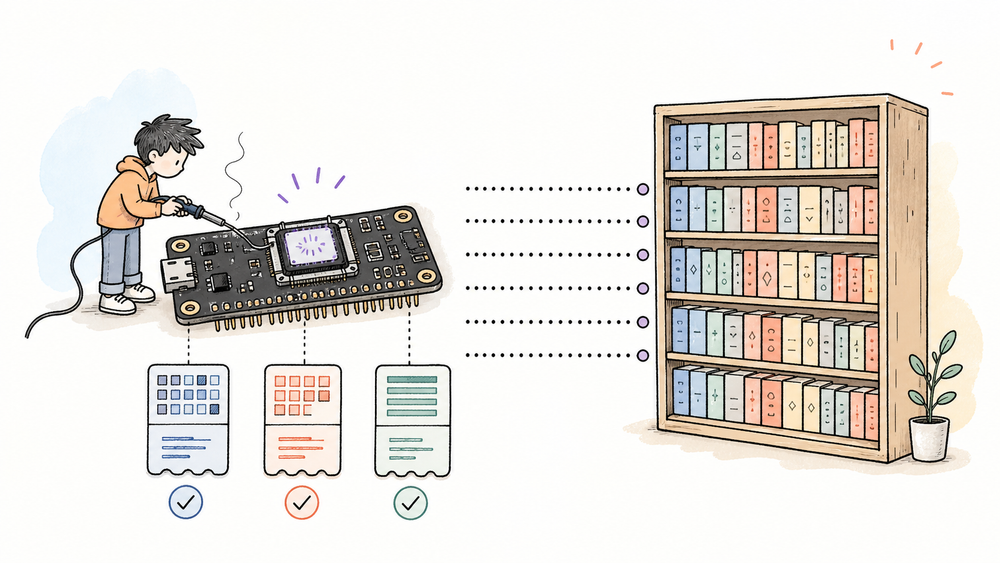
ESP32-AI is the kind of demo that sounds fake until you read the memory map. A 28.9M-parameter model is running on an ESP32-S3 microcontroller, but the useful question is narrower: does this change what builders should expect from local AI hardware?
Quick Navigation
- What is ESP32-AI? A local LLM demo on an ESP32-S3, not a general chatbot.
- What changed with ESP32-AI? The model uses flash as a sparse lookup tier.
- Can an $8 microcontroller really run a local LLM? Yes, within a tiny story-writing domain.
- Why should developers care? The trick is memory placement, not magic capability.
- What remains unclear? Reproducibility, power, promptability, and useful workloads.
- FAQ: Five practical questions before cloning the repo.
What We Know So Far
The public package is strong enough for an evidence-backed explainer, but not strong enough for a hands-on verdict. The evidence includes the GitHub README, RESULTS.md, repo demo media, an independent SingularityByte explainer. No independent physical-hardware reproduction is included here.
What is ESP32-AI?
ESP32-AI is an open-source experiment from developer slvDev that runs a 28.9M-parameter TinyStories language model on an ESP32-S3 microcontroller, with the project README saying the chip costs about $8, uses no server connection, and writes text at roughly 9 tokens per second (GitHub README). SingularityByte independently frames the result as author-reported engineering evidence. The useful part is not that the model is a mini ChatGPT; it is not. The repo says it writes short stories, does not answer questions, follow instructions, write code, or know facts. The technical change is a memory split: a small dense core stays near fast memory, while a 25M-parameter lookup table lives in flash and is sampled per token. That makes ESP32-AI a proof of memory-tier engineering for local AI hardware, not a consumer assistant you should deploy today.
What changed with ESP32-AI?
- Prior ESP32 language-model demos stayed near a few hundred thousand parameters.: New public information: ESP32-AI reports 28.9M stored parameters on ESP32-S3 N16R8, with a 14.9MB 4-bit model file (RESULTS.md).; Why it matters: The constraint moved from "can it fit at all?" to "what useful behavior can fit?"
- Tiny models usually keep almost everything in fast memory.: New public information: ESP32-AI keeps a small dense core near fast memory and puts the 25M-parameter table in flash (GitHub README).; Why it matters: It shows a real memory-tier pattern for small-device AI.
- Community claims around edge AI often blur demos and products.: New public information: An independent explainer frames the figures as author-reported and keeps the model limitation front and center (SingularityByte).; Why it matters: Readers get a better decision rule: admire the technique, do not ship it as a chatbot.
The public evidence is strongest on the storage and runtime shape. The repo was created on July 23, 2026, updated again on July 26, and includes the README, firmware, training code, RESULTS.md, and a demo GIF. The weak point is independent reproduction: public coverage explains and discusses the project, but does not include a second lab rerun.
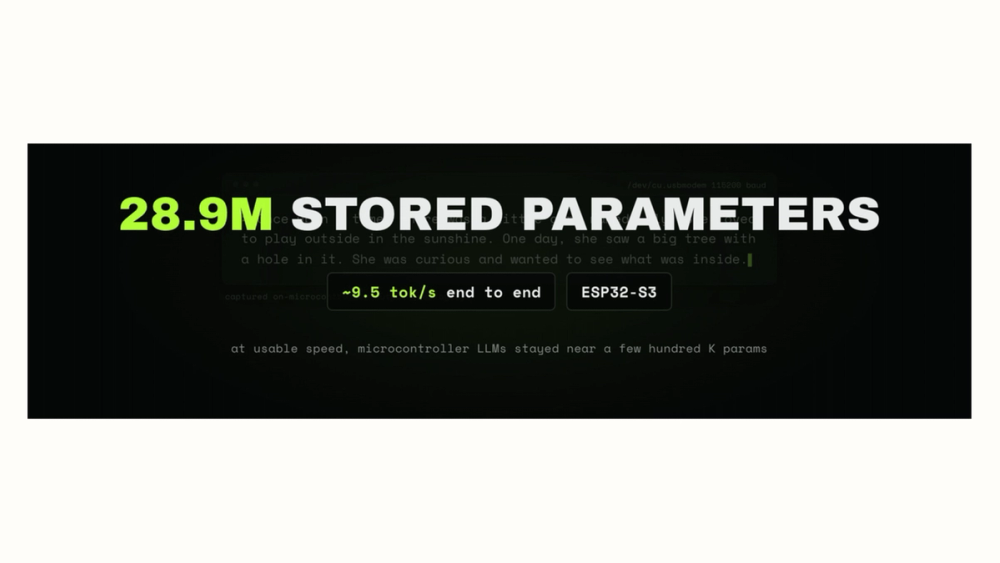
Source: slvDev's GitHub demo GIF. This frame is primary project media for the demo output and overlayed figures; the throughput still remains author-reported until reproduced elsewhere.

Can an $8 microcontroller really run a local LLM?
Yes, if "run a local LLM" means a tiny, domain-specific model writing short stories on-device. No, if it means a pocket ChatGPT replacement. That distinction matters because the same sentence can either teach you something useful or massively overpromise the device.
The model is trained on TinyStories, a dataset designed to test how small models can still produce coherent English stories (arXiv). That makes the demo clean: it tests whether a language model can generate simple text locally, not whether it can answer factual questions or operate tools.
The reported runtime is about 9.5 tokens per second end to end on ESP32-S3. The project also records a 9.72 tok/s compute-only figure and says the output head, not the flash table, is the biggest runtime cost (RESULTS.md).
My read: this is a serious hardware-memory demo, not a product announcement. If someone tries to sell it as "frontier AI on a microcontroller," walk away.
How does ESP32-AI work?
The trick is not squeezing the whole model into SRAM. That would fail. The ESP32-S3 has 512KB SRAM, 8MB PSRAM, and 16MB flash in the N16R8 board used by the project. ESP32-AI splits work across those tiers.
The dense core stays small enough for fast memory. The large parameter count mostly comes from a lookup table. The table lives in flash, and each token only needs a small set of rows. In the README's plain-language version, most parameters sit there quietly instead of being loaded every step.
That is why the model can claim 28.9M stored parameters without implying 28.9M active compute parameters. It is more like keeping a huge dictionary nearby and reading a few cards per token.
The developer view
The useful idea for developers is not "use this exact model." It is "separate hot weights from cold lookup capacity." If you build embedded AI, sensors, wearables, or cheap local agents, the question becomes: which part of your model needs fast memory every step, and which part can tolerate slower storage?
The repo includes firmware and export steps, but this is still a source-reading project. Pin the board variant, partition layout, Arduino ESP32 core, and model binary. Treat the numbers as a baseline to reproduce before adapting anything.
The product enthusiast view
For normal AI users, the takeaway is simpler. Local AI is not only about putting a smaller cloud chatbot on your laptop. Sometimes it is about making a tiny device smart enough for one narrow behavior without sending data to a server.
ESP32-AI is not ready to answer your questions. It does make the lower end of local AI hardware more interesting.
Why should builders care?
- Memory is the product constraint - The demo's value is a concrete split between SRAM, PSRAM, and flash.
- "On-device" needs a narrower definition - This is offline generation, but only in a toy story domain.
- The next useful step is workload design - The interesting follow-up is not a larger headline parameter count; it is whether a constrained model can handle a practical device task.
What remains unclear?
The biggest open question is reproducibility. The GitHub repo is detailed, but no second independent reproduction of the 9.5 tok/s result is cited here. That does not make the claim false; it makes it author-reported.
Power draw also needs care. Some community posts talk about LED-like power, but the project evidence does not provide a full power profile, so this article does not claim one.
Prompting is another gap. A TinyStories model can produce coherent story text. That is not the same as an instruction-following assistant, a coding helper, or a device-control planner.
Quick Take
- What is actually new?: Evidence-backed answer: ESP32-AI reports a 28.9M-parameter TinyStories model running locally on ESP32-S3.
- Who can use it now?: Evidence-backed answer: Developers and hardware hobbyists who are comfortable with source-level firmware projects.
- What is the strongest evidence?: Evidence-backed answer: The GitHub README,
RESULTS.md, and repo demo GIF. - What should developers verify?: Evidence-backed answer: Board variant, flash partition, model binary size, and end-to-end token speed on their own hardware.
- What is still unknown?: Evidence-backed answer: Independent reproduction, power profile, and whether a useful non-story task fits the same pattern.
I would test ESP32-AI if you care about embedded model placement. I would wait if you want an assistant, API product, or dependable edge-AI module.
FAQ
What is ESP32-AI? ESP32-AI is an open-source project that runs a 28.9M-parameter TinyStories language model on an ESP32-S3 microcontroller. It is best understood as a memory-tier engineering demo, not a general-purpose chatbot.
Is ESP32-AI available now? Yes. The repository is public on GitHub, including firmware, training code, results notes, and a demo GIF. Availability is source-level: you need compatible ESP32-S3 hardware and comfort with flashing firmware.
How is ESP32-AI different from TinyML classifiers? TinyML classifiers usually detect a keyword, sound, gesture, or anomaly. ESP32-AI generates short text. The capability is still narrow, but the memory layout shows a different path for fitting language-model capacity onto very small hardware.
What should developers know before using ESP32-AI? Reproduce the exact demo first. Check board memory, flash layout, model binary size, serial output, and token speed. Do not assume the technique transfers unchanged to instruction-following, factual answering, or device-control tasks.
What is still unverified about ESP32-AI? The headline measurements are author-reported from the project sources. Independent explanation and community discussion are available, but not a separate reproduction of the full 28.9M model and 9.5 tok/s result.
Discover practical AI products and emerging tools at AIToolHunt.