Newsletter
Join the Community
Subscribe to our newsletter for the latest news and updates
FLUX 3 video is the first Black Forest Labs launch that makes me look past image generation. The headline is not just "better video." It is a multimodal model family that claims native audio, longer video generations, and a robotics-adjacent action model called FLUX-mimic.
That sounds big. The useful question is narrower: who should test it now, and who should wait until the access story is less early?
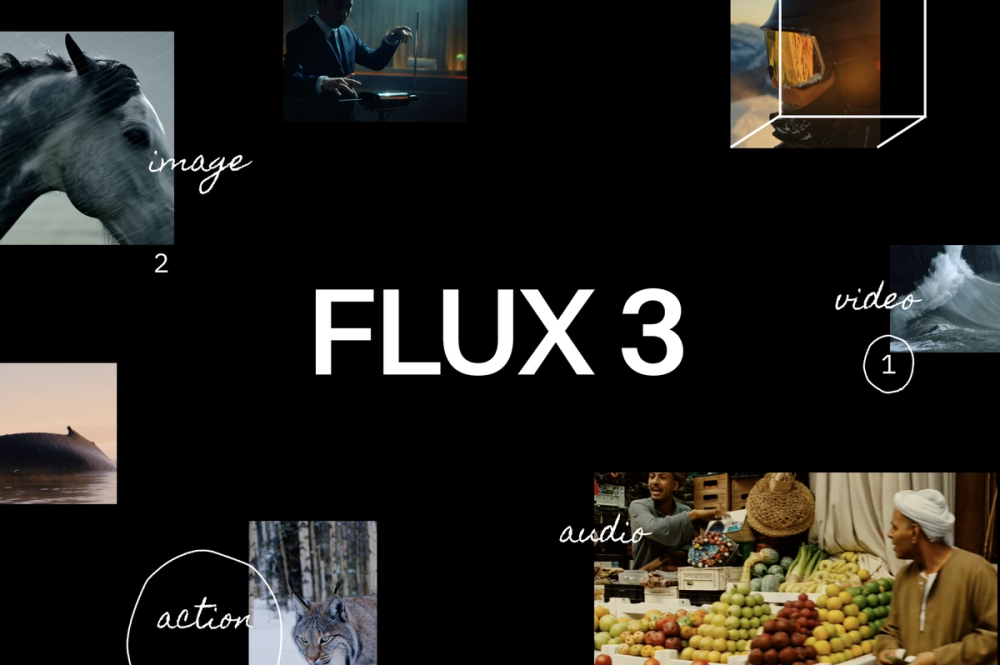
FLUX 3 video is Black Forest Labs' new multimodal model line for generating and understanding images, video, and audio, with an action-prediction branch called FLUX-mimic. According to BFL's launch note, FLUX 3 Video can generate up to 20 seconds of video with native audio in one run, while FLUX 3 Image is planned for early access "within the next few weeks." The company says it trained the family with a Self-Flow approach so one model can learn from images, video, audio, and actions instead of treating each modality as a separate product. The Decoder independently summarized the rollout as a staged launch, with open-weight FLUX 3 Dev access planned rather than available today. My read: creators can watch the video model now, but developers should treat the robotics story as partner-limited evidence, not a general robot API.
The proof has to come from the official pages and independent coverage. BFL's own page confirms the model-family framing, the native-audio video claim, and the preliminary preference chart. The FLUX-mimic page adds the action-prediction branch and the industrial manipulation trial context. The Decoder gives an outside check on the staged-access and open-weight timing.
BFL's strongest public media claim is a preliminary human preference evaluation for an early FLUX 3 candidate. The chart says FLUX 3 was preferred over several named video models, but the label matters: this is preliminary, vendor-run, and not a replacement for an independent benchmark suite.
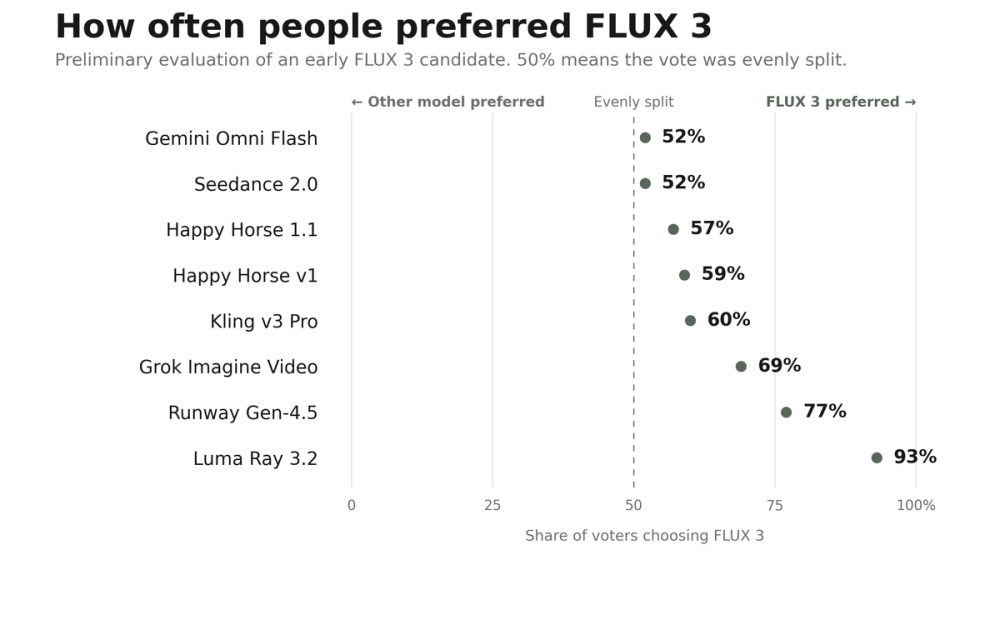
Source: BFL's FLUX 3 launch note. Boundary: BFL calls this a preliminary evaluation of an early candidate; 50% means split preference, not independent benchmark replication.
The second public claim is more unusual. FLUX-mimic is not pitched as a consumer video feature. It is described as an action-prediction model that uses video modeling to forecast what happens after a robot action, including a reported industrial context with mimic and Audi.
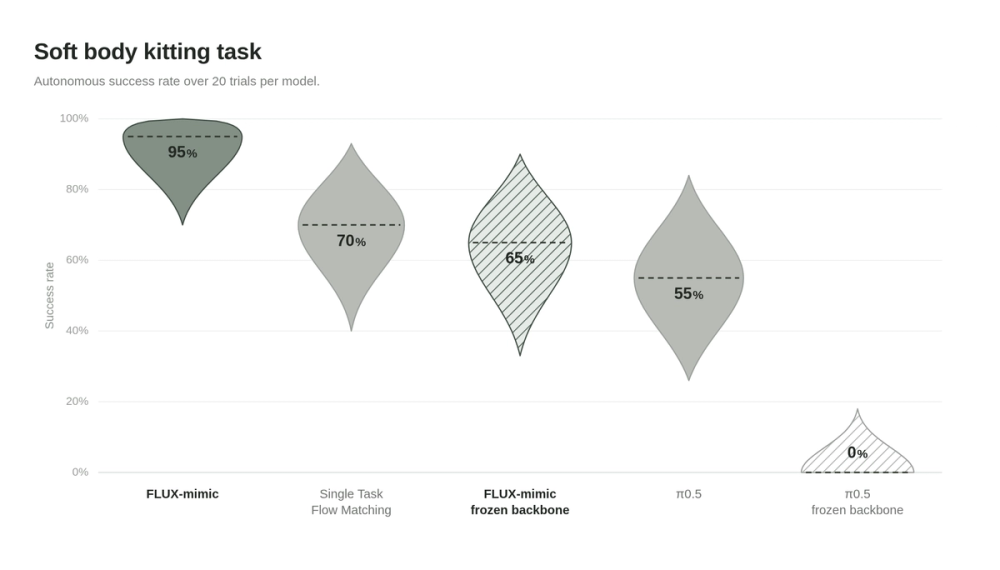
Source: BFL's FLUX-mimic technical note. Boundary: the chart reports 20 autonomous trials per model on one soft-body kitting task; it should not be read as a general robotics score.
FLUX-mimic is easiest to understand as future-frame prediction with actions attached. A normal video model predicts what frames should come next from text, image, or video context. An action-conditioned version also sees a proposed action and predicts the visual result.
That matters because robot control is full of tiny physical uncertainties: cloth bends, tools slip, lighting changes, and parts move in ways that are hard to encode as neat symbolic rules. A model that can predict "what the scene should look like after this action" can become a planning component, a simulator helper, or a training signal.
The public caveat is large. The BFL/mimic note shows specific tasks and reported trial counts, not a downloadable robotics toolkit. If you build in robotics, the interesting part is the research direction. The thing to wait for is reproducible code, task definitions, hardware setup, and safety boundaries.
For developers, FLUX 3 is a watchlist item, not a migration task. The public launch does not give you a stable SDK, public pricing, open-weight license text, or a robotics API you can wire into production this week.
The practical move is to track three things: when FLUX 3 Video access opens, what the FLUX 3 Dev open-weight terms allow, and whether FLUX-mimic publishes enough setup detail for outside replication. Until then, treat the official charts as vendor-reported evidence that deserves a test plan, not a procurement decision.
For a normal AI product enthusiast, the video story is more immediate. Native audio in the same generation pass could matter for short ads, product shots, explainers, and social clips if quality holds up in real prompts.
But this is still a public-evidence article, not a hands-on review. I would not cancel a Runway, Kling, or Luma workflow on the strength of one launch post. I would save the examples, watch early access reports, and compare whether audio sync, prompt control, and editability survive outside curated demos.
The biggest gap is access. BFL says parts of FLUX 3 are staged, and The Decoder reports open-weight FLUX 3 Dev as planned rather than available now. That means most builders cannot yet run clean side-by-side tests.
The second gap is benchmark scope. The official preference chart is useful because it shows the original vendor claim, but it does not replace independent blind evaluation across prompts, motion types, audio quality, editability, latency, and cost.
The third gap is robotics transfer. FLUX-mimic may be important research, but a limited industrial trial does not prove broad autonomy. If you work with physical systems, ask for task definitions, failure cases, control-loop integration, hardware assumptions, and safety review before treating the model as anything more than a promising technical signal.
The short version: FLUX 3 deserves a serious watchlist slot, but the right move today is evidence collection, not stack replacement.
What is FLUX 3 video?
FLUX 3 video is BFL's video branch in the new FLUX 3 multimodal family. BFL says it can generate up to 20 seconds of video with native audio, but public access and independent testing are still early.
Is FLUX 3 available now?
Not broadly in the way developers usually mean. As of July 24, 2026, public sources describe staged access. BFL's launch note points to upcoming early access for FLUX 3 Image, while The Decoder describes open-weight FLUX 3 Dev access as planned.
How is FLUX-mimic different from normal text-to-video?
FLUX-mimic is action-conditioned. Instead of only generating video from a prompt or image, it models what a scene may look like after a robot action. That makes it relevant to planning and robotics research, not just creative video generation.
What should developers know before using FLUX 3 video?
Developers should wait for concrete access terms: API availability, pricing, model limits, open-weight license, latency, and benchmark setup. If your use case needs auditability or production reliability, do not rely on vendor charts alone.
What is still unverified about FLUX 3 video?
Independent reviewers still need to test real prompts, audio sync, editing control, failure cases, latency, and cost. FLUX-mimic also needs outside replication before anyone should treat its industrial trial results as a general robotics capability.
Discover more practical AI products and emerging tools at AIToolHunt.