Newsletter
Join the Community
Subscribe to our newsletter for the latest news and updates
Gemini 3.6 Flash is the new Google model I would test first if you already run agentic or multimodal workloads on Gemini. The catch: this is not one launch with one obvious winner.
Google released Gemini 3.6 Flash, Gemini 3.5 Flash-Lite, and Gemini 3.5 Flash Cyber on July 21, 2026. The useful question is not "did Google ship three more names?" It is which model should you route to which job, and what should you wait to verify?
Gemini 3.6 Flash is Google's new stable Gemini API workhorse for agentic and multimodal tasks, released on July 21, 2026 alongside Gemini 3.5 Flash-Lite and Gemini 3.5 Flash Cyber. Google's announcement frames it as a faster, more efficient successor to Gemini 3.5 Flash, while the Gemini API latest-model guide says gemini-3.6-flash and gemini-3.5-flash-lite are GA and ready for production use. The practical point is model routing, not hype: use 3.6 Flash when a workflow needs stronger coding, UI control, long-context reasoning, or multimodal analysis; use 3.5 Flash-Lite when throughput and token cost matter more; treat Flash Cyber as a restricted security model for CodeMender pilots, not a general API default. The public evidence confirms launch, availability, pricing, and Google-reported benchmark gains; it does not prove that every agent will become cheaper without prompt, tool, and retry changes.
The headline is simple: Google is moving Flash from "cheap enough for scale" toward "good enough for agent work." The official latest-model guide lists 3.6 Flash at $1.50 per 1M input tokens and $7.50 per 1M output tokens. The same guide lists 3.5 Flash-Lite at $0.30 input and $2.50 output.
Google's announcement also says 3.6 Flash uses fewer tokens than 3.5 Flash in comparable agentic workflows. That is a useful claim, but it is still vendor-reported. If your agent spends money through tool calls, retries, search grounding, or long reasoning loops, you need to measure the whole run, not only the base token rate.
The independent framing is consistent. Axios described the launch as a cheaper-model push rather than a flagship-model flex, while Ars Technica highlighted the missing Gemini 3.5 Pro backdrop. That is the right lens: this is an efficiency and routing release, not proof that Google has won the top benchmark fight.
The public evidence supports five narrow claims. First, Google released 3.6 Flash and 3.5 Flash-Lite as GA API models on July 21, 2026. Second, Google published listed prices for both models, with Flash-Lite as the lower-cost lane. Third, Google reports benchmark gains for 3.6 Flash and Flash-Lite against earlier Gemini models. Fourth, 3.5 Flash Cyber is a limited CodeMender/security pilot, not a general self-serve model. Fifth, the docs contain an important implementation detail: the Gemini 3.5 Flash-Lite model page says Computer Use is not supported, while the latest-model guide says both new GA models support the full built-in tool suite including Computer Use. Treat that as a migration check, not a footnote.
The first migration I would run is narrow: send your existing Gemini 3.5 Flash agent traces through 3.6 Flash and compare completion rate, tool-call count, total tokens, retry count, and human correction rate. Even with attractive listed pricing, longer answers or more tool calls can erase the expected savings.
The second migration is simpler. For structured extraction, classification, document parsing, and routine subagent tasks, Flash-Lite should be the default challenger. It does not need to be smarter than 3.6 Flash to win; it only needs to be accurate enough at much lower cost.
Google's 3.6 Flash chart reports gains over Gemini 3.1 Pro and 3.5 Flash across DeepSWE 1.1, MLE-Bench, GDPval-AA v2, and OSWorld-Verified. That supports a real upgrade claim, especially for coding and computer-use tasks. It does not prove that 3.6 Flash beats every frontier model or every third-party agent harness.
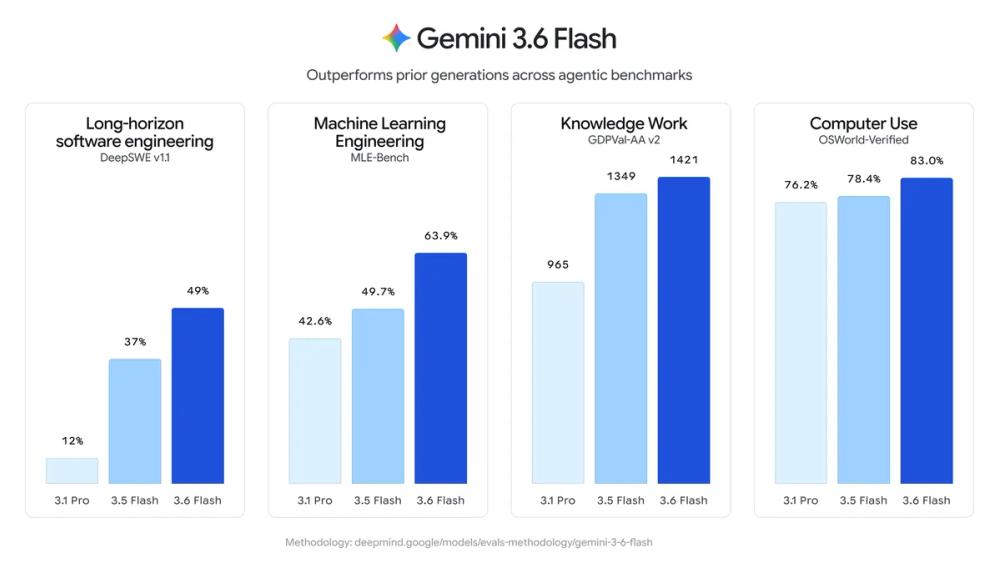
Google's original Gemini 3.6 Flash benchmark chart. Source: Google announcement. These are Google-reported evaluation results, so treat them as official launch evidence rather than independent reproduction.
Flash-Lite's chart is narrower. It compares 3.5 Flash-Lite to 3.1 Flash-Lite on Terminal-Bench 2.1 and GDPval-AA v2. That is enough to support "better than prior Flash-Lite" on the displayed tasks; it is not enough to call Flash-Lite the best small model for every high-throughput workload.
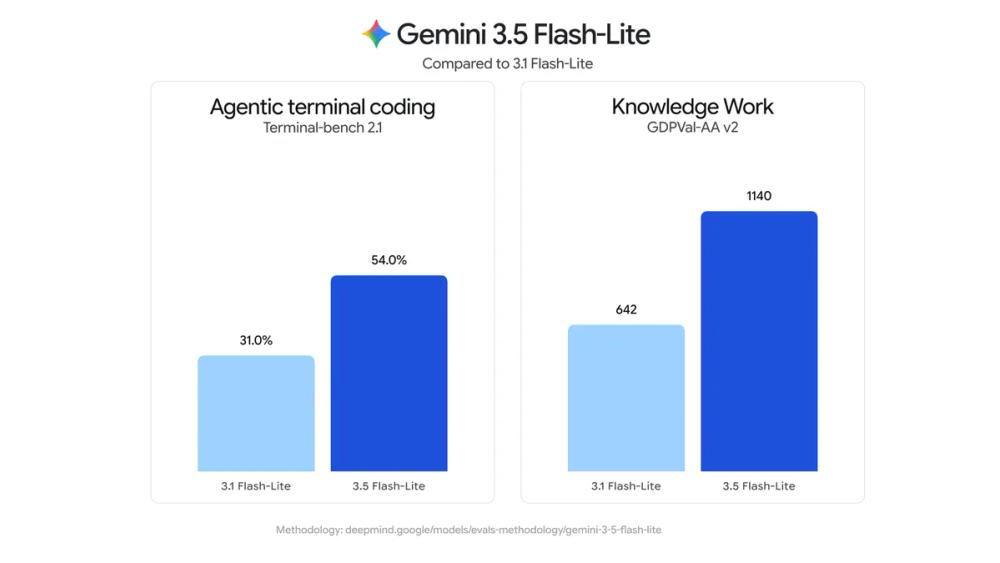
Google's original Gemini 3.5 Flash-Lite benchmark chart. Source: Google announcement. The comparison is against an earlier Flash-Lite generation, not the whole market.
Flash Cyber is the easiest one to overread. Google shows a Cyber-Gym comparison where Gemini 3.5 Flash Cyber in CodeMender is close to larger security-oriented systems, but the model is not broadly available. If you cannot access CodeMender through Google's trusted-partner path, this chart is market signal, not an integration plan.
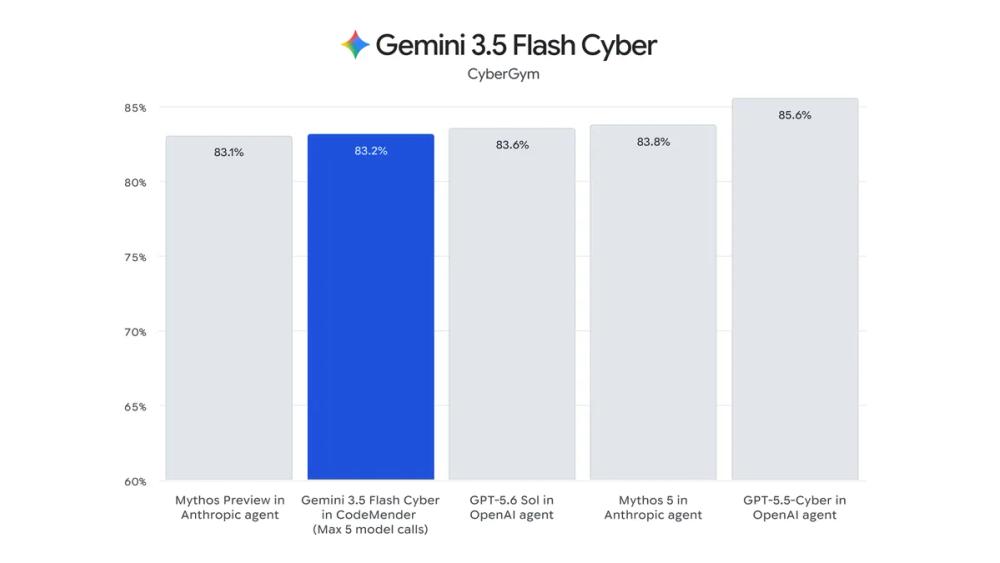
Google's original Gemini 3.5 Flash Cyber Cyber-Gym chart. Source: Google announcement. It supports a bounded security-agent claim, not public self-serve access.
If you use consumer Gemini surfaces, the public API release alone does not establish which model handles every request or how much the experience will improve. Judge the change by completed tasks, latency, and correction effort rather than the model name shown in an announcement.
That does not mean you should expect "Pro-level everything." The better expectation is lower friction on common work: coding help, long context, document understanding, spreadsheet-like extraction, image/video/audio inputs, and repeated agent steps.
For ordinary users, the best test is boring: ask Gemini to revise a messy document, inspect an image, reason over a PDF, or write and debug a small script. If the answer is shorter, more correct, and needs fewer follow-up prompts, the release matters. If it only sounds more confident, wait.
Three things are still worth watching. The first is the Computer Use doc mismatch for Flash-Lite. The model page and latest-model guide do not agree, so developers should verify the specific API endpoint and tool declaration before moving UI automation jobs to Flash-Lite.
The second is real-world cost. The official story combines published token prices with vendor-reported token efficiency. Your system may combine retrieval, function calls, grounding, retries, cache misses, and human review. Those are the units that decide the bill.
My practical take: test 3.6 Flash as your default agent model, test Flash-Lite as your cost-control lane, and ignore Flash Cyber unless you have a real CodeMender access path.
What is Gemini 3.6 Flash? Gemini 3.6 Flash is Google's latest stable Flash model for the Gemini API. Google positions it for agentic, coding, knowledge work, multimodal, and computer-use tasks, with a listed price of $1.50 per 1M input tokens and $7.50 per 1M output tokens.
Is Gemini 3.6 Flash available now? Yes. Google's latest-model guide says Gemini 3.6 Flash and Gemini 3.5 Flash-Lite are GA and ready for production use as of July 21, 2026. Flash Cyber is different: Google describes it as a limited trusted-partner and government pilot through CodeMender.
How is Gemini 3.5 Flash-Lite different from Gemini 3.6 Flash? Flash-Lite is the cost and throughput lane. Google lists it at $0.30 per 1M input tokens and $2.50 per 1M output tokens, with a minimal default thinking level. Use it for repeatable extraction or parsing before you pay for 3.6 Flash.
What should developers know before switching? Run a shadow test on real traces. Compare completion rate, tool calls, output tokens, total workflow cost, latency, and human correction rate. Also verify Flash-Lite Computer Use support, because Google's latest-model guide and model page currently conflict.
What is still unverified about the new Gemini models? The public record does not yet prove independent benchmark reproduction, universal cost savings, or broad Flash Cyber access. Google's charts support launch claims, but teams should still test their own prompts, tools, cache strategy, and review workflow.
Discover practical AI products and emerging tools at AIToolHunt.