
Source: Google’s official Gemini 3.7 Flash model card.
Google released Gemini 3.7 Flash only weeks after Gemini 3.6 Flash. The new model keeps a 1-million-token input window and low introductory API price while reporting much larger gains on several coding and agent benchmarks. That is enough to justify a controlled test, but not enough to justify a blind migration.
Quick Navigation
- What is it? The release, inputs, context, and price
- What changed? The measurable difference from Gemini 3.6 Flash
- How does it work? Thinking controls, multimodal context, and tool use
- Do the benchmarks settle it? Why the table is useful but incomplete
- Who should switch? A decision guide for builders and ordinary users
- FAQ: Five direct answers about access, pricing, context, coding, and migration
What is Gemini 3.7 Flash?
Gemini 3.7 Flash is Google’s general-availability multimodal model for fast, high-volume work, with text, image, video, audio, and PDF input, a 1-million-token input window, and up to 64,000 output tokens. Google positions it for coding, agentic workflows, and enterprise automation, and lets API users adjust how much the model thinks before responding. Introductory API pricing is $0.75 per million input tokens and $3.75 per million output tokens through December 31, 2026; Google says those rates double on January 1, 2027. The official model card reports sizable gains over Gemini 3.6 Flash on several coding and tool-use evaluations, but those results are vendor-reported and were not independently reproduced for this article. The practical decision is to test 3.7 Flash now on a pinned set of real tasks if code generation, tool use, or long multimodal context matters to you, while keeping 3.6 or another proven model as the fallback until quality, latency, and future pricing work for your application.
What the Public Docs Say
AIToolHunt reviewed Google’s launch page and primary model card, checked the live product facts against Artificial Analysis, and inspected the original benchmark table. We did not run Gemini 3.7 Flash, reproduce Google’s benchmarks, or conduct a hands-on latency test. Facts from Google, independent evaluator observations, and our migration recommendation are separated throughout the article.
What changed from Gemini 3.6 Flash?
The most important change is not the version number. It is Google’s claim that the same Flash product tier is more capable at work that requires a model to write code, operate tools, and persist through multi-step tasks.
Google’s launch article and model card report 43.6% on FrontierCode versus 34.4% for Gemini 3.6 Flash, 65.3% versus 48.6% on DeepSWE, 1588 versus 1538 on Code Arena, and 85.8% versus 78.0% on Terminal-bench 2.1. AutomationBench moves from 17.0% to 30.4%.
Those are material vendor-reported differences, especially for a model marketed as a volume workhorse. They are not a universal speed or accuracy guarantee. Results depend on each benchmark’s environment, harness, prompts, scoring rules, and point-in-time model snapshot.
The commercial detail is easy to miss. The $0.75 input and $3.75 output rates are introductory. According to the model card, they expire after December 31, 2026, when prices become $1.50 and $7.50. A migration that looks attractive today should still be modeled at the scheduled 2027 rate.
How does Gemini 3.7 Flash work for builders?
Gemini 3.7 Flash accepts several media types in one context, so an application can combine text instructions with screenshots, documents, audio, or video. Its large input window is useful for repository context, long document collections, and multi-file analysis, but input capacity is not the same as reliable recall. Builders still need retrieval tests at the lengths their product actually uses.
Google also exposes customizable thinking. More thinking can help on harder planning or debugging tasks, but it may increase latency and output cost. Less thinking can suit classification, extraction, or simple tool routing. The useful control is not “maximum reasoning everywhere”; it is selecting an effort level per task and measuring whether extra work improves completed outcomes.
For agents, the model is only one component. Tool schemas, permissions, retry rules, context packing, and verification determine whether a run succeeds safely. A stronger base model can reduce failures without eliminating the need for deterministic checks around file writes, purchases, messages, or production actions.
The developer view
Start with a shadow test rather than replacing a production route. Pin the exact model identifier and run a representative set of repository tasks, tool calls, and long-context requests against both your current model and Gemini 3.7 Flash. Record task completion, human corrections, invalid tool calls, latency, input and output tokens, timeouts, and total cost.
Pay special attention to failure recovery. Google’s model card lists hallucinations, occasional slowness or timeouts, and uneven knowledge coverage as limitations. A model that wins more tasks but leaves an agent in a harder-to-recover state may still be the worse product choice.
The AI product enthusiast view
If you use Gemini through a consumer product, the practical gain should appear as better multi-step work, code creation, and synthesis across files—not as a benchmark number. Pro and Ultra users can try the model in Gemini, while developers can access it through Google’s API surfaces. Availability inside a product does not mean every session or feature has identical tools, limits, or behavior.
For casual use, there is little reason to compare every benchmark. Try one task you already know well: combine several documents, ask for a small working app, or plan a multi-step workflow. Judge the result by corrections needed and usable completion, not by how confident the answer sounds.
Do Google’s benchmark gains prove Gemini 3.7 Flash is better?
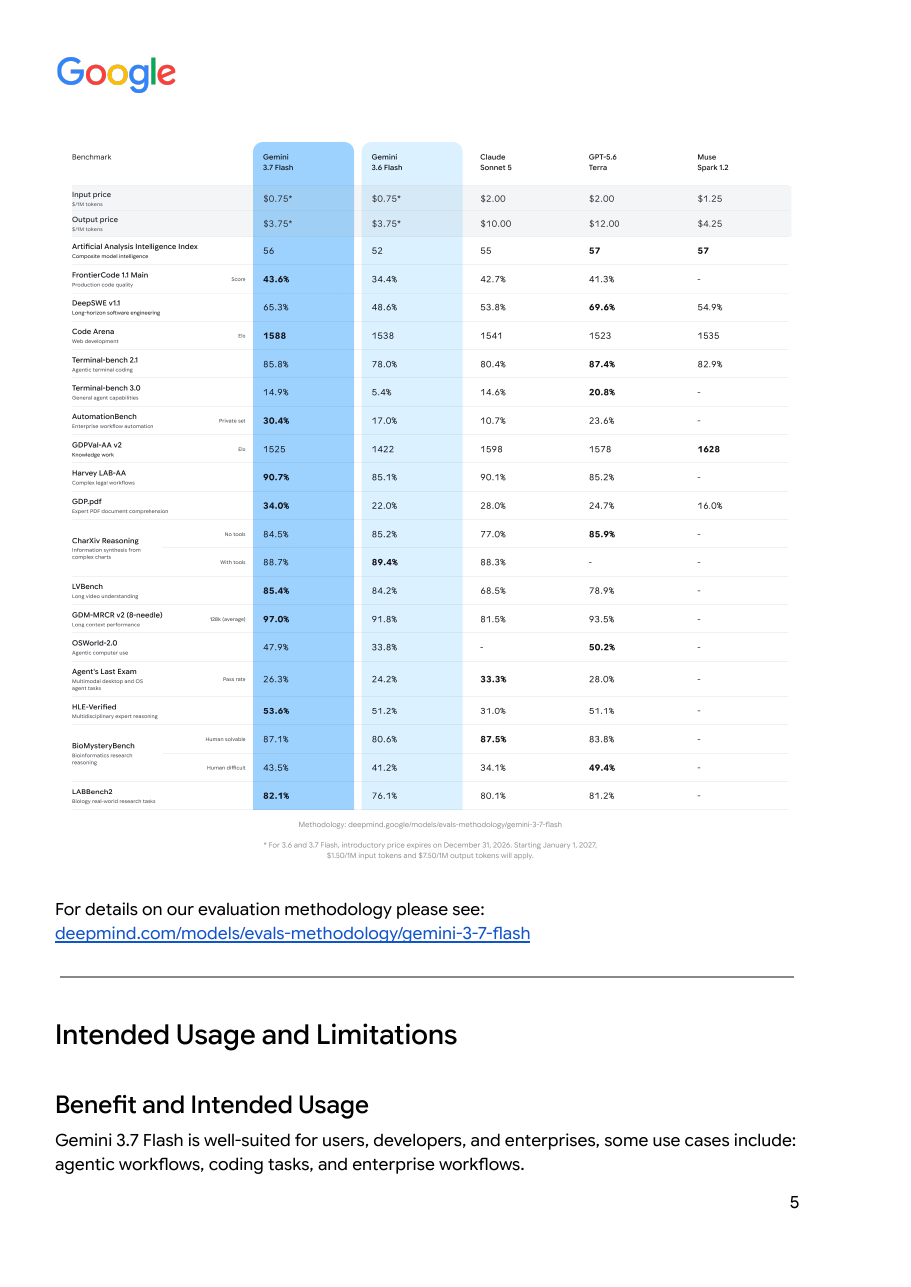
Source: Google’s official Gemini 3.7 Flash model card, page 5. This is the original vendor table, not an AIToolHunt redraw or independent reproduction.
No. The table proves what Google chose to report under its documented evaluation methods. It does not prove that Gemini 3.7 Flash will be best in your agent, IDE, or enterprise workflow.
The table is still valuable. It identifies tasks where Google measured clear movement, including software engineering, web development, terminal work, automation, long-context knowledge work, and expert reasoning. Artificial Analysis independently lists Gemini 3.7 Flash with an Intelligence Index around 56, a 1-million-token context window, and the same introductory API price. That independent listing corroborates broad product facts and an evaluator score, not Google’s individual coding claims.
Use the official table to choose tests. Do not use it to skip tests. A fair internal comparison should hold the task set, tool environment, time budget, and acceptance criteria constant, then include the scheduled 2027 price in the cost model.
Who should switch now, and who should wait?
- Test now if coding agents are central to your product. Google reports the largest improvements in exactly the tasks that matter to repository agents and tool-using workflows. 2. Test now if one model must handle mixed media and long context. The input contract supports text, images, video, audio, and PDFs inside a 1-million-token window. 3. Wait before a full migration if reliability is already acceptable. A shadow evaluation can reveal gains without introducing a new failure profile into production. 4. Wait if your economics only work at the launch price. Model the January 2027 price before committing architecture or customer pricing. 5. Keep a fallback for high-stakes actions. The model card still acknowledges hallucinations and intermittent slowness or timeouts.
The best first move is a one-week evaluation with a fixed task set and an explicit rollback path. Promote the model only if it improves completed work after accounting for retries, latency, supervision, and the scheduled price change.
What are the main limitations?
- The coding numbers are vendor-reported. AIToolHunt did not run the benchmarks, and the selected independent source does not reproduce them.
- Introductory pricing is temporary. Input and output prices are scheduled to double on January 1, 2027.
- Long context needs application testing. A 1-million-token limit does not guarantee faithful retrieval or reasoning across every position and media type.
- Agent outcomes depend on the surrounding system. Tool design, permissions, retries, and verification can dominate real reliability.
- Google documents ordinary model risks. Hallucinations, domain-dependent knowledge, slowness, and timeouts remain possible.
Quick Take
- Is Gemini 3.7 Flash generally available?: Evidence-backed answer: Yes. Google lists it as generally available for API use, and Gemini access is rolling through supported paid plans.
- Is it meaningfully different from 3.6 Flash?: Evidence-backed answer: Google reports large gains on several coding and agent evaluations, but they remain vendor results.
- Is the launch price permanent?: Evidence-backed answer: No. The model card schedules a doubling on January 1, 2027.
- Should developers migrate now?: Evidence-backed answer: Run a controlled shadow test now; migrate only after task, reliability, latency, and cost checks.
- Should ordinary users care?: Evidence-backed answer: Yes if they use Gemini for multi-file, coding, or multi-step tasks; otherwise the version change may be subtle.
My take: Gemini 3.7 Flash looks like a serious upgrade for coding and tool-using agents, not a cosmetic refresh. Its official results earn an evaluation. The temporary price and lack of independent reproduction mean the evaluation—not the launch table—must earn the migration.
FAQ
Is Gemini 3.7 Flash available now?
Yes. Google lists the model as generally available through its developer platform, and the Gemini app announcement says it is available to Pro and Ultra users. Exact product features and quotas can vary by surface and plan.
How much does Gemini 3.7 Flash cost?
The introductory API rate is $0.75 per million input tokens and $3.75 per million output tokens through December 31, 2026. The official model card says pricing changes to $1.50 input and $7.50 output per million tokens on January 1, 2027.
Does Gemini 3.7 Flash support one million tokens?
Yes, Google documents a 1-million-token input context and a maximum output of 64,000 tokens. Capacity does not guarantee perfect recall, so long-context products should test retrieval and reasoning at realistic document positions and media mixes.
Is Gemini 3.7 Flash better for coding than Gemini 3.6 Flash?
Google reports higher scores across FrontierCode, DeepSWE, Code Arena, Terminal-bench, and AutomationBench. Those results are encouraging but vendor-reported and task-specific. The reliable answer for your product requires a controlled comparison on your repositories and tools.
Should I replace my current model with Gemini 3.7 Flash?
Not immediately. Shadow-test it against the current route, include retries and human corrections, model cost at the scheduled 2027 price, and keep a fallback. Switch only if the complete workflow improves rather than one benchmark or prompt.
Find more practical AI products and model updates at AIToolHunt.