
Google's new Gemini 3.8 Flash TTS does something more interesting than adding another polished narrator voice: it turns speech generation into a directed performance workflow. You can describe a character, control individual lines, and build two-speaker scenes. That is worth testing now for prototypes—but the launch evidence does not yet justify replacing a production voice stack without listening tests, consent checks, and failure monitoring.
Source: Google's official Gemini 3.8 TTS launch post, published September 23, 2026.
Quick Navigation
- What is Gemini 3.8 Flash TTS? The model, access, and practical shift
- What changed? Voice design, direction, dialogue, and safeguards
- How does voice design work? Prompting a performance instead of choosing a preset
- Should developers try it now? A small, measurable pilot
- What remains unclear? Reliability, evaluation, and deployment gaps
- FAQ: Five direct answers
What is Gemini 3.8 Flash TTS?
Gemini 3.8 Flash TTS is Google's September 23, 2026 text-to-speech model for designing voices with natural-language directions, not just selecting a preset. The official launch post says developers can define a role, accent, vocal character, pacing, emotion, and line-level performance across more than 100 languages and dialects. It is rolling out through the Gemini API and Google AI Studio, while a lighter Flash-Lite version targets higher-volume generation. Google also offers voice replication from a 30-second sample, but requires a matching spoken consent recording from the voice owner and adds SynthID watermarking to generated audio. Those controls reduce obvious misuse paths; they do not prove every output is accurate, stable, or legally safe. The practical opportunity is a programmable voice-production layer for games, podcasts, dubbing, and agents. Developers should test it now on bounded scripts, but wait before migrating production until pronunciation, speaker drift, latency, regional availability, and consent operations pass their own acceptance tests.
What We Know So Far
This is a release analysis, not a hands-on product review. Google confirms the two model names, their intended roles, API and Studio distribution, input and output limits, consent check, and SynthID watermark. The Gemini 3.8 Audio model card also states that Flash TTS accepts up to 8K text tokens and produces audio with up to 64K output tokens.
The card is candid about broader foundation-model limits: hallucinations, occasional slowness, and timeouts can still happen. It also says the knowledge cutoff is January 2025. That matters when speech content depends on the model's knowledge rather than a script you fully supply.
The Decoder independently tested a prompted German-accented English voice twice. Its reviewer found convincing accent and intonation, but heard a high-pitched background whine and, in one clip, a voice change near the end. Simon Willison built a bring-your-own-key playground and reported generating a 78-second two-character clip in roughly 20 seconds for 2.74 cents. Both are useful observations, not broad reliability studies.
What changed in Gemini 3.8 Flash TTS?
- Pick from a small preset list: New public capability: Describe a new voice or browse more than 2,000 voices; Why it matters: Teams can start from character intent instead of a fixed catalog
- Apply one broad style: New public capability: Direct pacing, emotion, dialect shifts, and reactions line by line; Why it matters: Scripts become closer to performance specifications
- Assemble speakers manually: New public capability: Generate two-speaker dialogue from one script; Why it matters: Podcast and agent prototypes need less audio stitching
- Trust a user-uploaded sample: New public capability: Require a matching spoken consent statement for replication; Why it matters: Consent becomes part of the product flow, not only a policy page
- Mark generated speech outside the model: New public capability: Add SynthID to generated clips; Why it matters: Platforms get a machine-detectable provenance signal
The shift is from voice selection to voice direction. A developer can describe a new character, assign voices to multiple speakers, and place cues such as laughter, sighs, or backchannels inside a script. Flash-Lite offers the same general control surface with a scale-first positioning; Google reserves deeper character design for Flash TTS.
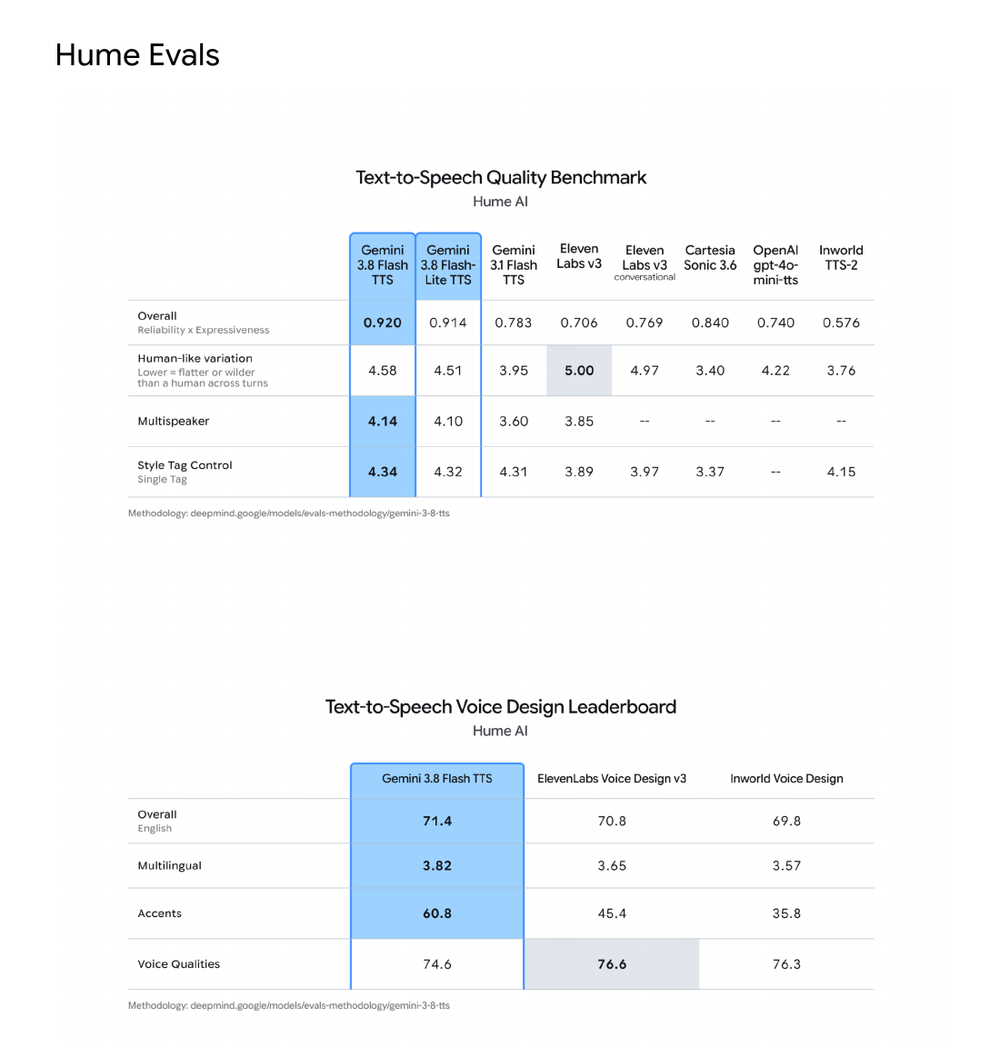
Source: Google DeepMind's official Gemini 3.8 TTS evaluation methodology and results. The image is a whitespace-cropped rendering of Google's original PDF page. Google says the tables use production checkpoints, default sampling, single-attempt generation, controlled listener panels, and blind comparisons. These vendor-published results were not independently reproduced for this article.
Google's Hume AI tables show Gemini 3.8 Flash TTS leading the listed models on the overall quality score, multispeaker score, style-tag control, and several voice-design categories. But one row makes the limitation visible: ElevenLabs scored higher on “human-like variation.” The chart supports a strong launch benchmark, not a universal best-voice claim.
How does Gemini 3.8 Flash TTS voice design work?
The simplest mental model is a screenplay plus casting notes. The text supplies what each speaker says. Natural-language directions supply who they are and how each line should sound. The model then produces the audio track while trying to preserve voice identity across the scene.
Voice replication is a different path. Google says a 30-second reference sample can create a voice profile, but the owner must also record a consent statement and the two voices must match. Replication is unavailable in Illinois, Texas, the EEA, the UK, Switzerland, and India through AI Studio at launch. That regional restriction is an operational requirement, not a footnote.
The developer view
Start with a test harness that holds the script constant. Generate at least five runs for each voice and score pronunciation, line-level instruction following, speaker separation, background artifacts, drift over long clips, latency, and cost. Keep source scripts and generated audio linked so a reviewer can reproduce failures.
Do not treat SynthID as an authorization system. It can help identify generated audio, while consent verification governs whether a replicated voice should be created at all. Your product still needs account controls, audit logs, deletion rules, abuse reporting, and a clear response when consent cannot be verified.
The API question is also narrower than “does it sound good?” Verify regional endpoints, data handling, output format, rate limits, retries, and how your player behaves when generation times out. Google's model card explicitly keeps slowness and timeouts in the known-limitations section.
The product enthusiast view
The fun part is obvious: one prompt can specify a Scottish detective, a tired game merchant, or two characters interrupting each other without manually editing every breath. Google's launch demos make the workflow look approachable, and Simon Willison's playground shows that a solo developer can wrap it quickly.
The less fun part is equally important. Release demos are selected examples. One independent reviewer already heard background noise and end-of-clip drift. If your use case is a casual prototype, that is tolerable. If it is an audiobook chapter, branded support voice, or paid localization job, listen to the entire output before shipping it.
Should developers try Gemini 3.8 Flash TTS now?
- Try now for prototypes and bounded scenes. Character design, two-speaker scripts, and line-level direction create a genuinely new workflow. 2. Pilot carefully for recurring content. Measure drift and artifacts across long clips, accents, and repeated generations rather than approving one good sample. 3. Wait for production migration if consent or residency is hard. Launch-region restrictions and voice-ownership operations can outweigh model quality.
A good first project is a non-celebrity fictional character with a short, fully supplied script. That exercises the new controls without making identity, current-fact, or long-form stability risk the center of the experiment.
What remains unclear?
- Google has not published a production reliability guarantee for long-form speaker consistency.
- The official evaluation combines Hume AI listener panels and Voice Arena comparisons, but it does not replace testing on your language, accent, script, and audio pipeline.
- The launch post says enterprise API access is coming soon; it does not give one universal availability date for every enterprise channel.
- Voice replication is region-restricted in AI Studio, and the operational details of consent review still need product-level testing.
- Two independent examples are useful signals, not enough evidence to estimate a general defect rate.
Quick Take
- What is actually new?: Evidence-backed answer: Natural-language voice design, line-level direction, native two-speaker scenes, and a large voice library
- Who can use it now?: Evidence-backed answer: Developers through Gemini API and Google AI Studio; product access differs between Flash and Flash-Lite
- What is the strongest evidence?: Evidence-backed answer: Google's launch post, model card, and original evaluation-methodology PDF
- What should developers verify?: Evidence-backed answer: Drift, noise, pronunciation, latency, cost, region support, and consent operations
- What is still unknown?: Evidence-backed answer: How reliably launch quality holds across long, repeated, production workloads
My take: Gemini 3.8 Flash TTS is ready for a serious prototype. It is not yet evidence that voice generation has become a fire-and-forget production step.
FAQ
What is Gemini 3.8 Flash TTS?
Gemini 3.8 Flash TTS is Google's text-to-speech model for creating and directing voices with natural-language prompts. It supports character design, line-level performance cues, multi-speaker scripts, more than 100 languages and dialects, and distribution through Gemini API and Google AI Studio.
Is Gemini 3.8 Flash TTS available now?
Yes. Google began rolling it out on September 23, 2026 through Gemini API and Google AI Studio, with Gemini Notebook access for the Flash model. Enterprise API availability is described as coming soon rather than universally available at launch.
Can Gemini 3.8 Flash TTS clone any voice?
No. Google says replication uses a 30-second reference sample plus a spoken consent recording from the same voice owner. AI Studio replication is also unavailable in several regions at launch, including Illinois, Texas, the EEA, UK, Switzerland, and India.
How should developers test Gemini 3.8 Flash TTS?
Use a fixed script and run it repeatedly. Score pronunciation, direction following, speaker separation, background noise, long-clip drift, latency, and cost. Review full outputs rather than approving a short highlight, and keep consent and provenance records separate from quality testing.
What is still unverified about Gemini 3.8 Flash TTS?
Google's benchmark results are vendor-published, and independent testing is still sparse. One reviewer found background whine and voice drift in a small test. Long-form reliability, defect rates, enterprise rollout timing, and operational consent handling need more evidence.
Discover practical AI products and emerging tools at AIToolHunt.
Sources
- Google: Gemini 3.8 Flash TTS and Flash-Lite TTS launch
- Google DeepMind: Gemini 3.8 Audio model card
- Google DeepMind: Gemini 3.8 TTS evaluation methodology
- Google AI Studio: Speech generation documentation
- The Decoder: Independent Gemini 3.8 Flash TTS test
- Simon Willison: Gemini 3.8 TTS playground and sample