
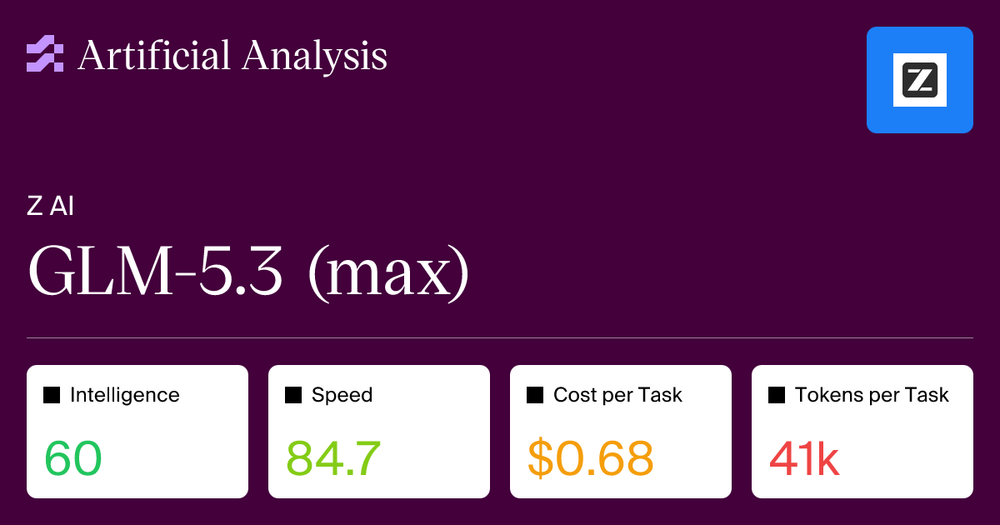
Source: Artificial Analysis's GLM-5.3 model evaluation. These are point-in-time evaluator results under its own harness, not a universal ranking.
GLM-5.3 is the rare model launch where the cost story may matter as much as the benchmark story. Its API is live, its coding and agent scores moved sharply, and an independent evaluator puts it near the current frontier. The catch: it is verbose, the weights are still pending, and your own agent harness may expose a very different bill.
Quick Navigation
- What is GLM-5.3? The model, API status, and direct answer
- What changed? Post-training gains, independent measurements, and evidence limits
- How does it work? Long-horizon environments and mandatory reasoning
- What changes for developers? Migration details and a practical shadow test
- Who should try it? A test-now versus wait decision
- FAQ: Five direct answers on access, cost, weights, benchmarks, and migration
What is GLM-5.3?
GLM-5.3 is Z.ai's text-only reasoning model for coding, defensive cybersecurity, and long-horizon agent work, available through the company's API and partner gateways as of August 18, 2026. Z.ai says the model keeps GLM-5.2's base and gets its gains from another month of post-training on longer, executable tasks rather than a new pretraining run. The official technical post documents low, high, and max reasoning effort, while disabling thinking is no longer supported. Independent evaluator Artificial Analysis reports an Intelligence Index score of 60, about 84.7 output tokens per second, and roughly $0.68 per evaluation task. That combination makes GLM-5.3 worth a controlled coding-agent test, not an automatic production switch: the evaluator also found unusually high output-token use, the public weights were still pending on August 19, and neither source proves reliability on your repositories, tools, permissions, or latency targets.
What We Know So Far
This is a documentation-and-evaluation analysis, not a hands-on review. Z.ai supplies the architecture story, API behavior, benchmark tables, and launch status. Artificial Analysis supplies independent measurements for intelligence, speed, cost, context, and verbosity. The article treats both benchmark sets as point-in-time evidence, not a promise that GLM-5.3 will win on every codebase.
What changed with GLM-5.3?
- GLM-5.2 already used Z.ai's long-context and reinforcement-learning stack: New public evidence: Z.ai says GLM-5.3 keeps the same base and scales post-training for another month; Practical consequence: The release tests how far better environments and rewards can move an existing base
- Thinking could be disabled in older integrations: New public evidence: GLM-5.3 requires thinking and adds low, high, and max effort; Practical consequence: A model-ID swap can break requests or change latency and token use
- Vendor benchmarks showed a capable but less competitive agent model: New public evidence: Z.ai reports sharp gains on Terminal-Bench 3.0, DeepSWE, and agent tasks; Practical consequence: Coding-agent builders have a concrete reason to run a shadow evaluation
- Cheap tokens were the headline: New public evidence: Artificial Analysis measured a score of 60, about 84.7 tok/s, and about $0.68 per task, but also high output volume; Practical consequence: Cost per token looks attractive; cost per completed workflow still needs measurement
- Z.ai described GLM as an open-weight family: New public evidence: The API is live, but GLM-5.3 weights are not yet public; Practical consequence: Cloud testing is possible now; self-hosting claims must wait
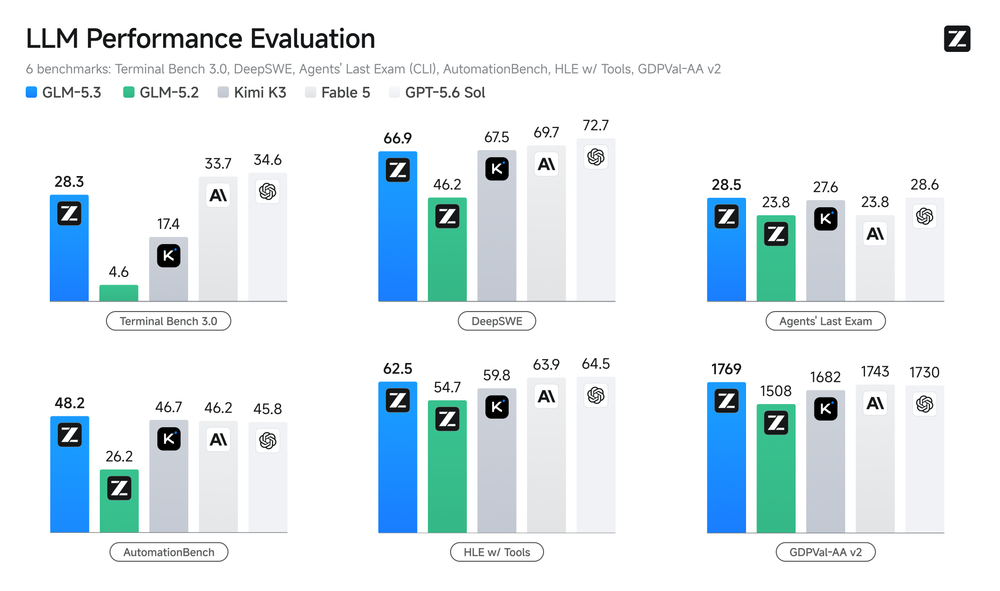
Source: Z.ai's official GLM-5.3 technical post. The chart is vendor-reported and unredrawn; results depend on the documented harness, effort, context, rollout count, verifier, and timeout settings and have not been independently reproduced here.
The cleanest independent result is not that GLM-5.3 is “the best.” Artificial Analysis scores the max-effort configuration at about 59.5, rounded to 60, near Kimi K3 and several proprietary models. Its page also reports a one-million-token context window and text-only input and output.
The less flattering metric is just as useful. Artificial Analysis says GLM-5.3 generated far more output tokens than the comparison median during its Intelligence Index evaluation. A cheap model that reasons for longer can still create an expensive workflow, especially when an agent loops through tools, retries, and repository context.
How does GLM-5.3 work?
Z.ai's central claim is unusually specific: the base model did not change. The team says it spent another month scaling post-training with more long-horizon environments, more diverse tasks, and more compute. Those environments are executable workspaces where a model must diagnose, change code, run experiments, and satisfy a verifier instead of answering a short prompt.
The training stack combines long-context processing, reinforcement learning on long tasks, asynchronous rollouts, synthesized environments, and synthesized verifiers. In plain English, Z.ai is trying to reward ownership of a complete task, not just the next plausible code snippet.
That approach can improve agent behavior without a new pretraining run, but the evidence still has boundaries. Z.ai runs many comparisons inside a Claude Code harness with specified context lengths, reasoning effort, timeouts, and official or custom verifiers. Those details make the results more interpretable; they do not make them portable to every production agent.
The developer view
There is one migration detail you should not miss. GLM-5.3 no longer supports thinking.type: "disabled". Z.ai says to enable thinking and set reasoning_effort to low before changing the model ID, or the request can fail. That is not a cosmetic SDK change—it affects success rate, latency, output length, and cost.
Run GLM-5.3 as a shadow model before routing real work to it. Use 30 to 50 representative tasks, keep tool permissions identical, cap retries, and measure completed-task cost, wall-clock time, regression rate, human corrections, tool errors, and output tokens. The winner is the model that closes your task reliably, not the one with the prettiest launch chart.
The AI product enthusiast view
GLM-5.3 makes a practical point about model progress: a new base is not required for a meaningful capability jump. Better post-training environments can move coding and agent behavior enough to change the buying conversation.
For normal users, the immediate benefit is access rather than openness. You can try the model through the API or supported coding plans now. You cannot yet download the GLM-5.3 weights, and public evaluations do not prove that a favorite coding assistant has integrated the model well.
Who should try GLM-5.3 now, and who should wait?
- Try it now if your agent bill is dominated by expensive frontier models. The measured cost per evaluation task is low enough to justify a shadow test. 2. Try it now if your workload is long-horizon coding or tool use. That is where Z.ai concentrated post-training, and the public benchmark delta is large. 3. Wait if you need self-hosting, private weights, or offline deployment. The GLM-5.3 weights were still unavailable on August 19. 4. Wait if predictable output length matters more than token price. Independent evaluation flags unusually high token use. 5. Do not switch on composite scores alone. A 60-point index does not measure your repository permissions, tool reliability, patch acceptance, or incident cost.
My decision rule is simple: promote GLM-5.3 only if it beats the current model on completed-task cost and correction rate while staying inside your latency budget. A lower API price without a lower workflow cost is not a win.
What remains unclear?
- Open-weight timing and terms: Z.ai says the weights are coming after safety evaluation and hardening, but they were not public at the time of writing.
- Workload transfer: Public coding and agent benchmarks do not reveal performance on your repositories, tools, policies, or flaky dependencies.
- Output discipline: Artificial Analysis observed high output-token use; it is unclear how much low effort and better prompting can reduce it without hurting completion rates.
- Long-run reliability: There is no broad independent record for multi-hour agent tasks, recovery from tool failures, or repeated production runs.
- Security tradeoffs: Better defensive cyber capability is useful, but teams still need permission boundaries, audit logs, sandboxing, and review gates around autonomous tools.
Quick Take
- What is actually new?: Evidence-backed answer: The GLM-5.3 API is live, with a same-base post-training update focused on coding, cyber defense, and long-horizon agents.
- Who can use it now?: Evidence-backed answer: Developers can use Z.ai's API and supported partner gateways; the weights are not yet public.
- What is the strongest evidence?: Evidence-backed answer: Detailed Z.ai benchmark methods plus Artificial Analysis measurements for intelligence, speed, cost, context, and verbosity.
- What should developers verify?: Evidence-backed answer: Completed-task cost, correction rate, latency, tool errors, and output tokens in an identical shadow harness.
- What is still unknown?: Evidence-backed answer: Self-hosting details and broad independent production reliability on long agent workflows.
My take: GLM-5.3 has enough credible evidence to earn a serious evaluation, especially for coding agents priced out of proprietary frontier models. It has not earned a blind migration.
FAQ
Is GLM-5.3 available now?
Yes. Z.ai announced first-party API and partner gateway availability on August 18, 2026. Availability varies by provider and plan, so confirm the model ID, region, rate limits, and current pricing before moving production traffic.
How much does GLM-5.3 cost?
Artificial Analysis lists Z.ai API pricing at $1.40 per million input tokens and $4.40 per million output tokens, with about $0.68 per Intelligence Index task. Treat those as point-in-time figures; provider pricing and workload verbosity can change the real bill.
Are the GLM-5.3 weights open?
Not yet as of August 19, 2026. Z.ai says it plans to release the weights after additional safety evaluation and hardening. Until the files and license are actually published, GLM-5.3 should be described as API-accessible, not currently open-weight.
Is GLM-5.3 better than Kimi K3 or GPT-5.6 Sol?
No single public result proves that. GLM-5.3 is near Kimi K3 on Artificial Analysis's composite index and leads some vendor-reported tasks, while other models lead elsewhere. Choose with a workload-matched shadow test, not a global winner label.
What must developers change when migrating from GLM-5.2?
Enable thinking before switching the model ID. GLM-5.3 supports low, high, and max reasoning effort and no longer accepts disabled thinking. Recheck timeouts, token budgets, retry policy, and cost controls because output behavior may change.
Discover practical AI products and developer tools at AIToolHunt.