Newsletter
Join the Community
Subscribe to our newsletter for the latest news and updates
Gemma 4 E2B on Pixel sounds like Google has dropped a private, offline Gemini replacement onto every Pixel 10. That is not what the public evidence says.
Google has released a real TPU-optimized model package, opened a real developer path, and demonstrated useful offline experiences. But the July announcement is a developer showcase, not a notice that every Pixel owner now has a new system assistant.
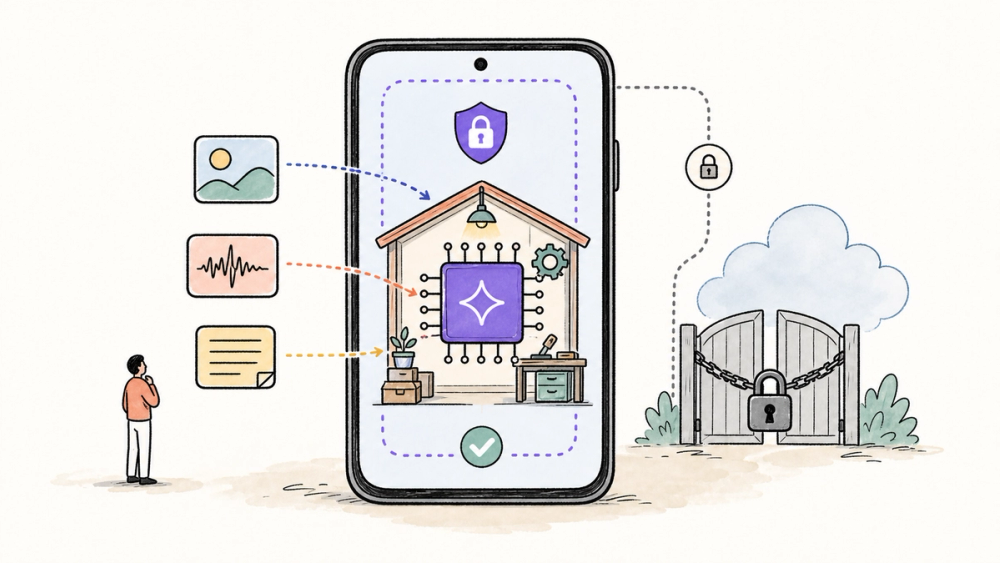
That narrower story is still important. It shows what the next consumer AI product shape could be: smaller multimodal models running beside your photos, audio, and phone controls instead of shipping every prompt to a server.
Gemma 4 E2B on Pixel is Google’s TPU-optimized version of its small, open-weight multimodal model for the Pixel 10 family. Google says the model runs natively on the phone’s Tensor Processing Unit, allowing supported apps to process text, images, and audio without sending those inputs to a cloud model. In its July 13, 2026 announcement, Google showed offline chat, image questions, audio transcription, and agent-style tasks, but these were demonstrations rather than a broad consumer feature rollout. Developers can request access to the Google Tensor SDK Beta, which officially supports Pixel 10, Pixel 10 Pro, Pixel 10 Pro XL, and Pixel 10 Pro Fold. A 3.11 GB TPU-compiled Gemma package is also listed on Hugging Face. The practical takeaway is narrow: the model and developer path are real, while a universal, preinstalled Gemma assistant for every Pixel owner was not announced.
Google’s May 19 Tensor SDK Beta announcement says the SDK compiles models for the Tensor TPU, deploys supporting libraries through Google Play, packages model files through AI Packs, and can fall back to CPU or GPU when needed. It lists four supported devices: Pixel 10, Pixel 10 Pro, Pixel 10 Pro XL, and Pixel 10 Pro Fold.
The July update adds a sharper model story. Google’s Gemma 4 model card describes E2B as part of an open-weight family that handles text and images, with native audio input on E2B, E4B, and 12B variants. The output remains text, so “multimodal” here means the model can understand multiple input types, not that it generates images or audio.
Android Authority independently covered the Pixel showcase and reported the same central facts: a Pixel TPU-optimized Gemma 4 E2B build, local processing, and demonstrations of trip planning, recipes, smart-home tasks, Mobile Actions, image questions, and transcription.
The strongest evidence is unusually concrete for a conference announcement. There is an official launch post, a current Beta signup page, a device list, an open model card, a public LiteRT-LM repository, and a 3.11 GB file specifically compiled for Google Tensor G5.
The evidence is weaker on the experience a normal buyer can use today. Google repeatedly says it “demonstrated” or “showcased” Agent Skills, Mobile Actions, offline chat, Ask Image, and audio transcription. The same post sends developers to the Tensor SDK Beta, source code, models, a codelab, and AI Edge Gallery.
That wording matters. It supports “developers can start experimenting,” but it does not support “Google shipped a new built-in Gemma assistant to all Pixel 10 owners.” As of July 17, 2026, the public Tensor SDK page still says “Sign-up for Beta,” which also means access should not be described as unrestricted general availability.
This article is therefore a release explainer, not a hands-on TPU benchmark. Google’s public demos establish feasibility; they do not independently establish sustained speed, battery impact, thermal behavior, model quality, or reliability across third-party apps.
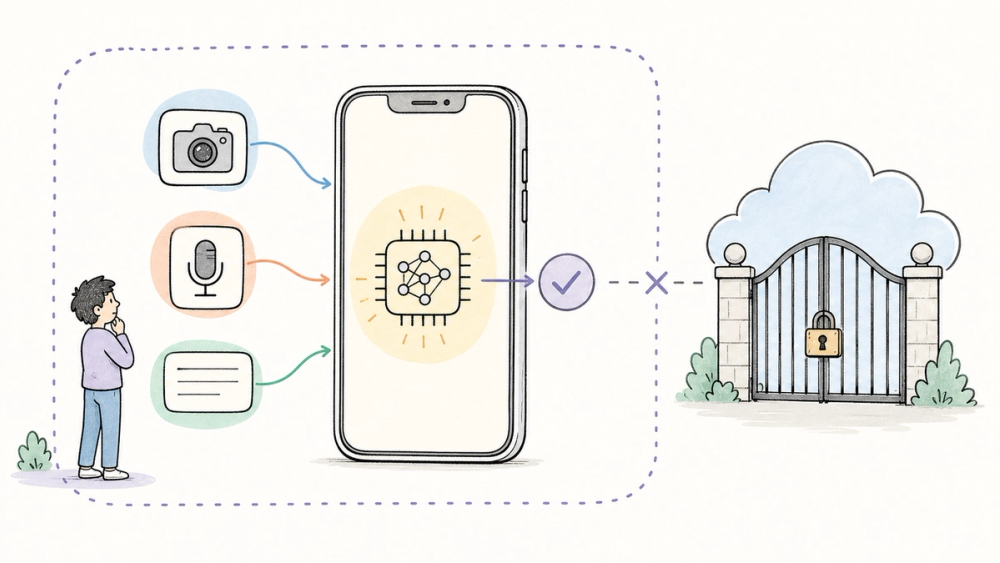
The simplest mental model has three layers.
Google’s Tensor SDK documentation describes a compile, deploy, and run flow. A developer compiles a supported model for the target system-on-chip, distributes runtime components and model files with the Android app, and invokes inference on the TPU. The SDK can specify CPU or GPU fallbacks when TPU execution is unavailable.
The local path changes the data flow. If an app performs inference entirely on the phone, the model does not need to upload the prompt, photo, or audio clip to a remote inference service. That can enable airplane-mode use, reduce network latency, and keep model inputs on the device.
But “on-device model” is not the same as “the entire app is private.” That is a practical inference, not a contradiction of Google’s demo. An app could still use analytics, sync data, call other network services, or upload results. Developers must audit the whole data path, not stop at the model runtime.
The best reason to test now is not novelty. It is the chance to design features around a dependable local boundary: photo classification where images remain on the phone, voice notes transcribed without a connection, or phone actions that do not wait for a cloud round trip.
The catch is platform scope. The TPU-specific path currently targets the Pixel 10 family and requires Beta signup. A production Android app still needs a strategy for unsupported devices, model delivery size, memory pressure, thermal limits, fallback behavior, and what happens when a task exceeds a small model’s capability.
The 3.11 GB Tensor G5 package is a useful reality check. On-device does not mean tiny. Shipping or downloading a multi-gigabyte asset affects install design, storage prompts, update cadence, and whether the feature should be optional.
For a normal user, offline multimodal AI could be more meaningful than another benchmark win. A travel helper that works on a flight, an image explainer that does not upload a photo, or lecture transcription without a network connection are easy benefits to understand.
The sensible response is still to wait for real apps. Google showed the building blocks and demos, not a polished replacement for Gemini in the Pixel launcher. The consumer value will depend on which developers gain access, what they ship, how clearly they disclose network behavior, and whether local quality is good enough for everyday tasks.
My take: the release is more important as infrastructure than as a finished consumer product. Google is giving developers the pieces to make offline AI feel native to the phone. Whether those pieces produce trustworthy apps is the next test.
The honest headline is not “Gemini is now fully offline.” It is “Google has made a credible Pixel-specific path for developers to build offline multimodal AI.”
Is Gemma 4 E2B available on Pixel 10 now?
The model artifact and developer path are real as of July 17, 2026. Google lists a Tensor G5-compiled package and invites developers to sign up for Tensor SDK Beta. However, Google did not announce that every Pixel 10 owner now has a universal, preinstalled Gemma 4 assistant.
Which Pixel phones support the Google Tensor SDK?
Google’s current documentation lists Pixel 10, Pixel 10 Pro, Pixel 10 Pro XL, and Pixel 10 Pro Fold. The cited announcement does not promise the same TPU-specific SDK path for older Pixel phones or non-Pixel Android devices.
Does Gemma 4 E2B work completely offline?
Google demonstrated Gemma 4 E2B and related phone actions running without an internet connection. A correctly designed app can run model inference locally, but users should not assume the entire app is offline; analytics, syncing, fallback services, or other network calls can still exist.
Is Gemma 4 E2B on Pixel private?
Local inference can keep prompts, photos, and audio on the device instead of sending them to a cloud model. That is a meaningful privacy advantage. It is not a blanket guarantee for every app, so privacy policies and network behavior still matter.
Can developers ship Gemma 4 E2B apps through Google Play?
Google documents a deployment workflow using Play Feature Delivery for runtime libraries and AI Packs for model files. The Tensor SDK remains a Beta signup program, so developers should confirm access, supported operators, fallback behavior, licensing, package size, and production requirements before committing to a launch.
Discover practical on-device AI tools and emerging products at AIToolHunt.