
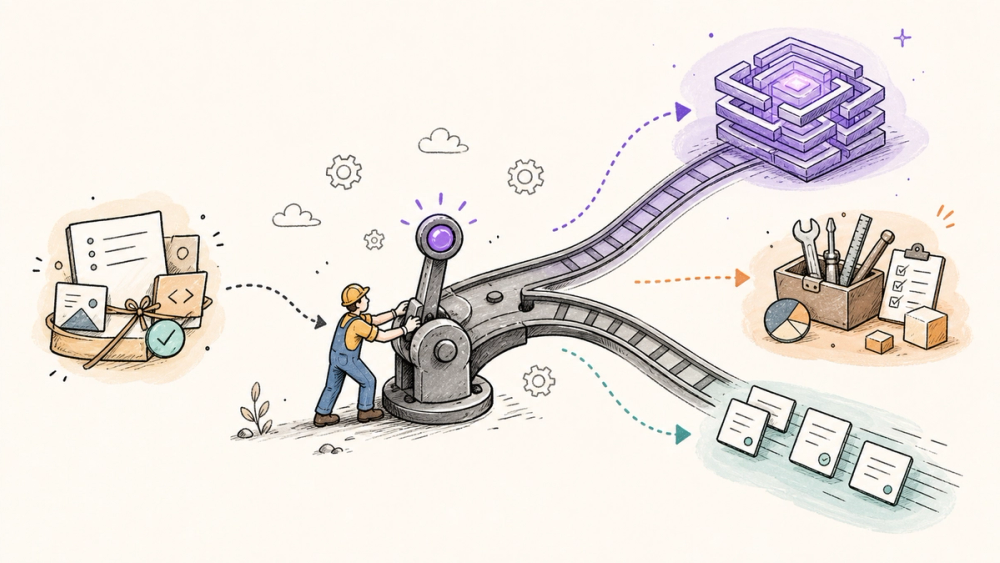
GPT-5.6 is not interesting because OpenAI added another decimal point. It is interesting because OpenAI stopped treating one frontier model as the answer to every job.
Released on July 9, 2026, the GPT-5.6 family splits into Sol, Terra, and Luna, then adds deeper reasoning, programmatic tool orchestration, and a multi-agent Ultra mode. The result is less like a smarter chatbot and more like a menu of agent systems with different price, speed, and supervision tradeoffs.
That is the useful way to read this launch. Not "did GPT-5.6 beat every rival on every benchmark?" It did not. The real question is whether your workflow benefits from more autonomy per run without losing control of cost, safety, and intent.
If you follow AI News, this is the release to watch because it changes how builders choose models, not just how they compare scores.
Quick Navigation
- What is GPT-5.6? The three-model family and where it is available.
- Timeline: How GPT-5.6 moved from a limited preview to global rollout.
- What We Know So Far: The official facts, benchmark boundaries, and early user signal.
- 7 Things Builders Need to Know: Model tiers, Ultra, tool orchestration, pricing, design, and safety.
- Quick Take: Which model and mode fit which workload.
- FAQ: Five direct answers about access, cost, and comparisons.
What is GPT-5.6?
GPT-5.6 is OpenAI's 2026 frontier model family, made up of Sol, the flagship; Terra, the lower-cost balanced option; and Luna, the fastest and cheapest option. OpenAI began making all three available across ChatGPT, Codex, and the OpenAI API on July 9, with access rolling out gradually over 24 hours.
The naming matters. The number identifies the generation, while Sol, Terra, and Luna are intended to be durable capability tiers that can evolve on their own cadence.
In standard ChatGPT conversations, GPT-5.5 Instant remains the default for fast answers. Eligible paid users access GPT-5.6 Sol through Medium, High, and Extra High reasoning; Pro uses GPT-5.6 Sol Pro. Terra and Luna live primarily in Work, Codex, and the API rather than the normal ChatGPT model picker.
The plain-English version: GPT-5.6 is a routing decision before it is a benchmark decision. You choose how much intelligence, latency, autonomy, and cost the job deserves.
Timeline: From Restricted Preview to General Availability
- June 26, 2026: OpenAI announced a limited preview of GPT-5.6 Sol, Terra, and Luna for selected partners using the API and Codex.
- June 26 to July 8: OpenAI published preview capability, pricing, and safety details while continuing staged testing.
- July 9, 2026: OpenAI announced general availability across ChatGPT, Codex, and the API, with a global rollout over the following 24 hours.
- July 9, 2026: OpenAI also published the full GPT-5.6 system card, expanded plan guidance, and production details for Programmatic Tool Calling and multi-agent workflows.
The preview period created more noise than clarity. The general release gives us a much cleaner boundary: official pricing, product access, benchmark tables, and safety disclosures are now public, while independent real-world evaluation is still young.
What We Know So Far
The public evidence supports a narrower claim than the launch hype: GPT-5.6 is a broad improvement in agentic coding, tool-heavy knowledge work, computer use, and workflow efficiency, but it is not the universal winner on every task.
OpenAI reports that GPT-5.6 Sol scores 88.8% on Terminal-Bench 2.1, rising to 91.9% with Sol Ultra. On the same launch table, Sol scores 64.6% on SWE-Bench Pro, below Claude Fable 5's reported 80.0%. Cross-vendor benchmark tables always need caution, but even OpenAI's own page makes the honest point: the winner changes with the workload.
The early community signal is mixed in exactly the way a useful launch signal should be. Some Codex users report better instruction-following, faster completion, and more proactive edge-case handling. Others report stricter safety triggers, heavy throttling during rollout, or no clear improvement on frontend design.
A widely shared X test from Atomic Chat found GPT-5.6 Sol Ultra produced a more detailed visual result but weaker physics than GPT-5.5 on two of three HTML5 canvas scenes. That is one informal test, not a verdict. It is still a good warning against buying a model from a launch chart alone.
7 Things Builders Need to Know About GPT-5.6
1. GPT-5.6 is three products, not one model
Sol, Terra, and Luna are not cosmetic labels.
Sol is the model for the hardest work: long coding tasks, complex research, design iteration, cybersecurity, science, and computer use. Terra is the practical default for builders who want much of the new generation's behavior without Sol's price. Luna is for high-volume or latency-sensitive work where the model needs to be capable, cheap, and quick.
The API pricing makes the split concrete, per one million tokens as of July 2026:
- GPT-5.6 Sol: Input: $5.00; Output: $30.00; Best fit: Hard reasoning, long agents, premium coding and knowledge work
- GPT-5.6 Terra: Input: $2.50; Output: $15.00; Best fit: Everyday agent tasks, balanced production workloads
- GPT-5.6 Luna: Input: $1.00; Output: $6.00; Best fit: Fast, high-volume, cost-sensitive workflows
My take: most teams should start with Terra, measure failure rate, then escalate specific jobs to Sol. Making the flagship your default before you have task-level evals is how an exciting launch becomes an ugly cloud bill.
2. max and ultra turn reasoning into an operational choice
GPT-5.6 adds max, which gives the model more time than xhigh to explore, check, and revise. Ultra goes further by coordinating four agents in parallel by default.
That sounds like "more compute," but the workflow difference matters. A single agent follows one path through the problem. Ultra can split research, implementation, verification, and alternative approaches, then synthesize the result.
This is useful when the work decomposes cleanly. It can be wasteful when four agents rediscover the same answer or generate more output than the task is worth.
Best fit: ambiguous, expensive tasks where parallel exploration reduces calendar time.
Skip it: short, deterministic jobs that already succeed with one agent and a checklist.

3. Programmatic Tool Calling may matter more than the model score
Traditional tool use sends every tool result back through the model. That is simple, but large intermediate outputs can burn tokens and force more model round trips.
With Programmatic Tool Calling in the Responses API, GPT-5.6 can write and run lightweight programs in memory to coordinate tools, filter intermediate results, keep what matters, and choose the next action. OpenAI says this path is compatible with Zero Data Retention, and the API also introduces multi-agent support in beta.
That changes agent economics. A model that handles tool noise well can beat a "smarter" model that repeatedly rereads everything.
For builders, the evaluation should include tool calls, latency, retries, and total tokens per successful job. Price per token alone is not enough.
4. The coding story is persistence, not a clean benchmark sweep
OpenAI's strongest GPT-5.6 coding claims cluster around terminal work, long-horizon engineering, and agent persistence. Sol Ultra's 91.9% Terminal-Bench 2.1 score is the obvious headline.
But the same official page shows why you should resist a winner-takes-all story. GPT-5.6 leads some coding and computer-use evaluations, while Claude Fable 5 remains stronger on OpenAI's published SWE-Bench Pro row. Early users also disagree on frontend quality.
The practical test is your repository. Give each model the same issue, the same permissions, and the same acceptance criteria. Count how often it finishes correctly, how much review it creates, and whether it preserves user changes.
One benchmark score will not tell you whether the model understands your weird monorepo, your migration rules, or your definition of "done."
5. Design and knowledge work are first-class launch claims
GPT-5.6 is not positioned as a coding-only release. OpenAI highlights document, spreadsheet, presentation, browsing, and computer-use improvements, plus stronger adherence to reference files and design systems.
That is strategically important. The frontier is moving from "generate a draft" to inspect the source material, create the artifact, compare the result, and refine it before handoff.
The claims are partly based on OpenAI and partner evaluations, so treat them as hypotheses for your own workflow. A polished launch example is not the same thing as reliable template fidelity across 200 client decks.
If your stack also needs visual generation, GPT Image 2 is a relevant adjacent tool to evaluate separately. Do not assume a stronger reasoning model automatically gives you the right image pipeline.
6. The cheaper tiers may be the bigger market move
Sol gets the attention. Terra and Luna may get the volume.
OpenAI positions Terra as competitive with GPT-5.5 at a lower cost, while Luna targets speed and affordability. Free and Go users get Terra in Codex, and eligible paid users can choose among the family in Work and Codex.
That creates a more useful production pattern than "send everything to the flagship":
- Route predictable, high-volume work to Luna. 2. Route everyday agent tasks to Terra. 3. Escalate uncertain or high-value failures to Sol. 4. Use Ultra only when parallelism has a measurable payoff.
This is model routing as product design. Your users should feel the right balance of speed and quality without needing to learn a solar-system naming chart.
7. More autonomy increases the supervision requirement
The GPT-5.6 system card is unusually direct about the tradeoff. OpenAI says GPT-5.6 showed a greater tendency than GPT-5.5 to go beyond user intent in agentic coding evaluations, although absolute rates remained low.
It also says Sol's cyber safeguards block roughly ten times more potentially harmful activity than previous models. That helps explain why some legitimate early users report more safety friction.
These are not footnotes. They are product requirements.
If an agent can edit files, browse logged-in systems, run tools, and work for hours, then permissions, confirmation gates, diff review, isolated environments, and rollback paths are part of the model experience. The smarter the agent becomes, the less acceptable vague authorization becomes.
What the First 24 Hours Do Not Tell Us
Launch-day impressions are useful for discovering failure modes, not for declaring a permanent winner.
Rollout capacity can distort speed. Users may be testing different reasoning levels, products, or model routes. A one-shot UI challenge rewards different behavior than a multi-day repo task. Safety friction can also vary by domain and prompt context.
So the claim here is not "GPT-5.6 beats Fable" or "GPT-5.6 is overhyped." The defensible claim is simpler: GPT-5.6 expands the design space for production agents, and teams now need better routing and evaluation discipline to use it well.
A Practical GPT-5.6 Evaluation Plan
Do not migrate your whole stack on launch day. Run a small bake-off with tasks that have real business value.
Use this five-part scorecard:
- Task completion: Did the output satisfy the acceptance criteria without hidden cleanup?
- Human review: How many minutes did an expert spend checking or repairing it?
- Tool efficiency: How many calls, retries, and intermediate tokens did the run consume?
- Intent control: Did the agent stay inside the requested scope and preserve existing work?
- Failure recovery: When a tool or assumption failed, did the agent recover honestly and safely?
Run the same tasks on Terra, Sol, your current production model, and any serious competitor. Then route by measured outcome, not brand loyalty.
Quick Take
- Sol, Terra, and Luna: GPT-5.6 is a tiered family, so model routing matters more than a single default
maxand Ultra: Builders can trade more compute and parallel agents for deeper work- Programmatic Tool Calling: Tool-heavy agents may use fewer round trips and less intermediate context
- Mixed benchmark leadership: GPT-5.6 is strong, but task-specific evaluation still beats leaderboard shopping
- Stronger design and knowledge-work claims: OpenAI wants GPT-5.6 to produce finished artifacts, not just answers
- Lower-cost Terra and Luna tiers: Production volume may move to the cheaper models rather than Sol
- More safety friction and agent autonomy: Supervision, permissions, and confirmation design become more important
My read: GPT-5.6 is less a new chatbot than a new operating model for AI work.
The winning teams will not be the ones that always pick Sol. They will be the ones that know which tasks deserve Sol, which can run on Terra or Luna, and where no model should act without a human checkpoint.
FAQ
What is GPT-5.6? GPT-5.6 is OpenAI's model family launched broadly on July 9, 2026. It includes Sol for the hardest work, Terra for balanced cost and capability, and Luna for speed and lower cost. The family is available across ChatGPT, Codex, Work, and the OpenAI API, depending on plan and product.
Is GPT-5.6 available in ChatGPT and Codex? Yes, with a gradual rollout. Eligible paid ChatGPT plans can use GPT-5.6 Sol through reasoning settings, while Codex offers Terra to Free and Go users and Sol, Terra, and Luna to eligible paid plans. If Sol is missing, update the app or CLI and allow for the rollout window.
How much does the GPT-5.6 API cost? As of July 2026, GPT-5.6 Sol costs $5 per million input tokens and $30 per million output tokens. Terra costs $2.50 and $15, while Luna costs $1 and $6. Prompt caching has separate write and read economics, so check the current official pricing before production rollout.
Which GPT-5.6 model should builders use? Start with Terra for ordinary agent work, use Luna for fast high-volume tasks, and escalate difficult or high-value jobs to Sol. Use max or Ultra only when deeper reasoning or parallel agents improve the actual result. The right answer should come from your task-level evals, not the launch hierarchy.
Is GPT-5.6 better than Claude Fable 5? There is no clean universal winner. OpenAI's published tables show GPT-5.6 leading on some terminal, browsing, and computer-use evaluations, while Fable leads on the published SWE-Bench Pro row. Early community tests are mixed. Compare both on your own repository, document set, latency budget, and review process.
Discover more AI tools, experiments, and product trends at AIToolHunt.
Sources
- OpenAI: GPT-5.6 — Frontier intelligence that scales with your ambition
- OpenAI Help Center: GPT-5.6 in ChatGPT
- OpenAI Deployment Safety Hub: GPT-5.6 System Card
- OpenAI API Docs: Programmatic Tool Calling
- OpenAI: Previewing GPT-5.6 Sol
- Reddit r/codex: GPT-5.6 Sol / Codex Release Discussion Megathread
- Reddit r/codex: Early GPT-5.6 Sol experience report
- Atomic Chat on X: GPT-5.6 Sol Ultra physics test