Newsletter
Join the Community
Subscribe to our newsletter for the latest news and updates
The GPT-5.6 price cut changes a real builder decision, not just a pricing page. OpenAI cut Luna API prices by 80%, reduced Terra by 20%, and added a faster Sol API mode on July 30. The interesting question is whether Luna is now cheap enough to become the default worker inside agent loops.
My answer is yes for well-specified, repeatable work—after evaluation. A cheap model that retries, overproduces tokens, or breaks tool calls can still cost more per completed task than a pricier model.
OpenAI's official July 30 announcement gives the current list prices, subscription boundary, and Fast mode terms.
OpenAI also published an engineering explanation one day earlier. It attributes lower serving costs to changes across model behavior, inference routing, kernels, caching, and the agentic harness. Those are vendor-reported mechanisms and measurements, not an independent audit.
Axios independently reported the cuts and highlighted the timing: the reduction arrived only three weeks after GPT-5.6 reached general availability. Simon Willison's launch analysis records the earlier prices and makes the most useful caution: token price alone does not tell you cost per task when models use different amounts of reasoning.
GPT-5.6 Luna's price cut makes it a serious default candidate for high-volume agent work, but it does not make Luna the best model for every task. OpenAI's July 30 pricing announcement cuts Luna API prices by 80% to $0.20 per million input tokens and $1.20 per million output tokens, while Terra falls 20% to $2 and $12. The same post says paid Codex and ChatGPT Work subscriptions keep their existing prices and quota budgets, although Luna and Terra now consume fewer usage credits. Axios independently confirms the unusually fast price reduction, just three weeks after the model family launched. The practical decision is workload-specific: use Luna for well-specified, repeatable jobs, then compare completed-task cost, retries, and tool reliability against Terra or Sol before moving production traffic. A lower token bill is not a quality guarantee, and the announcement does not publish independent production success rates.
The prices above come from OpenAI's July 9 launch post and July 30 update. They are API list prices, not a promise about your bill. Cached input, long-context premiums, reasoning tokens, retries, and provider discounts can change the final amount.
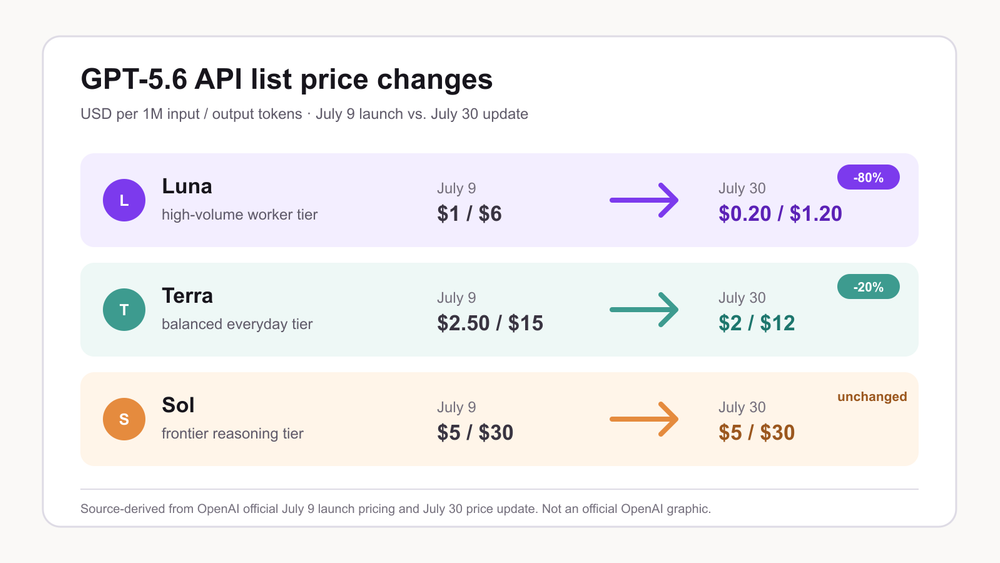
Source: OpenAI's July 9 launch pricing and July 30 price update. This card transcribes API list prices from those official pages; it is not an OpenAI-designed graphic or a benchmark.
The subscription change is easy to misread. OpenAI says ChatGPT and Codex plan prices and quota budgets did not increase. Instead, Luna and Terra now consume fewer usage credits inside paid plans. That should stretch the same allocation further, but it does not reset exhausted usage or create unlimited access.
Sol's Fast mode is a separate choice. OpenAI says it replaces Priority Processing in the API and can deliver up to 2.5 times Standard speed at twice the Standard processing price, with no change in intelligence. Treat the multiplier as a vendor claim and verify latency on your own traffic.
The best use of the new pricing is not “send everything to Luna.” It is to separate uncertainty from execution.
Use a stronger model to resolve ambiguous requirements, choose architecture, or investigate a difficult failure. Once the plan is clear, route repetitive implementation, search, extraction, test generation, and background checks to Luna. Escalate to Terra or Sol when an evaluation fails or the task becomes uncertain again.
OpenAI's engineering post says its own harness reduces repeated work by controlling context bloat, preserving prompt-cache prefixes, and loading tools only when needed. That mechanism matters to builders because a cheap model cannot rescue an agent loop that resends bloated context on every step.
Start with one measured workflow, not a company-wide model swap. Record task completion, human corrections, retries, input tokens, output tokens, tool-call failures, latency, and total cost. Compare Luna with your current model on the same repository and acceptance tests.
A useful test set might include 20 routine issues, five ambiguous bugs, and five long-running tool tasks. Luna should win the routine set on completed-task cost. Terra or Sol may still win when planning errors create expensive rework.
For ordinary Codex and ChatGPT Work users, the immediate benefit is more work from the same paid-plan credit budget when Terra or Luna is available. That does not mean the plan itself became cheaper, and OpenAI did not promise a new quota amount.
The product lesson is bigger than one price cut: model choice is becoming a per-step product decision. A good agent should spend expensive reasoning only where uncertainty justifies it.
Try Luna now if your workload is high-volume, easy to verify, and cheap to retry: classification, repository search, boilerplate implementation, test generation, structured extraction, or background subagents.
Keep Terra in the middle when the work needs stronger judgment but does not justify Sol: normal debugging, feature implementation, code review, or document synthesis with clear acceptance criteria.
Reserve Sol for architecture, ambiguous failures, security-sensitive analysis, hard planning, and final review. Use Fast mode only when waiting has a measurable business cost.
Wait before switching production traffic if you lack representative evaluations, tool-call observability, retry budgets, or a clean fallback path. Price is an input to model routing, not a substitute for reliability data.
OpenAI did not publish independent production success rates for the new price tier. The official post includes customer examples and vendor evaluations, but those do not prove Luna will finish your tasks with fewer retries or less supervision.
The subscription-credit effect also needs account-level observation. OpenAI says Terra and Luna consume fewer credits, but it does not publish a universal conversion table for every plan and workload in the announcement.
Finally, Fast mode's “up to 2.5x” speed is not a latency guarantee. Queueing, prompt length, tool calls, region, and application overhead can dominate end-to-end response time.
My call: Luna is now cheap enough to earn a default-worker trial, but not a default-worker promotion without an evaluation set.
What is the new GPT-5.6 Luna API price?
Starting July 30, 2026, OpenAI lists GPT-5.6 Luna at $0.20 per million input tokens and $1.20 per million output tokens. That is 80% below its July 9 launch price. Actual cost can differ with caching, long context, reasoning, retries, and provider pricing.
Did GPT-5.6 Terra also get cheaper?
Yes. Terra moved from $2.50 to $2 per million input tokens and from $15 to $12 per million output tokens, a 20% reduction. It remains the middle option between low-cost Luna and frontier Sol.
Did Codex and ChatGPT subscription limits increase?
OpenAI says subscription prices and quota budgets remain unchanged. Terra and Luna now consume fewer credits against paid subscriptions, so the same allocation should last longer. The announcement does not promise unlimited access, a quota reset, or one universal credit conversion rate.
Is GPT-5.6 Luna good enough for coding agents?
It may be a strong worker for well-defined coding tasks, but price alone cannot answer that. Test Luna on representative repository work and measure task completion, retries, tool-call reliability, human corrections, latency, and total cost against Terra or Sol.
What is GPT-5.6 Sol Fast mode?
Fast mode replaces API Priority Processing. OpenAI says it can run Sol up to 2.5 times faster than Standard processing at twice the price without changing intelligence. Developers should verify end-to-end latency themselves.
Discover more practical AI products and emerging tools at AIToolHunt.