Newsletter
Join the Community
Subscribe to our newsletter for the latest news and updates
Grok 4.6 is a same-price model update aimed at longer agent runs, coding, and interactive visual work. xAI made it available on August 12, 2026, through its API, Cursor, Grok Build, and Grok Bot. The interesting question is not whether one launch chart looks good. It is whether the model finishes your expensive multi-step tasks with fewer retries.
This is an evidence review, not a hands-on model test. The xAI announcement and official release thread establish the launch, positioning, and unchanged headline API price. The Cursor field guide adds partner observations about coding and longer tasks. Artificial Analysis published an independent evaluation and original comparison chart, but its results are still a point-in-time benchmark rather than proof that every agent workflow will improve.
Grok 4.6 is xAI's hosted frontier model update for coding, long-running agents, and ambitious interactive work. On August 12, 2026, xAI made it available through the API, Cursor, Grok Build, and Grok Bot, while keeping headline API pricing at $2 per million input tokens and $6 per million output tokens. xAI says it handles harder tasks than Grok 4.5 and trained it on model-development work, including inference optimization; those remain vendor claims. In a separate evaluation, Artificial Analysis scored it alongside other frontier models while reporting lower task cost, but that harness cannot predict your repository, tools, or retry policy. The practical change is therefore a testable option, not an automatic migration: builders with expensive multi-step workloads can compare completed-task cost and reliability now, while teams that need stable provider coverage, repeatability data, or independently reproduced safety results should wait.
xAI's official table shows Grok 4.6 High improving over Grok 4.5 High across the listed coding and agent evaluations. It also shows a mixed competitive picture: Grok leads some rows, while GPT-5.6 Sol Max or Claude Fable 5 Max lead others. That is more useful than a blanket “best model” claim.
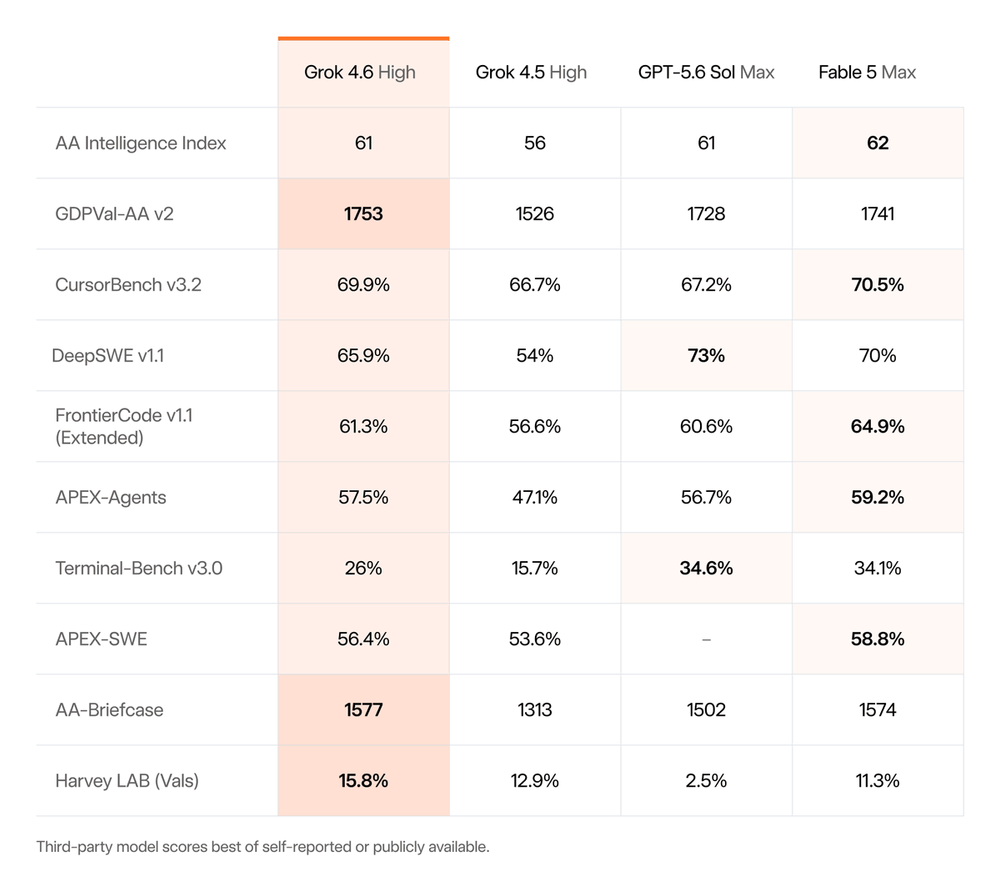
Original comparison table attached to xAI's Grok 4.6 release post. These are xAI-reported launch results; several third-party rows use the best publicly available comparator score, and this article did not reproduce the full table.
The useful reading is workload-specific. Grok 4.6's xAI-reported Terminal-Bench v3.0 result trails the two named rivals in the table, while its GDPval-AA v2 and AA-Briefcase rows are stronger. Before switching, identify which kind of work resembles your actual agent loop.
xAI's model-card discussion says the model was trained on internal model-development tasks such as production inference and kernel optimization. An earlier checkpoint reportedly explored hundreds of candidate optimizations, verified end-to-end effects, and contributed a small number of changes to xAI's production inference stack. This is a concrete vendor case study, not an independent reproduction.
The mechanism that matters to builders is behavioral rather than a new API primitive: the model is meant to keep working, inspect results, and revise its approach over a longer sequence. A model can look fast per token yet become expensive if it loops, calls the wrong tool, or produces patches that need repeated repair. Measure the whole task.
Start with 20 to 50 held-out tasks that your current model already attempts. Keep the agent harness, tool schema, repository snapshot, and stopping rules fixed. Track completion rate, accepted patches, wall-clock time, input and output tokens, cache reads, failed tool calls, retries, and human cleanup.
Do not compare a maximum-effort run on one model with a default-effort run on another. xAI's table labels Grok 4.6 as High, and some public discussions distinguish High from xHigh. Record the exact model and effort setting, then repeat enough tasks to expose variance.
Normal users will encounter Grok 4.6 through products rather than raw API calls. Day-one placement in Cursor and xAI's agent products makes it easy to try on a contained project. The safest test is a reversible job with a visible result: generate a small app, repair a known bug, or assemble a research artifact whose sources you can check.
Wait before trusting it with unattended purchases, credentials, production deployments, or destructive file operations. Better launch scores do not remove the need for permissions, review, and rollback.
Artificial Analysis placed Grok 4.6 at 61 on its Intelligence Index, the same headline score as GPT-5.6 Sol in the captured chart and below Claude Opus 5 and Claude Fable 5 variants. Its accompanying analysis reported strong agentic results and lower task cost than several frontier competitors. Treat both the score and cost as properties of that evaluator's current harness.
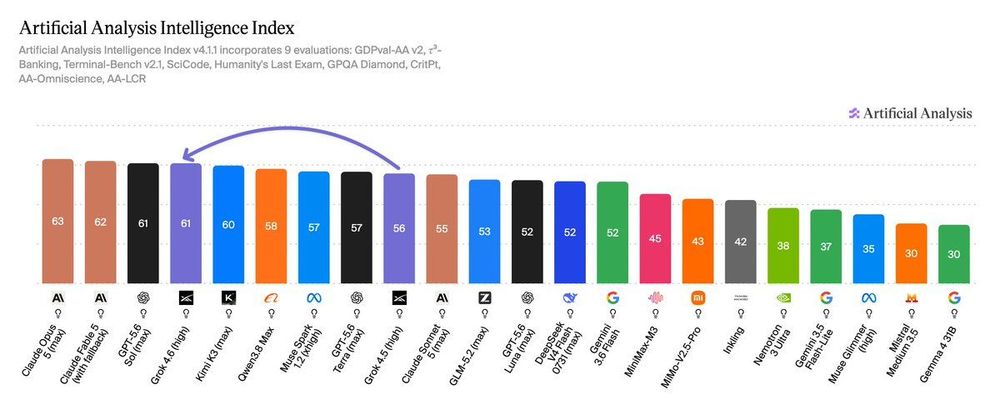
Original chart from Artificial Analysis's Grok 4.6 evaluation thread. The chart is an independent, point-in-time evaluation with its own task mix, effort settings, prices, and confidence limits; it is not a universal quality ranking.
The evaluation strengthens the case for a trial because it does not come from xAI. It still does not answer how the model handles your private code, tool errors, long context, or repeated runs. Cost per successful task—not price per token or one composite score—should decide adoption.
My decision rule: test Grok 4.6 now if long agent runs are a meaningful cost center and you can run a controlled, reversible evaluation. Wait if you need Bedrock availability, stable cross-run variance, independently reproduced safety evidence, or a model you can self-host.
Grok 4.6 looks like a serious price-to-completion candidate. It has not earned an automatic place as every agent's default model.
What is Grok 4.6? Grok 4.6 is xAI's August 2026 hosted model update for coding, long-running agents, and interactive visual work. It is available through xAI's API and several agent products, but xAI has not released open weights for self-hosting.
Is Grok 4.6 available now? Yes. xAI said it was available on August 12, 2026, in the API, Cursor, Grok Build, and Grok Bot. Availability through other cloud marketplaces may differ, so verify the current provider list before planning a migration.
How much does the Grok 4.6 API cost? xAI's launch thread lists $2 per million input tokens and $6 per million output tokens, unchanged from Grok 4.5. Your real cost also depends on cache pricing, prompt size, tool calls, retries, and whether the agent finishes successfully.
How should developers test Grok 4.6? Use held-out tasks with a fixed harness and compare successful completions, accepted patches, wall-clock time, tokens, cache use, retries, tool failures, and cleanup. Record the exact effort setting and repeat tasks so one lucky run does not decide the migration.
What is still unverified about Grok 4.6? The public evidence does not establish repeatability across private workloads, reliable long-context behavior, or independently reproduced safety results. xAI's production optimization story and launch table are vendor-reported; independent benchmarks remain harness-specific snapshots.
Discover practical AI products and emerging tools at AIToolHunt.