Newsletter
Join the Community
Subscribe to our newsletter for the latest news and updates
Kimi K3 arrived with the kind of score that can flatten a complicated model launch into one irresistible headline: No. 1 in Frontend Code Arena with 1679 points.
That result matters. Human voters preferred its generated interfaces enough to move Kimi from 18th with K2.6 to first with K3. The model led six of seven frontend domains and even finished ahead of Claude Fable 5 overall. For developers who care about how quickly a model can turn a prompt into a convincing visual prototype, this is a real change—not a cosmetic version bump.
It is also only one part of the story. K3 is not first on every coding benchmark, its independent intelligence score sits below the leading proprietary models, and early reviewers have already raised questions about speed, verbosity, price, bugs, and whether impressive demos survive real product work.
This report separates the evidence into three lenses: Arena’s human preference test, Artificial Analysis’s independent measurements, and Moonshot AI’s own benchmark table. That is the only fair way to answer the practical question: what is Kimi K3 actually good enough to replace?
Kimi K3 benchmarks show a model with a genuine frontend breakthrough, not a clean sweep of every capability. In the Frontend Code Arena, human voters placed K3 first with 1679 points, up 17 positions from Kimi K2.6; it ranked first in six of seven frontend domains and second in gaming. Artificial Analysis independently scored it at 57 on the Intelligence Index, while measuring 62 output tokens per second and unusually high token use. Moonshot's own benchmark table reports 77.8 on Program Bench, 88.3 on Terminal-Bench 2.1, 81.2 on FrontierSWE, and 42.0 on SWE Marathon. Those results are strong, but not uniformly best: K3 still trails GPT-5.6 Sol or Claude Fable 5 on several coding, reasoning, and agentic tests. The practical verdict is to try K3 first for visually judged frontend prototypes, then verify logic, tests, accessibility, and maintainability before adopting it as a default coding model.
Frontend Code Arena is a preference arena. Models receive frontend tasks, produce working results, and human voters compare outputs without relying solely on a fixed test suite. That makes it particularly useful for qualities that conventional code benchmarks often miss: visual hierarchy, spacing, composition, interaction polish, and whether a generated page feels like a coherent product rather than a pile of components.
Arena’s July 16 result placed Kimi K3 first at 1679. The domain breakdown is more revealing than the headline. K3 ranked first in Brand & Marketing, Reference-Based Design, Data & Analytics, Consumer Product, Simulations, and Content Creation Tools. It ranked second in Gaming, behind Claude Fable 5.
The 17-position jump from K2.6 is the strongest evidence that Moonshot changed something users can perceive. A one- or two-place leaderboard move can reflect a crowded field or confidence intervals. Moving from 18th to first, while leading six distinct categories, is harder to dismiss as noise.
Still, preference is not correctness. A polished dashboard can contain the wrong aggregation. A beautiful form can have broken validation. An animated landing page can fail keyboard navigation, load slowly, or become impossible to maintain. Arena tells us that people liked K3’s frontend outcomes; it does not certify the codebase behind every outcome.
The public evidence is strong enough to confirm the launch, the Arena result, current API access, price, and several independent measurements. It is not yet strong enough to certify K3 as the best coding model for every workload. The comparison below therefore keeps vendor-reported scores, independent measurements, and human preference results in separate rows. No hands-on repository test was performed for this report, and Moonshot’s promised weights and technical report were still pending on July 17.
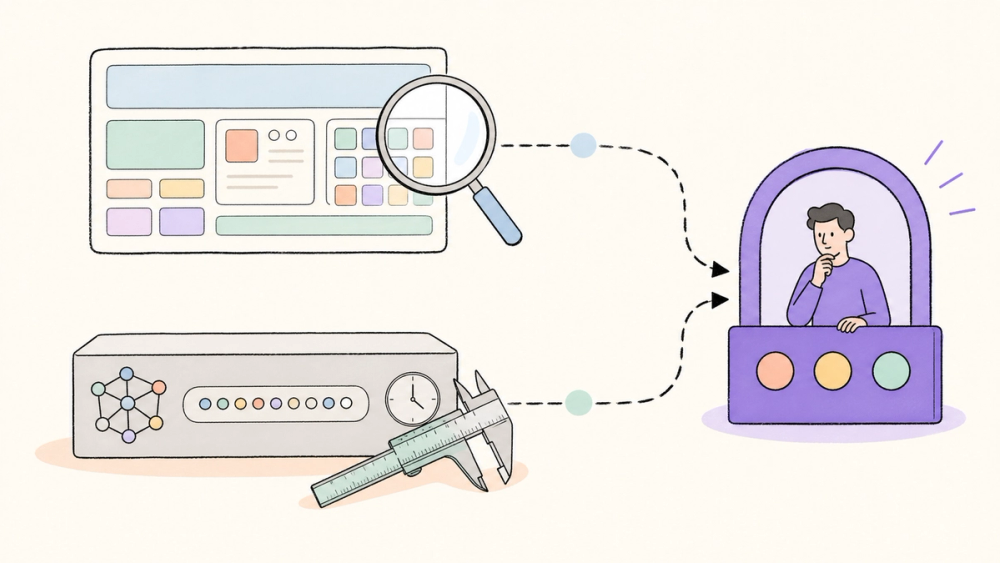
The distinction matters because benchmark names are easy to conflate. The 88.3 figure belongs to Terminal-Bench 2.1, not Frontend Code Arena. Terminal-Bench evaluates agent performance in terminal environments. Frontend Code Arena uses human preferences for generated frontend work. They support different claims.
Artificial Analysis provides the cleanest external counterweight to the launch table. Its live model page gave K3 an Intelligence Index score of 57, placing it near the frontier but not at the top of the field. It measured 62 output tokens per second, below the comparison median of roughly 72–73, and a 1.99-second time to first token.
The same analysis flags unusually high output-token use. K3 consumed about 130 million output tokens across the Intelligence Index evaluation, compared with a median near 63 million. Longer answers are not automatically worse, and they may partly explain stronger completion quality. But verbosity affects latency, cost, review time, and agent loops. A model that reaches the right answer through twice as much output can feel slower and cost more in production than its headline token price suggests.
Moonshot presents K3 as a 2.8-trillion-parameter model with native vision and a one-million-token context window. Its architecture activates only a small fraction of the total experts for a given token—Moonshot says effectively 16 of 896 experts—using Stable LatentMoE, Kimi Delta Attention, and Attention Residuals.
The reported coding results are broad rather than uniformly dominant:
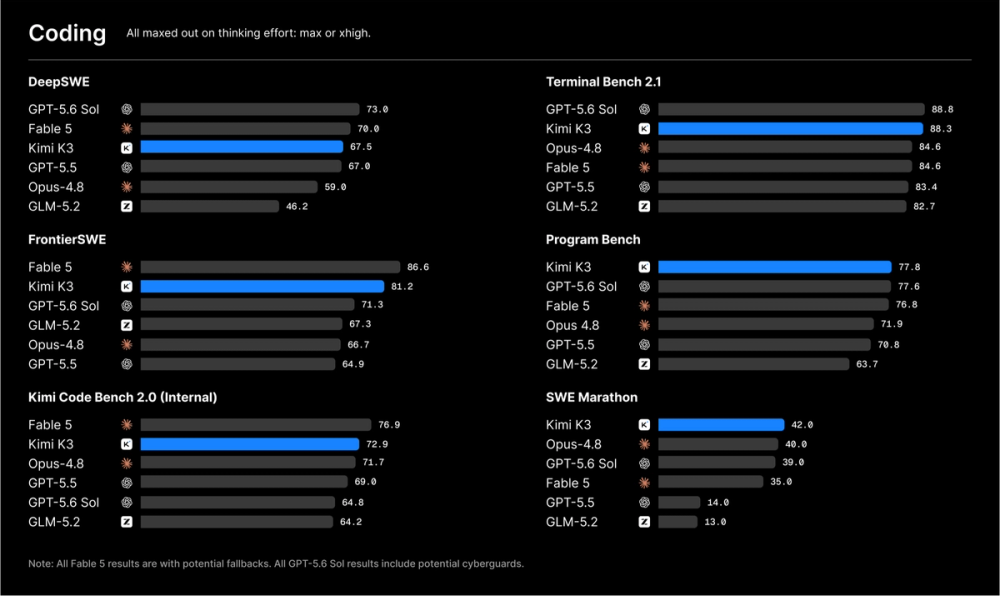
Moonshot AI's original coding benchmark chart. Source: Kimi K3 launch post. These are vendor-reported results at maximum reasoning effort, and the launch footnotes show that benchmark harnesses vary.
The agentic and reasoning picture is similar. Moonshot reports 1668 on GDPval-AA v2, compared with 1760 for Fable and 1748 for Sol. K3 leads the table on BrowseComp at 91.2, while its 43.5 on Humanity’s Last Exam trails Fable’s 53.3 and sits close to Sol’s 44.5.
These are worthwhile results, but readers should preserve the footnotes. Moonshot used maximum effort settings, mixed Kimi Code, Claude Code, and Codex harnesses, and included internal evaluations. Harness quality can materially affect agent benchmarks. Moonshot also says in its own launch post that K3 still trails Claude Fable 5 and GPT-5.6 Sol overall. That unusually direct caveat is more credible than pretending every bolded cell equals universal superiority.
Modern coding models are already capable of producing valid React components, wiring common APIs, and resolving many repository issues. The bigger difference for ordinary AI users is often the distance between “technically rendered” and “looks like something I would use.”
Kimi K3’s Arena result suggests a major reduction in that distance. Leading Reference-Based Design means it may follow a visual target more faithfully. Leading Data & Analytics suggests it can assemble dense dashboards that voters prefer. Leading Consumer Product and Content Creation Tools indicates the improvement is not limited to decorative landing pages.
Early demonstrations point in the same direction. TestingCatalog highlighted strong animated and 3D frontend generations. One reported task took roughly 35 minutes—slower than Fable in that comparison—but produced one of the best outcomes for the prompt. Simon Willison’s hands-on note also used a playful SVG task to inspect the model’s visual coding behavior rather than trusting a table alone.
One community example makes the frontend claim more concrete. Sam Folorunsho recorded a Kimi-generated browser experience styled as a macOS desktop, opened its App Store, installed a Chess application, and played against the computer. That does not prove the underlying code is maintainable or that every prompt will work, but it shows something a leaderboard cell cannot: the generated interface held together across multiple windows, installation feedback, navigation, and an interactive game state.
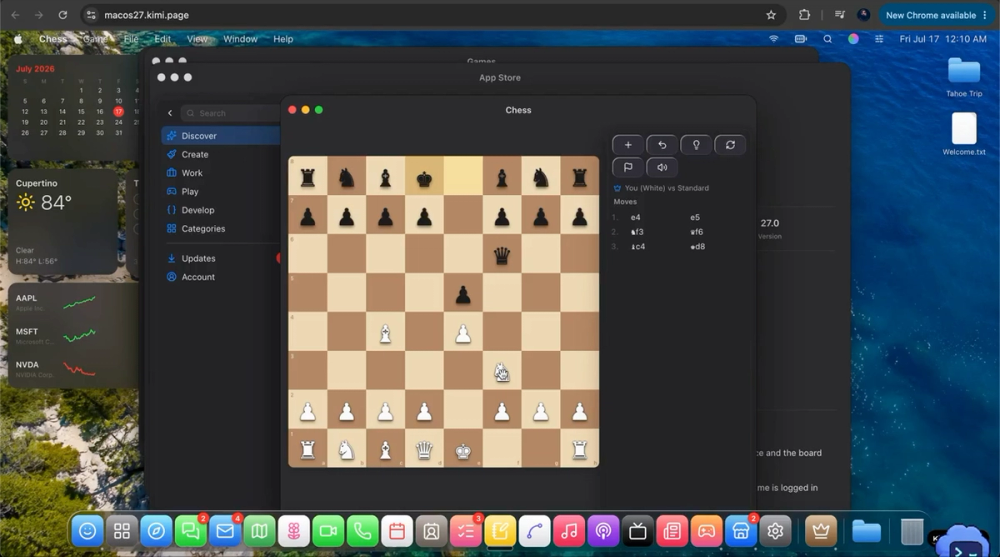
Representative frame captured from Sam Folorunsho's original X video. The linked 33-second recording is the primary community source; this locally stored still is used for accessibility, stable rendering, and Sanity image delivery.
For a longer walkthrough, AICodeKing published a nine-minute coding and frontend test. The video description identifies it as sponsored by Moonshot AI, so it belongs in the article as a demonstration of prompts and outputs—not as an independent verdict or replacement for the official and third-party score sources.
AICodeKing tests Kimi K3 on coding and frontend tasks; the creator identifies the video as sponsored by Moonshot AI, so it is presented as a hands-on demonstration rather than independent benchmark evidence.
Watch on YouTubeThat is promising evidence, not a production guarantee. Curated demonstrations favor self-contained pages where visual quality is immediately legible. Real frontend work includes an existing design system, responsive breakpoints, loading and error states, analytics, localization, accessibility, performance budgets, tests, and code review. K3 now deserves a serious trial on that work; the public evidence does not yet show it consistently completing the whole list.
The most useful coverage shares a broadly positive but split verdict.
Together, the reviews support a narrower conclusion than the launch-day hype: K3 is a legitimate frontier contender with a particularly strong visual coding profile. They do not establish that it is the best model for every repository, every agent task, or every cost-sensitive workflow.
There is also a timing boundary around the word “open.” Moonshot said full weights would arrive by July 27, 2026. At the time of this review, those weights were not yet available for outside inspection, deployment testing, or reproducibility work. It is accurate to call K3 an announced open-weight model; it is premature to treat the promised release as already verified.
Moonshot’s published API rates are $0.30 per million cache-hit input tokens, $3 per million cache-miss input tokens, and $15 per million output tokens. The one-million-token context window is useful for large repositories and document sets, but context capacity does not mean every million-token prompt will be economical or reliable.
For interactive prototyping, 62 output tokens per second is usable. It is not exceptionally fast in Artificial Analysis’s comparison. For agentic workflows, the more consequential issue may be total output. Verbose planning and repeated explanations increase both elapsed time and the expensive output side of the bill.
A fair evaluation should therefore track task-level measures, not token prices alone:
K3 can be cheaper than a competitor per successful task even with premium output pricing if its first frontend attempt needs much less rework. It can also be more expensive if long generations hide bugs that require another full pass. Only a workload-level test can resolve that tradeoff.
Start with a trial, not a default-model migration.
K3 is an especially compelling candidate for greenfield prototypes, reference-based page recreation, dashboards, simulations, and other tasks where visual judgment matters. Give it an actual design system, real data shapes, responsive requirements, and a definition of done. Then compare the resulting pull request with your current model using the same prompt and repository state.
Before shipping, verify four layers:
For backend-heavy migrations, complex debugging, or long autonomous agent runs, the public results do not justify switching on the frontend score alone. Moonshot’s own table shows task-dependent wins and losses. Keep the model that performs best on the kind of failure that is most expensive for your team.
For ordinary AI product enthusiasts, the takeaway is simpler: Kimi has moved from “interesting alternative” to “must-try visual builder.” Try the same concrete frontend prompt in K3 and your current favorite model. Judge the rendered result, then click everything and inspect what is underneath.
What is Kimi K3?
Kimi K3 is Moonshot AI’s 2.8-trillion-parameter mixture-of-experts model with native vision and a one-million-token context window. Moonshot offers it through Kimi.com, Kimi Work, Kimi Code, and its API, and said full model weights would be released by July 27, 2026.
What score did Kimi K3 get in Frontend Code Arena?
Arena reported 1679 points and first place overall. K3 ranked first in six of seven frontend domains and second in Gaming, representing a 17-position improvement over Kimi K2.6.
Is Kimi K3 better than Claude Fable 5 and GPT-5.6 Sol?
It was preferred overall in Frontend Code Arena, but that does not make it universally better. Moonshot’s own table shows K3 ahead on some coding and browsing tests and behind on others. Artificial Analysis also places it below the very top models on its composite Intelligence Index.
How much does the Kimi K3 API cost?
Moonshot lists $0.30 per million cache-hit input tokens, $3 per million cache-miss input tokens, and $15 per million output tokens. Actual task cost depends heavily on cache use and K3’s relatively high output-token consumption.
Are Kimi K3 model weights available now?
They were not available at the time of this July 17 review. Moonshot announced that full weights and a technical report would be released by July 27, 2026, so developers should verify that release before describing K3 as locally deployable.
Compare Kimi K3 with other coding and frontend AI tools at AIToolHunt.