Newsletter
Join the Community
Subscribe to our newsletter for the latest news and updates
Source: Aleph Alpha's Kolibri release. The official cover identifies the release; it does not demonstrate model behavior or performance.
Most open-model launches sell a giant parameter count. Kolibri asks a more useful question: can a team get a long-context, self-hosted English-German model without paying to activate every parameter on every token? The answer is worth a narrow trial for teams with that exact fit—not a reason to replace a proven general-purpose model overnight.
Kolibri is a newly released English-German open model from Aleph Alpha, built for teams that want Apache-licensed weights and a very long context window but can accept a specialized, not yet independently benchmarked option. In its October 3 release, Aleph says Kolibri has 78.1 billion total parameters, activates 3.46B per token, supports up to 1M tokens, and can be downloaded with full weights under Apache 2.0. The company's technical report says it is a mixture-of-experts model: one shared expert and six routed experts run per token, a structure intended to control active compute. An independent launch report repeats those release facts, but it does not independently validate quality, cost, or reliability. Aleph's report also contains vendor-run benchmark results, so they should frame a test plan, not settle a model choice. For a US builder, the first question is whether German-English coverage, self-hosting control, and 1M-context experiments matter more than mature tooling and third-party benchmarks.
The public evidence supports a narrow conclusion: Kolibri is a released, downloadable model with a documented design and a stated operating scope. Its parameter counts, routing description, context ceiling, and license come from Aleph Alpha's own announcement and report. The independent coverage confirms the launch but does not supply a separate benchmark, production reliability study, or cost analysis. That means the article treats release facts as confirmed, vendor comparisons as vendor-run evidence, and every recommendation as a trial decision rather than a claim of universal performance.
The important change is not simply that the model is larger. Aleph says Kolibri routes each token through six of 384 routed experts plus one shared expert. That is why the release can describe a 78.1B-total model while reporting 3.46B active parameters per token. It is a compute-design detail, not a promise that every workload will be cheap or fast.
The release also matters because it is unusually specific about its intended scope. Aleph positions Kolibri around English-German work, regulated organizations, and controlled deployment. That is more actionable than a vague claim that an open model is for everyone. It is also a reason to avoid projecting the release onto a consumer laptop, every language, or an untested agent stack.
Mixture of experts, or MoE, is a model design in which a router selects a small subset of specialized neural-network blocks for each token instead of running every block. Kolibri's public report says its router sends each token to six routed experts and one shared expert. That helps explain the 3.46B active-parameter figure, but it does not erase the operational work of holding, serving, monitoring, and evaluating a 78.1B-total-weight model.
For a developer, the useful lesson is to separate two questions that marketing often blends together. First: how much compute is active for a token? Second: what infrastructure, latency, memory, model-serving setup, and evaluation effort does your real task require? Kolibri's documentation answers the first question at a high level. A pilot must answer the second one on the deployment path you actually intend to use.
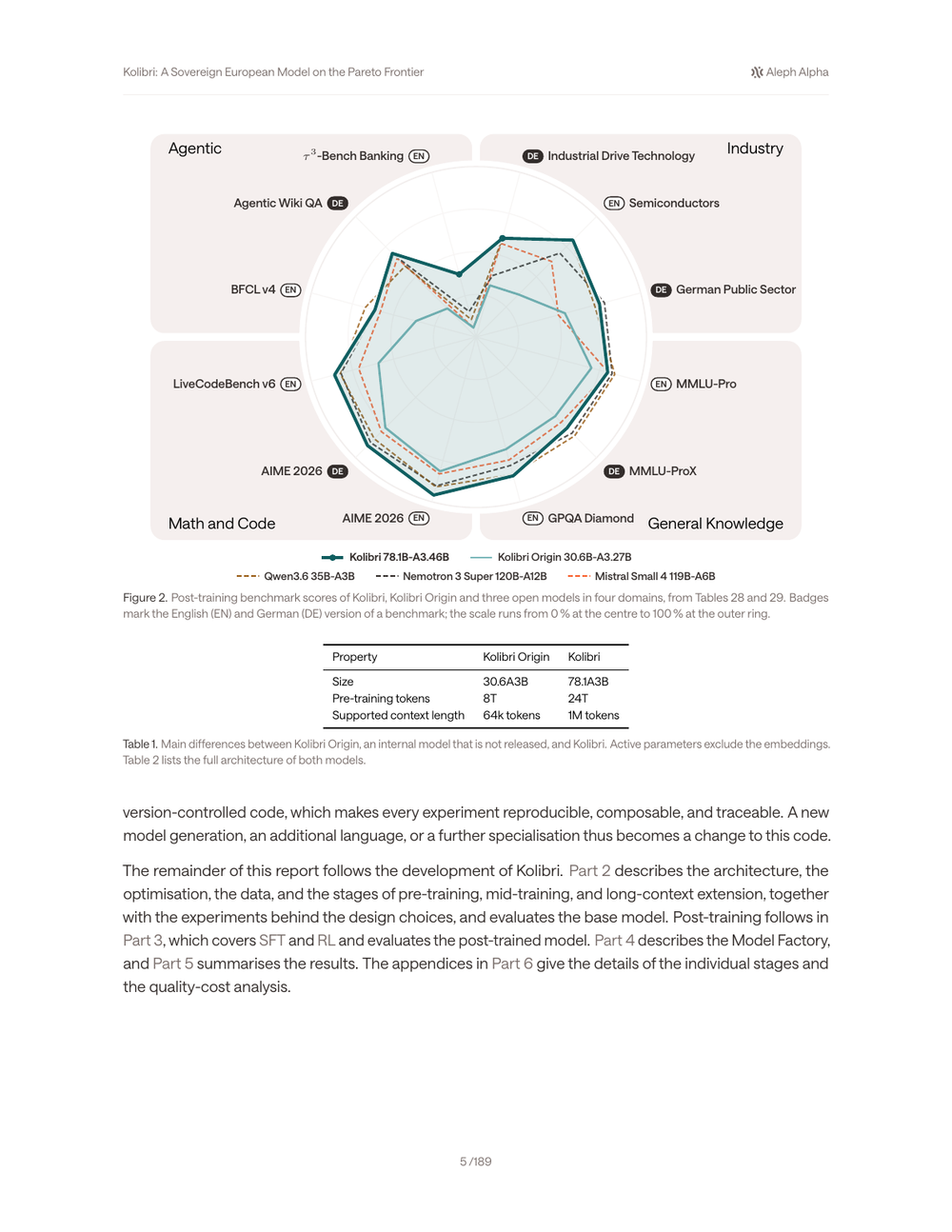
Source: Aleph Alpha's technical report, Figure 2. It is the original vendor-run post-training comparison linked to Tables 28 and 29, not an independently reproduced benchmark or a production-performance guarantee.
Start with a real but reversible English-German task: retrieval over bilingual technical documents, a grounded internal assistant, or a tool-use workflow whose outputs still receive review. Keep the test small enough to compare a baseline model, measure quality separately by language, and log the cost and latency that matter in your own serving environment.
Do not begin with a one-million-token prompt just because that ceiling is public. Long-context claims are most valuable when the retrieval strategy, truncation behavior, latency budget, and evaluation set are already defined. Otherwise, a larger context window can turn into an expensive way to hide an unmeasured failure mode.
The release is interesting because the tradeoff is explicit: a European vendor is putting open weights, bilingual specialization, sparse routing, and controllable reasoning effort into one package. That gives people who follow open models something concrete to inspect beyond a benchmark tweet.
It does not establish that Kolibri is the best open model for English work, that its reported results transfer to every app, or that open weights make a deployment simple. Those are separate decisions, and the current public evidence does not collapse them into one answer.
My take: Kolibri is a credible candidate for a disciplined bilingual open-model evaluation. If your need is simply "the strongest model for any English task," wait for independent comparisons and let a narrower first use case earn the migration.
What is the Kolibri open model?
Kolibri is Aleph Alpha's newly released English-German mixture-of-experts model. The company says it has 78.1B total parameters, activates 3.46B per token, supports up to 1M tokens of context, and ships with downloadable Apache 2.0 weights. Those are release claims, not a guarantee of task-specific quality.
Is Kolibri available now?
Aleph Alpha announced Kolibri on October 3, 2026 and says the full weights can be downloaded on Hugging Face under Apache 2.0. Before planning a deployment, confirm current availability, distribution terms, hardware guidance, and any hosted-access details directly on the official release and model pages.
How is Kolibri different from a dense open model?
Kolibri uses mixture-of-experts routing. Its report says each token uses six routed experts and one shared expert, so only a subset of the model's 78.1B total parameters is active for a token. That can change compute behavior, but it does not by itself determine deployment cost or output quality.
What should developers test before using Kolibri?
Use representative English-German examples, compare a known baseline, separate quality results by language and task, and measure latency and cost in the intended serving setup. Treat the 1M-token context as a testable ceiling, not a reason to skip retrieval, truncation, safety review, or human evaluation.
What is still unverified about Kolibri?
Aleph Alpha publishes a detailed post-training comparison, but the current public evidence does not include an independent reproduction of its scores or a broad production reliability study. Teams should also verify serving requirements, long-context behavior, tool-use quality, and compliance needs against their own workload.
Discover practical AI products and emerging tools at AIToolHunt.