

MAI-Cyber-1-Flash is a real Microsoft AI release, but the useful reading is narrower than the headline. On July 27, Microsoft announced a cybersecurity-specific model running inside MDASH, its multi-agent system for vulnerability identification and remediation, and said the combined MDASH setup reached 95.95% on CyberGym at half the cost of the previous best internal mix. That is interesting for defenders and AI builders because it shows a practical routing pattern: use a smaller specialist for most security work, then escalate the hard cases to a frontier model.
It is not proof that a standalone model can now find every serious bug. The official materials, the model card, and The Hacker News all point to the same boundary: the 95.95% number belongs to MDASH with MAI-Cyber-1-Flash plus GPT-5.4, not to MAI-Cyber-1-Flash alone.
What We Know So Far
Microsoft's launch post says MAI-Cyber-1-Flash is now built into MDASH, a multi-model agentic security system. The company says the new setup combines MAI-Cyber-1-Flash with GPT-5.4, reaches 95.95% on CyberGym, and reduces cost by 50% versus its previous best MDASH model mix. Microsoft also says the specialist model is intended to handle up to 90% of MDASH tasks, with the hardest 10% sent to GPT-5.4.
The MAI-Cyber-1-Flash model card adds the technical shape: 137 billion total parameters, 5 billion active parameters, a 256,000-token context window, and a cybersecurity fine-tune derived from MAI-Code-1-Flash. Access is restricted to select MDASH customers through Azure AI Foundry Private Preview, so ordinary users cannot download it or chat with it directly today.
What is MAI-Cyber-1-Flash?
MAI-Cyber-1-Flash is Microsoft's cybersecurity-specific model for MDASH, not a public chatbot or a downloadable security model. Microsoft's model page says it runs inside MDASH, a multi-agent vulnerability identification and remediation harness, and the model card describes a sparse mixture-of-experts transformer with 137 billion total parameters, 5 billion active parameters, and a 256,000-token context window. The release matters because Microsoft is using the smaller specialist for most MDASH vulnerability-analysis work while routing the hardest remainder to GPT-5.4. The claim to watch is therefore a system claim: Microsoft reports MDASH with MAI-Cyber-1-Flash plus GPT-5.4 at 95.95% on CyberGym, with lower cost than its previous MDASH model mix. Developers should read it as a routing and security-operations story, not proof that one standalone model now solves vulnerability discovery. That distinction helps buyers ask for workflow metrics, not just leaderboard language, before trusting automation in production security review.
What changed in Microsoft's MDASH release?
The change is not just a new model name. Microsoft previously described MDASH as a system with more than 100 specialized agents, and its May 2026 security blog said that MDASH helped find 16 vulnerabilities across Windows networking and authentication components, including four critical remote-code-execution issues. In that earlier post, Microsoft reported an 88.45% public CyberGym score for MDASH.
Now Microsoft says the updated MDASH system, with MAI-Cyber-1-Flash as the high-volume specialist and GPT-5.4 for harder tasks, reaches 95.95% on CyberGym. The company says the cost comparison is against its previous best mix of GPT-5.4, GPT-5.4 mini, and GPT-5.3 codex inside MDASH.
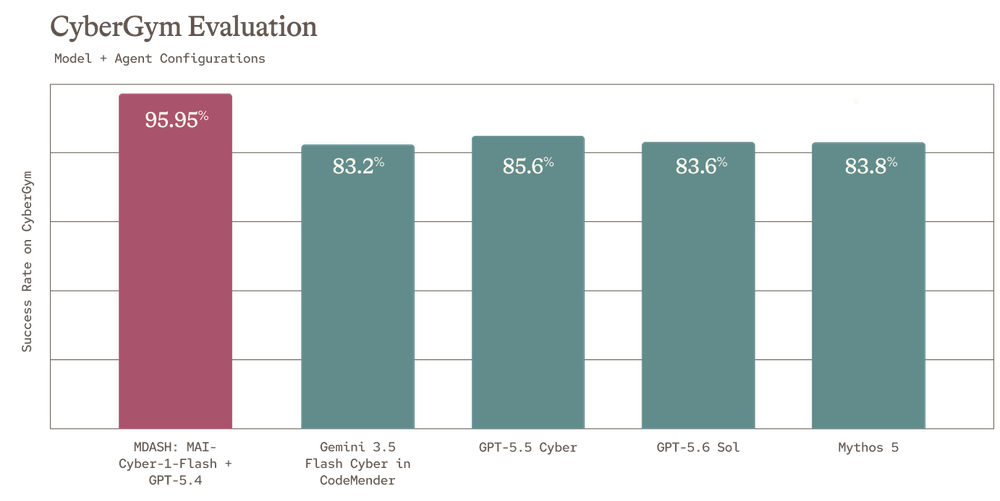
Source: Microsoft's official CyberGym Evaluation chart. The chart is vendor-published evidence for a system-level MDASH benchmark, not an independently reproduced standalone score for MAI-Cyber-1-Flash.
That boundary matters because CyberGym Level 1 gives an agent the vulnerability description and unpatched source code, then checks whether it can produce a working proof of concept against the vulnerable version and not the patched one. It is a useful security-agent benchmark, but it is not the same as blind zero-day discovery, patch correctness, or production incident response.
How does MAI-Cyber-1-Flash work inside MDASH?
Microsoft frames the model as a compact specialist inside a larger orchestration layer. The model card says MAI-Cyber-1-Flash is a cybersecurity fine-tune of MAI-Code-1-Flash, optimized for vulnerability detection, prioritization, and remediation workflows. The launch post says MDASH routes most routine or repeatable tasks to the smaller specialist while reserving GPT-5.4 for the hardest 10%.
The developer view
For developers, the important pattern is model routing, not model worship. Security workflows often mix long code context, vulnerability descriptions, exploit reproduction, patch reasoning, and noisy test feedback. A 256K-context specialist with only 5 billion active parameters could make the common path cheaper if the router is good enough. That is the lesson to borrow even if you never touch MDASH: pair a cheaper domain model with a frontier-model fallback, measure end-to-end task success, and keep human review in the loop.
The product enthusiast view
For ordinary AI product watchers, MAI-Cyber-1-Flash is another sign that the next wave of useful AI may be embedded inside vertical systems rather than sold as general chatbots. You probably will not try this model directly. You may feel its effect if your company uses MDASH, Microsoft Defender integrations, or future security products built around the same agentic workflow.
Why should defenders and builders care?
The attractive part is cost-to-coverage. Security teams do not just need the smartest possible model; they need repeatable coverage across many repositories, alerts, and dependency surfaces. If a specialist can handle most vulnerability-analysis work at materially lower cost, teams can run more checks, run them more often, or reserve frontier-model calls for cases where they actually matter.
The second reason to care is evidence discipline. Microsoft's model card says the evaluation happened in controlled, network-isolated environments and warns that generated text or code may still be inaccurate or incomplete. That is the right kind of caution for a security tool: model output should feed review, reproduction, and test workflows, not bypass them.
What remains unclear?
The biggest open question is independent reproducibility. The Microsoft chart is useful because it is an official artifact, and The Hacker News correctly separates the MDASH system score from the model alone. But Microsoft has not provided enough public detail for outsiders to reproduce the exact 95.95% cost and score combination.
The second gap is access. The model page says MAI-Cyber-1-Flash is available only to verified defenders through MDASH and Azure AI Foundry Private Preview. That is appropriate for a security model, but it means developers cannot easily compare it with open-weight coding or cyber models in their own pipelines.
The third gap is benchmark scope. CyberGym is valuable because it is built from real historical vulnerabilities, but Level 1 gives agents the vulnerability description. Do not translate a high CyberGym score into "this system can replace security engineers." A better reading is: MDASH may be getting cheaper and stronger at guided vulnerability reproduction and remediation workflows.
Quick Take
Try it now if you are a verified enterprise defender already evaluating MDASH, or if your team can measure it against real internal vulnerability workflows with human review. Watch it closely if you build AI security tools, code agents, or model-routing systems. Wait if you need an open model, self-hosting, public API access, or independently reproduced benchmark numbers.
For most AI enthusiasts, the broader takeaway is simple: vertical agent systems are becoming the place where specialized models prove themselves. The headline is not "one cyber model beats everyone." The more useful headline is "Microsoft is showing how a smaller specialist plus a frontier fallback can improve a real security workflow."
FAQ
Is MAI-Cyber-1-Flash available as a public model?
No. Microsoft says access is restricted to verified defenders through MDASH and Azure AI Foundry Private Preview.
Did MAI-Cyber-1-Flash alone score 95.95% on CyberGym?
No. Microsoft's reported 95.95% score is for MDASH using MAI-Cyber-1-Flash plus GPT-5.4.
What makes the model technically notable?
The model card describes a sparse mixture-of-experts model with 137 billion total parameters, 5 billion active parameters, and a 256,000-token context window.
Can developers copy the idea without using MDASH?
Yes, at the architecture level. The reusable idea is to route common domain tasks to a cheaper specialist and reserve a stronger model for hard cases, then judge the full workflow.
What should security teams verify before trusting it?
They should test on their own repositories, confirm reproduction quality, review generated patches, measure false positives, and compare cost against their current scanning and triage workflow.
Discover practical AI products and emerging tools at AIToolHunt.