

Matrix-Game 3.5 is worth attention because it moves world models from demo video toward inspectable developer infrastructure. Riemann Dynamics now has a project page and GitHub repo for an interactive 720p world model, but the honest question is not "is this ready for everyone?" It is "what can builders verify today?"
Quick Navigation
- What is Matrix-Game 3.5? The direct definition and availability boundary
- What changed in this release? Base weights, memory design, and the real-time caveat
- How does Matrix-Game 3.5 work? Patch Memory, PRoPE, reference tokens, and distillation
- Why should builders care now? Where developers can learn from it
- What remains unclear? Hardware, speed, licensing, and deployment gaps
- FAQ: Five practical questions before you try it
What the Public Docs Say
This is a public-source explainer, not a hands-on review. The strongest sources are the Riemann Dynamics project page, the GitHub README, the downloaded official memory-system figure, and independent launch coverage. I am treating the available base models as confirmed, and the distilled real-time autoregressive models as a stated future release.
What is Matrix-Game 3.5?
Matrix-Game 3.5 is Riemann Dynamics' open-weight interactive world model for 720p, camera-controllable video generation in first-person and third-person modes. Its project site and GitHub README describe three changes: Patch Memory plus Warped PRoPE for geometry-aware recall, a static-dynamic split that keeps scene patches separate from subject reference tokens, and a real-time distillation path from a bidirectional diffusion model toward a few-step causal generator. The publishable fact for developers is narrower than the demo hype: the team currently provides two 5B base models built on Wan2.2-TI2V-5B, while the distilled real-time autoregressive models are still listed as coming soon in the README. That means builders can study the repo, requirements, samples, and base weights now, but should treat minute-long real-time interaction as a technical direction to verify, not a finished consumer feature. The useful lens is evaluation, not replacement for a production game engine.
What changed in this release?
- Matrix-Game 3.0 framed the line as real-time streaming interactive world modeling: New public information: Matrix-Game 3.5 adds a public project page, GitHub repo, and base model release path; Why it matters: Developers can inspect the approach instead of relying only on demo clips
- Long-horizon video generation often loses geometry when the camera returns to earlier areas: New public information: The 3.5 docs center Patch Memory and Warped PRoPE for camera-aware recall; Why it matters: The technical bet is memory and camera geometry, not just larger video generation
- Real-time claims are easy to over-read from short videos: New public information: The README says the base bidirectional 5B models are available, while distilled real-time autoregressive models are coming soon; Why it matters: Builders should test the base release now and wait before planning around real-time production use
The biggest change is not just that another world-model demo exists. The GitHub README gives developers installation steps, sample inputs, model download instructions, hardware requirements, and a single infer.py entry point. That turns the story from "cool video" into something a research engineer can actually audit.
The release also matters because it separates what is public today from what is promised next. The repo says it currently provides two pretrained 5B base models for first-person and third-person modes. It also says distilled real-time autoregressive models will be released soon. That gap is where the hype control belongs.
Chinese independent coverage of the WAIC announcement, syndicated by Sina, presents the release as part of Kunlun's broader "world model" push. I would treat that as useful launch context, not as a substitute for the primary technical docs.
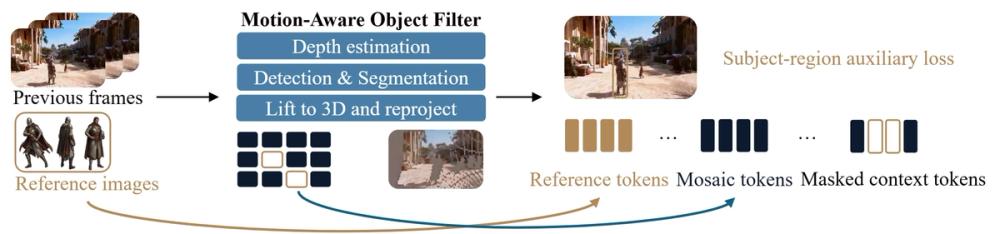
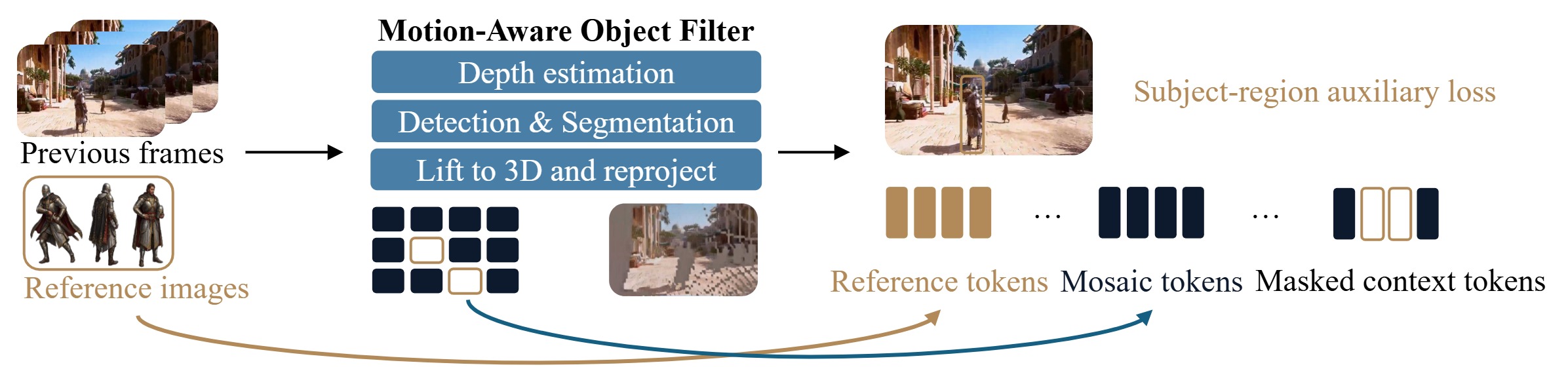
Source: Riemann Dynamics' Matrix-Game 3.5 memory-system figure. It supports the memory-design explanation; it does not prove real-time speed or general product readiness by itself.
How does Matrix-Game 3.5 work?
The mechanism starts with a boring but important problem: if a model generates a world over time, it has to remember where things were when the camera turns back. Pretty clips are not enough. The model needs a way to carry scene structure across viewpoints.
Matrix-Game 3.5's answer is Patch Memory. The public docs describe historical observations being lifted into 3D patch representations, then retrieved for later views. In plain English: instead of asking the model to hallucinate every new frame from scratch, it gets a structured memory of earlier patches that can be aligned with the current camera.
Warped PRoPE handles the camera side of that story. The project page says it injects camera projection geometry into spatiotemporal rotary position embeddings. You do not need to worship the math to understand the product implication: camera motion becomes part of the attention geometry, which is exactly where many video generators get shaky.
The third piece is the static-dynamic split. Static scene areas go into Mosaic Memory, while dynamic subjects are represented through reference tokens. That matters for third-person generation because a model must preserve both the world and the protagonist. If it mixes both into one blurry memory soup, you get ghosting, identity drift, or objects that reappear in the wrong place.
The developer view
This is not a weekend toy for most laptops. The README requirements call for one NVIDIA GPU with at least 40 GB VRAM, Linux, at least 64 GB RAM, and Python 3.10. It also depends on Wan2.2-TI2V-5B and Depth-Anything-3 checkpoints, so your first evaluation cost is environment setup, not prompt writing.
For developers, the useful test is clear: run the bundled first-person or third-person sample, inspect the generated video, inspect memory_visualization.mp4, then change camera trajectory and anchor image separately. If the memory visualization stops making sense, you have learned something more valuable than a social clip could tell you.
The repo is licensed under Apache License 2.0, according to its README, but the model stack includes third-party components and checkpoint dependencies. If you are considering commercial use, review the upstream model licenses and sample asset terms before you build a product plan around it.
The product enthusiast view
For normal AI users, Matrix-Game 3.5 is not yet "type a sentence, get a playable game." The public material is closer to a research release for interactive world generation. That is still exciting, but it changes what you should expect.
The practical near-term use is learning where video AI is going: persistent scenes, controllable cameras, reference identity, and memory across a longer rollout. If you are a creator, game designer, or AI hobbyist, the demos are a preview of a future tool category. If you need something reliable this week, wait for a product wrapper or a hosted demo with clear limits.
Why should builders care now?
- World models are becoming editable systems, not just generated clips. Camera trajectories, anchor images, reference crops, and memory visualization are all developer-facing handles. 2. The memory design is the useful idea to study. Patch Memory and static-dynamic separation are more transferable than any single demo environment. 3. The base release lets teams evaluate tradeoffs early. You can inspect requirements, dependencies, samples, and repo structure before the real-time distilled models arrive.
My take: Matrix-Game 3.5 is interesting because it exposes the scaffolding behind the demo. The best builders will not ask whether it "beats" a closed video model. They will ask whether its memory design can survive the ugly camera paths and object changes their own product would need.
What remains unclear about Matrix-Game 3.5?
The first open question is speed. The project site brands the work as 720p, real-time, and streaming, but the public README still separates available base models from distilled real-time autoregressive models that are coming soon. Until those weights and runnable instructions are public, real-time product planning should stay conservative.
The second question is reproducibility outside the authors' tested stack. A 40 GB VRAM requirement already narrows the audience. Different drivers, CUDA versions, checkpoint paths, prompts, and camera files can turn a clean README into a long debugging session.
The third question is product fit. Interactive world generation could matter for game prototyping, robotics simulation, embodied agents, XR, and creator tools. It could also remain a research artifact if setup cost, latency, visual stability, or licensing complexity stays high.
Quick Take
- What is actually new?: Evidence-backed answer: Matrix-Game 3.5 publishes a project page and repo for a memory-augmented 720p interactive world model.
- Who can use it now?: Evidence-backed answer: Developers with a Linux machine, a 40 GB VRAM NVIDIA GPU, and patience for checkpoint setup.
- What is the strongest evidence?: Evidence-backed answer: The Riemann Dynamics project site and GitHub README.
- What should developers verify?: Evidence-backed answer: Memory visualization quality, camera trajectory handling, hardware use, and third-party license constraints.
- What is still unknown?: Evidence-backed answer: Public readiness of the distilled real-time autoregressive models and real-world stability beyond curated samples.
The short version: try Matrix-Game 3.5 if you want to understand where controllable world models are heading; wait if you need a polished consumer tool or a production SLA.
FAQ
What is Matrix-Game 3.5?
Matrix-Game 3.5 is an interactive world model from Riemann Dynamics for 720p camera-controllable video generation. The public release includes a project page, GitHub repo, and two 5B base models for first-person and third-person modes.
Is Matrix-Game 3.5 available now?
Partly. The GitHub README says the 5B base models are available through the linked model repository, but the distilled real-time autoregressive models are still described as coming soon. Treat the current release as research/developer access.
How is Matrix-Game 3.5 different from Matrix-Game 3.0?
The 3.5 release emphasizes Patch Memory, Warped PRoPE, static-dynamic separation, and a real-time distillation framework. Compared with the earlier Matrix-Game 3.0 framing, this version puts more public detail around memory and camera geometry.
What should developers know before using Matrix-Game 3.5?
The requirements are heavy: Linux, Python 3.10, at least 64 GB RAM, and an NVIDIA GPU with at least 40 GB VRAM. Start with the bundled samples before changing prompts, cameras, or reference images.
What is still unverified about Matrix-Game 3.5?
The big unknown is practical real-time readiness. The public docs show the architecture and base model release, but the distilled real-time autoregressive models are still pending. Independent performance testing across non-curated scenes is also missing.
Discover practical AI products and emerging tools at AIToolHunt.