Newsletter
Join the Community
Subscribe to our newsletter for the latest news and updates
MiMo-V2.6-Pro is open-weight, multimodal, and aggressively priced. It is also a 1.02-trillion-parameter mixture-of-experts model whose official self-hosting examples assume serious multi-GPU infrastructure. That makes this less of a laptop-model story and more of a test of whether open agent training can produce a useful API-era alternative.
MiMo-V2.6-Pro is Xiaomi's flagship open-weight, multimodal agent model, released on September 22, 2026 under an MIT license. The official release says it accepts text, images, video, and audio, supports a 1-million-token context window, and is available through Xiaomi products, its API, OpenRouter, and public weights. The pinned model card identifies a 1.02-trillion-parameter mixture-of-experts architecture with 42 billion parameters active per request. Xiaomi reports that one mixed reinforcement-learning run improved coding, general-agent, visual, and cybersecurity tasks, but those benchmark results remain vendor-run. Separately, Artificial Analysis placed the model at 46 on its Intelligence Index and called it the leading open-weights model at launch. The practical conclusion is narrower: developers can inspect the weights and try a low-cost API today, while self-hosting the flagship checkpoint requires infrastructure far beyond a typical workstation, making an API the practical starting point for a reversible evaluation.
This is a source-based launch analysis, not an AIToolHunt hands-on benchmark. Xiaomi's release page, pinned model card, and technical report establish the public weights, license, architecture, training design, deployment recipes, and vendor-reported evaluation results. Artificial Analysis supplies an independent model score and price-efficiency signal, while The Decoder independently confirms the launch and pricing.
The evidence does not establish universal superiority. Xiaomi chose the tasks, harnesses, graders, checkpoints, and comparison settings in its technical report. Artificial Analysis uses a separate composite index, which is useful for relative positioning but cannot predict how the model will perform inside your repository, browser workflow, or multimodal product.
The important change is a combined model-and-training release. Xiaomi did not only publish a larger checkpoint; it documented a single reinforcement-learning run that mixed coding, general-agent, visual, and cybersecurity environments.
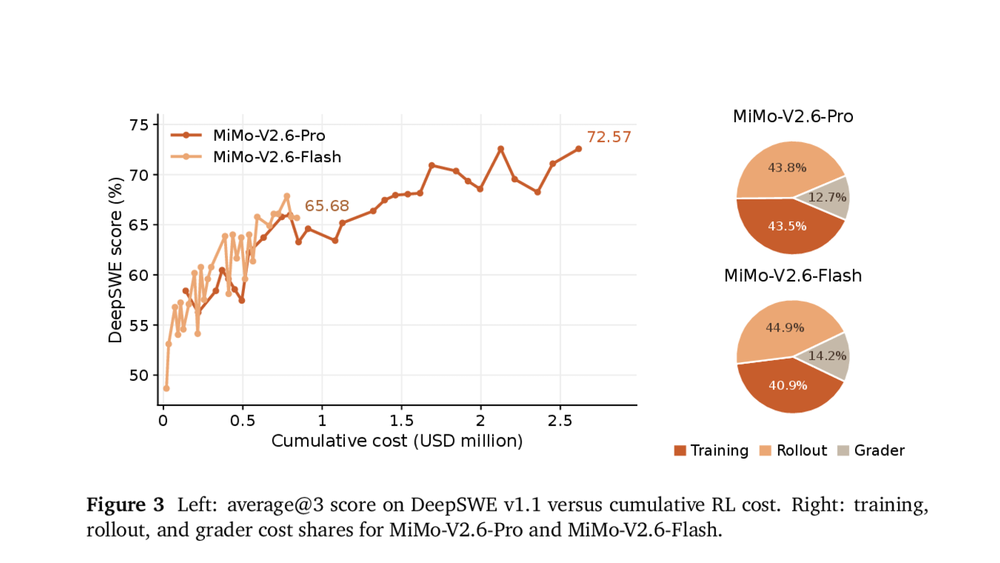
Source: Xiaomi's pinned MiMo-V2.6 technical report, Figure 3. The chart reports Xiaomi's own average-at-three DeepSWE v1.1 results and cost allocation; AIToolHunt did not reproduce the training run or benchmark harness.
The figure is useful because it shows what Xiaomi actually spent compute on. For Pro, the report assigns 43.5% of reinforcement-learning cost to training, 43.8% to rollouts, and 12.7% to grading. It also reports DeepSWE average-at-three rising from 58.4 to 72.6 as cumulative RL cost reached roughly $2.6 million. That is evidence of Xiaomi's run, not proof that every downstream agent will improve by the same amount.
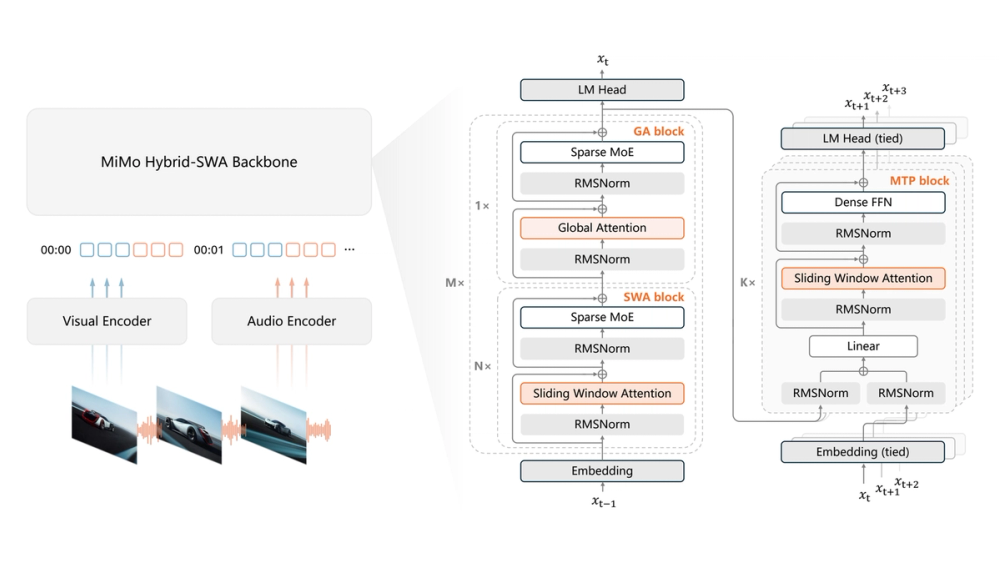
MiMo-V2.6-Pro uses a sparse mixture-of-experts backbone. “Sparse” means the model stores far more parameters than it activates for each token: 1.02 trillion total, 42 billion active. The backbone alternates sliding-window attention, which concentrates on nearby context, with periodic global-attention blocks that reconnect distant information.
The reinforcement-learning run is the more interesting layer. Xiaomi says each update used 1,568 prompts with 16 rollouts apiece—about 25,000 candidate trajectories and 2.7 to 3.7 billion training tokens per step. Coding, office, visual, and cybersecurity tasks shared the batch instead of training separate specialist checkpoints.
Binary tests cannot distinguish two solutions that both pass. Xiaomi's groupwise grader compares trajectories inside each rollout group, builds task-specific rubrics, and redistributes reward toward stronger passing solutions. The intended effect is to reward not just success, but cleaner paths and lower token use. This is a vendor-described mechanism; its broader reproducibility depends on the promised environments, graders, and training code being complete enough for outsiders to run.
The lowest-risk evaluation path is API-first. Xiaomi lists MiMo-V2.6-Pro at $0.435 per million cache-miss input tokens and $0.87 per million output tokens as of September 22, 2026. Artificial Analysis reports $0.13 per composite-index task, which suggests a strong cost position but is not a workload quote.
Self-hosting is a different project. The official SGLang example uses tensor parallelism across 16 ways plus data parallelism across two nodes; the vLLM example uses tensor parallelism across eight devices. Those are reference recipes rather than minimum requirements, but they make the boundary obvious: downloadable weights do not turn a trillion-parameter model into a desktop install.
A useful pilot should pin the exact checkpoint, choose one harness, and log task success, wall-clock time, total tokens, tool errors, recovery behavior, and cost. Compare Pro against Flash and one incumbent model on the same tasks. If the harness changes, the benchmark changed.
Ordinary users can try the model through Xiaomi's AI Studio, MiMo Desktop, or third-party API access without managing the weights. The official demos cover software, office work, visual design, audio, and computer-use scenarios, but they are curated examples rather than reliability studies.
The most reasonable expectation is broad capability at an attractive price, not guaranteed autonomous work. A model can understand several modalities and still fail on permissions, long task recovery, browser state, or exact visual details. Try reversible tasks first and keep confirmation steps around file changes, purchases, messages, and production systems.
The decision rule is straightforward: test Pro through an API if agent quality per dollar matters, test Flash when latency or volume matters more, and consider self-hosting only when control justifies infrastructure at this scale.
API builders with repeatable coding, document, browser, or multimodal tasks should run a controlled comparison now. The combination of public weights, low listed pricing, and independent index placement is strong enough to justify a pilot.
Research teams with multi-GPU serving capacity may also learn from the checkpoint and report. They should verify that every promised training environment, grader, and framework component is actually available and reproducible before designing a research plan around the release.
Wait if your only question is whether the model “wins” a leaderboard. Composite scores hide harness quality, token budgets, latency, and failure recovery. Also wait if your use case involves irreversible actions and you do not yet have approval checkpoints, sandboxing, and logs.
These gaps do not make the release uninteresting. They define the tests a careful team should run before changing models.
My take: MiMo-V2.6-Pro is worth an API pilot because the evidence and price clear that bar. “Open weights” alone does not clear the self-hosting bar.
Is MiMo-V2.6-Pro available now?
Yes. Xiaomi says Pro and Flash are available through AI Studio, MiMo Code, MiMo Desktop, its API platform, OpenRouter, Hugging Face, and ModelScope as of September 22, 2026. Access conditions and regional availability can vary by service.
Is MiMo-V2.6-Pro really open source?
The model card publishes the weights under an MIT license, so “open-weight” is the precise description for the checkpoint. Xiaomi also says it is opening training environments and RL code, but developers should inspect the released repositories before assuming the full training run is reproducible.
Can MiMo-V2.6-Pro run on a local workstation?
Not realistically for most developers. The model has 1.02 trillion total parameters and 42 billion active per token. Official serving examples use eight-way or larger tensor parallelism. Use an API first unless you already operate substantial multi-GPU infrastructure.
How much does the MiMo-V2.6-Pro API cost?
Xiaomi lists $0.435 per million cache-miss input tokens and $0.87 per million output tokens as of September 22, 2026, with a lower cache-hit input price. Verify the live pricing page before budgeting because promotions, regions, and providers may differ.
Should agent developers switch to MiMo-V2.6-Pro?
Run a fixed pilot before switching. Compare Pro, Flash, and your incumbent model on identical tasks and one unchanged harness. Measure success, recovery, latency, tokens, tool errors, and cost. A leaderboard score is a reason to test, not a migration plan.
Discover practical AI products and emerging tools at AIToolHunt.