Newsletter
Join the Community
Subscribe to our newsletter for the latest news and updates
Official artwork from Modular's Mojo open source announcement.
Mojo open source is now more than a public standard library. Modular has released the language's compiler and toolchain, giving AI developers a real source tree they can inspect, build, and fork. The important question is not whether this sounds ambitious. It is whether the new transparency removes enough risk to justify trying Mojo now.
Mojo open source means Modular has released the Mojo compiler, build tools, and related source code—not merely the standard library—under Apache 2.0 with LLVM exceptions. As of August 18, 2026, developers can inspect, fork, and build the language from the public repository, which materially reduces dependence on a closed compiler. The official announcement says the whole compiler and toolchain are available, while the repository README identifies KGEN as the compiler source. This does not make Mojo a drop-in Python replacement or prove production maturity. Independent developer Simon Willison notes that Mojo now presents itself as a Python-inspired language focused on GPU programming, not necessarily a full Python superset. Modular also says compiler and tooling contributions are not yet accepted, even though the code can be built and modified. The practical change is auditability and experimentation today; ecosystem depth, compatibility, and contribution governance still need time.
Mojo 1.0 and Mojo's source release are separate events. The Mojo 1.0 release notes are dated August 11, 2026, and focus on language and standard-library stability policies. The compiler and toolchain became public one week later, on August 18.
The license is a meaningful part of the change. For covered repository code, Modular uses Apache 2.0 with LLVM exceptions. That makes inspection and internal experimentation easier to evaluate than a closed toolchain. The repository README separately identifies a Modular Community License for MAX usage and distribution and tells users to validate the licenses of third-party software they combine with it.
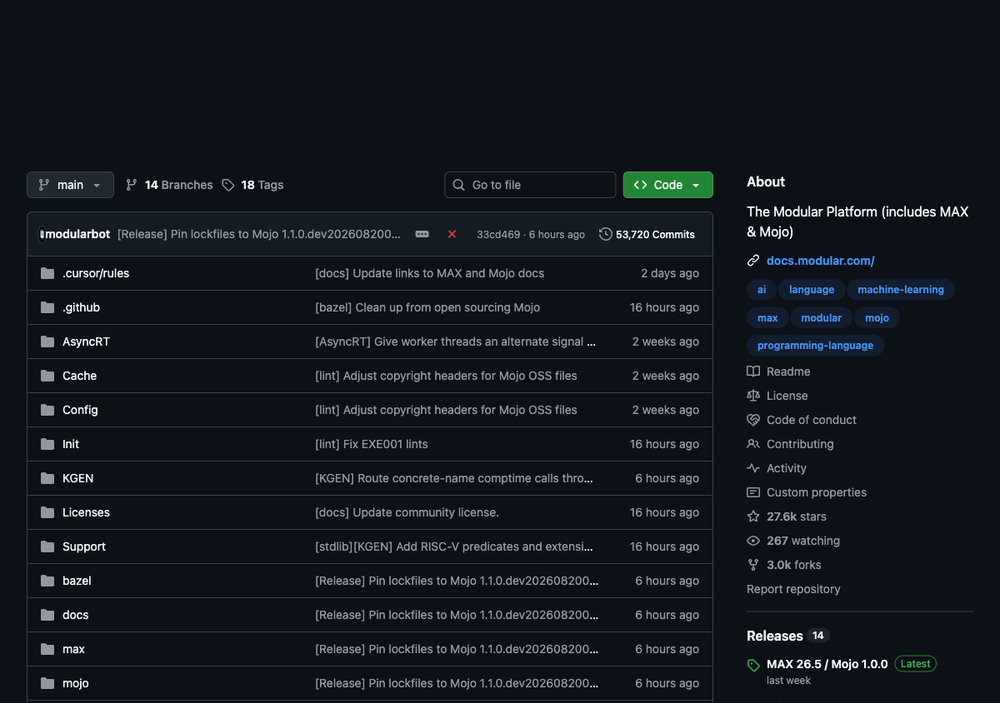
Source: the public Modular repository, captured August 20, 2026. The screenshot proves that the source tree and KGEN directory are publicly visible; it does not prove runtime performance or production adoption.
The public repository separates major components instead of presenting Mojo as one opaque download. Its README points to KGEN for the compiler, mojo/stdlib for the standard library, and separate max directories for accelerator and inference components.
Modular's announcement documents a Bazel source build using --config=build-mojo and the //KGEN:mojo target. In plain English, Bazel is the build system that resolves the repository's components and produces the compiler binary. The source is visible enough for a developer to trace and modify that path, then run the language's tests against a custom build.
There is still a bootstrapping boundary. Modular says a prebuilt Mojo compiler is currently necessary when customizing MAX kernels or models. Open source therefore improves inspectability and control, but it does not eliminate every dependency on Modular's distributed tooling.
This release is most actionable for compiler engineers, GPU-kernel developers, language researchers, and ML infrastructure teams. They can inspect the compiler implementation, test a private fork, and compare the documented source build with their deployment requirements.
Contribution access is narrower than source access. Modular says the standard library has accepted contributions since 2024, but it is not yet accepting compiler or tooling contributions and aims to open that path by the end of 2026. FOSS Force independently highlighted the same governance limit. That is a reason to experiment, not a reason to promise upstream influence.
For most people using AI chatbots, image tools, or Python application frameworks, this release does not unlock a new consumer feature. Its value is upstream: a potentially important AI-systems language is now easier for developers to audit and shape.
If you mainly assemble APIs, agent frameworks, or data pipelines, the source release may not solve your immediate bottleneck. Python's package ecosystem and team familiarity can matter more than compiler access. Watch what builders ship with Mojo before treating openness alone as proof of practical advantage.
Try it now if you build GPU kernels or heterogeneous systems — the compiler source gives you a concrete path to inspect code generation and experiment with a fork.
Run a bounded evaluation if toolchain control matters — confirm that your team can reproduce the documented build, license review, and test flow before discussing adoption.
Wait if you need a drop-in Python replacement — independent reporting says Mojo's direction is Python-inspired GPU programming, not guaranteed full Python compatibility.
Wait if upstream compiler influence is required — source is public, but compiler and tooling contributions are not yet accepted.
The useful decision is smaller than “replace Python.” Pick one compute-heavy component, reproduce the source build, and measure the engineering cost around it. If the surrounding packages, debugging workflow, and team skills become the bottleneck, the open compiler has not yet solved your problem.
The public evidence establishes the release date, source availability, license, repository layout, and current contribution boundary. It also establishes that Mojo 1.0 preceded this event by one week. Those are verifiable facts.
What remains unclear is just as important:
The open source release lowers adoption risk because developers can inspect and fork the toolchain. It does not, by itself, demonstrate ecosystem maturity, support quality, or a universal performance advantage.
Bottom line: Mojo is now credible enough for a bounded systems experiment, but openness is the beginning of its adoption test—not the result.
Is the Mojo compiler really open source now?
Yes. Modular published the compiler and toolchain source on August 18, 2026, and the public repository identifies KGEN as the compiler directory. The repository uses Apache 2.0 with LLVM exceptions for covered code, while MAX and third-party components may carry separate terms.
Can Mojo replace Python for AI development?
Not as a general assumption. Mojo uses Python-inspired syntax and targets high-performance, GPU-oriented programming, but independent reporting notes that a full Python superset is no longer the guaranteed direction. Teams should test package compatibility and workflow cost before moving an application.
Can developers contribute to the Mojo compiler today?
Not yet. Modular says outside contributions to the compiler and tooling are not currently accepted, although the source can be read, built, modified, and forked. Standard-library contributions have been accepted since 2024, and compiler contributions are targeted for later in 2026.
Who should try Mojo open source first?
Compiler engineers, GPU-kernel developers, ML infrastructure teams, and language researchers have the clearest reason to try it. They can evaluate source quality, build reproducibility, and hardware targeting. Most Python API developers can wait for stronger package and production evidence.
What should a Mojo evaluation test before adoption?
Start with one compute-heavy component. Reproduce the source build, inspect license boundaries, confirm target-hardware support, and record debugging and integration costs. The test should answer whether Mojo improves that component without making the surrounding system harder to maintain.
Discover more practical AI developer tools at AIToolHunt.