Newsletter
Join the Community
Subscribe to our newsletter for the latest news and updates
NVIDIA has agreed to acquire Hugging Face for $12.93 billion. The price is the loud part; the useful question is quieter: will developers still get a neutral Hub for models, frameworks, clouds, inference providers, and non-NVIDIA hardware? Official statements promise yes. Today’s evidence does not prove what the defaults will look like a year from now.
The NVIDIA Hugging Face acquisition is a $12.93 billion agreement announced on September 3, 2026, for NVIDIA to acquire the company behind the widely used open-model Hub. NVIDIA’s official announcement says it plans to scale the platform, strengthen its infrastructure, and expand developer access. Hugging Face CEO Clément Delangue separately said the founders and team will stay, while the platform is intended to remain open, independent, and compute agnostic. Those are confirmed public commitments, not evidence that every future ranking, default service, price, cloud integration, or accelerator path will remain neutral. For ordinary users, the announcement delivers no new feature, price, or access tier today. For developers, the sensible response is neither panic nor blind trust: keep shipping, record today’s behavior as a baseline, and monitor whether models remain equally discoverable, downloadable, and deployable across vendors after the deal progresses.
The short answer is almost nothing visible yet. Hugging Face’s own cofounder says users should not expect an immediate change. That means there is no evidence-based reason to move models, rewrite deployment code, or abandon the Hub solely because of the announcement.
What did change is the expected incentive structure if the deal closes. Hugging Face would sit inside the company that dominates AI accelerators and wants more developers running open models. NVIDIA says it will invest in the Hub’s infrastructure and reach. Better capacity, integrations, and enterprise support could be useful—but the planned ownership would also create a reason to favor NVIDIA-optimized paths over rivals.
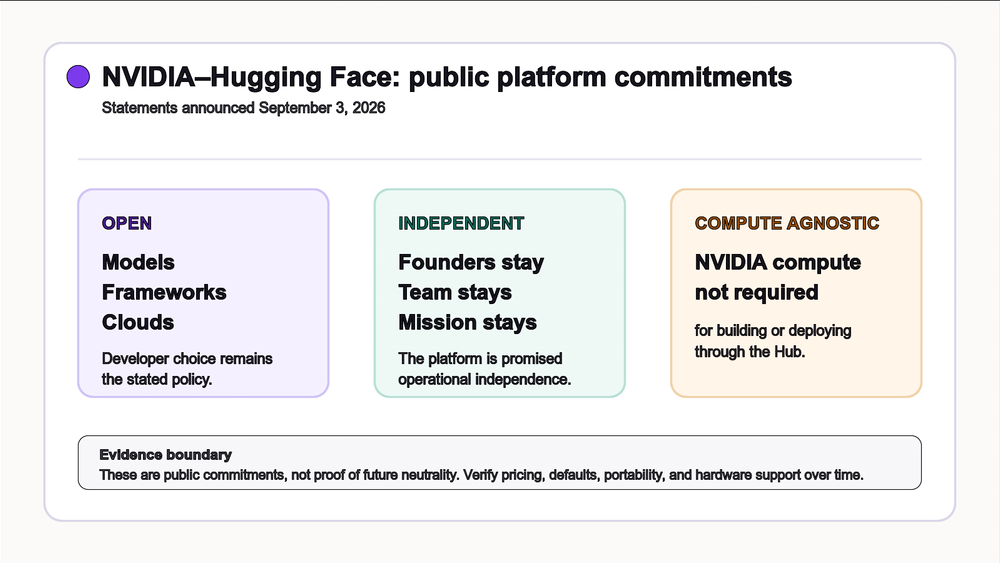
Sources: NVIDIA’s official announcement, NVIDIA Newsroom, and Hugging Face CEO Clément Delangue. This source-derived summary records public commitments; it does not claim that future neutrality has been independently proven.
Neutrality is not binary. A platform can remain open while gradually steering behavior through defaults, ranking, pricing, documentation, or the quality of first-party integrations. None of those changes has been announced. They are the practical surfaces worth watching.
For example, NVIDIA could make its own inference path faster to configure, give its models better placement, or ship deeper observability for its hardware. Those improvements would not automatically block AMD, Google, Amazon, or other providers. But they could make the nominally open choice less competitive in everyday use.
The opposite outcome is also plausible. NVIDIA could fund better model hosting, faster downloads, stronger security, and more reliable tools while preserving equal access. The announcement gives us promises, not enough operational detail to choose between these outcomes.
If your workflow only downloads public weights and deploys elsewhere, the near-term risk is lower than it is for teams that depend on hosted inference, private repositories, enterprise controls, or marketplace discovery. The deeper the Hub sits in your production path, the more useful a portability baseline becomes.
Capture model and dataset identifiers, revisions, licenses, access rules, inference-provider configuration, download routes, billing behavior, and supported accelerators. Keep deployment manifests outside a single provider’s console. Confirm that a critical repository can be mirrored or restored without inventing a crisis migration.
For a normal user browsing demos or trying open models, the deal is not a feature launch. You do not get a new capability today. The upside is potential investment in faster, more reliable access; the risk is subtle steering toward one company’s ecosystem.
Watch the product, not the slogans. If search results, featured models, default inference providers, or hardware recommendations start changing, those are observable signals. A corporate logo on a deal announcement is not enough by itself.
Create a lightweight quarterly check instead of arguing from vibes:
The goal is not to prove motive. It is to detect product behavior that raises switching cost or reduces choice. A neutral platform should make those checks boring.
Act now if your company has a formal vendor-neutrality, data residency, procurement, or business-continuity requirement. “Act” means document dependencies and test a recovery path—not evacuate. Teams running private repositories or hosted inference should know exactly which Hugging Face services are difficult to replace.
Wait if you use the Hub casually, download public models, or have no observed change to your workflow. The official commitments are favorable, and the cost of a premature migration can exceed the risk it claims to solve.
Test later when the combined company announces new defaults, pricing, enterprise packaging, ranking rules, or hardware integrations. That is when comparison becomes evidence instead of speculation.
Bottom line: if the deal closes, it will change who owns the Hub, not what most developers need to do tonight. Trust the commitment enough to avoid panic; verify it enough to preserve leverage.
Did NVIDIA already complete the Hugging Face acquisition?
The companies announced a definitive agreement on September 3, 2026. The reviewed official wording describes an agreement to acquire, so it is more accurate to avoid saying the transaction has already closed.
Will Hugging Face require NVIDIA GPUs now?
NVIDIA says no. Its public commitment says NVIDIA compute will not be required to build on or deploy through Hugging Face. That is a clear promise, but developers should still monitor future defaults, documentation, and integration parity.
Should developers move their models off Hugging Face?
Not based on the announcement alone. Hugging Face says nothing changes for users today. Teams with strict continuity requirements should document dependencies and test mirrors or recovery paths, but a panic migration would outrun the evidence.
What would show that Hugging Face is no longer neutral?
Watch for measurable steering: unequal search visibility, vendor-biased defaults, worse support for non-NVIDIA accelerators, harder exports, inconsistent pricing presentation, or undocumented ranking policies. Ownership alone does not prove those outcomes.
What is the biggest potential benefit of the deal?
More infrastructure, compute access, enterprise support, and visibility could make open models easier to host and use. Those benefits are plans, not delivered features yet, so users should judge them when product changes ship.
Discover practical AI products and emerging developer tools at AIToolHunt.