
OpenAI says an internal version of Astra generated arguments for ten long-open problems in mathematics and theoretical computer science. The company also released a 249-page manuscript and Lean formalizations. That is a serious evidence package, but it is not the same as ten independently accepted breakthroughs—or a model you can use today.
The useful question is not whether the announcement sounds historic. It is what a developer, researcher, or AI enthusiast can verify right now.
Quick Navigation
- What is OpenAI Astra? The unreleased model and the public proof package.
- What changed? Ten manuscripts, formal certificates, and a stated human role.
- What does Lean verify? The difference between kernel checking and community acceptance.
- Who should care now? Researchers, tool builders, and normal AI users.
- What remains unclear? Access, reproducibility, review, and generalization.
- FAQ: Five direct answers about Astra, proofs, Lean, availability, and impact.
What We Know So Far
OpenAI then provided three inspectable artifacts: an official announcement, a 249-page manuscript, and an Apache-2.0 Lean repository with one formalization module for each result.
OpenAI says the mathematical arguments came from an internal Astra model, while humans prepared manuscripts and helped formalize the results. That attribution is a vendor statement, not an independently auditable transcript of the discovery process.
The wider mathematics community has already set a higher bar. The Leiden Declaration calls for transparent methods, independent verification, formal proofs where appropriate, and peer-reviewed publication. A Nature editorial likewise emphasizes transparency, integrity, and fairness when AI enters mathematical research.
This article analyzes the public artifacts. It does not claim hands-on access to Astra or independent validation of all ten mathematical results.
What is OpenAI Astra?
OpenAI Astra is the name of the company's next major model family, but the version behind these math results is internal and not publicly available as of August 2, 2026. What is public is unusually substantial: OpenAI released a 249-page collection covering ten claimed advances, plus a Lean 4 repository with a formalization module for each result and instructions for building them. OpenAI says Astra generated the core arguments, humans prepared the manuscripts with the model, and the model later formalized each argument. Those statements establish provenance only at the level OpenAI disclosed. They do not reveal the failed attempts, prompts, human interventions, total research workflow, or independent review history. The safest reading is therefore narrow: Astra produced a serious, inspectable research package that experts can now check. It is not yet evidence that the public can use Astra, that every result has passed community scrutiny, or that the model generalizes from these selected problems to ordinary scientific work.
What changed with the ten-proof release?
- AI math claims often arrived as demos or short proof attempts: New public material: Ten long-form manuscripts are collected in one public paper; Why it matters: Specialists can inspect complete arguments rather than a press summary
- Formal verification was easy to mention but hard to inspect: New public material: The
openai/ten-proofsrepository exposes ten Lean modules and build instructions; Why it matters: Developers can reproduce kernel checks against a named toolchain - The role of the model was often vague: New public material: OpenAI explicitly attributes the arguments to Astra and manuscript preparation to humans working with the model; Why it matters: The claim is clearer, although the full interaction history remains undisclosed
- Astra was an unknown internal name: New public material: OpenAI calls it its next major model family; Why it matters: The work signals a future capability direction, not current product access
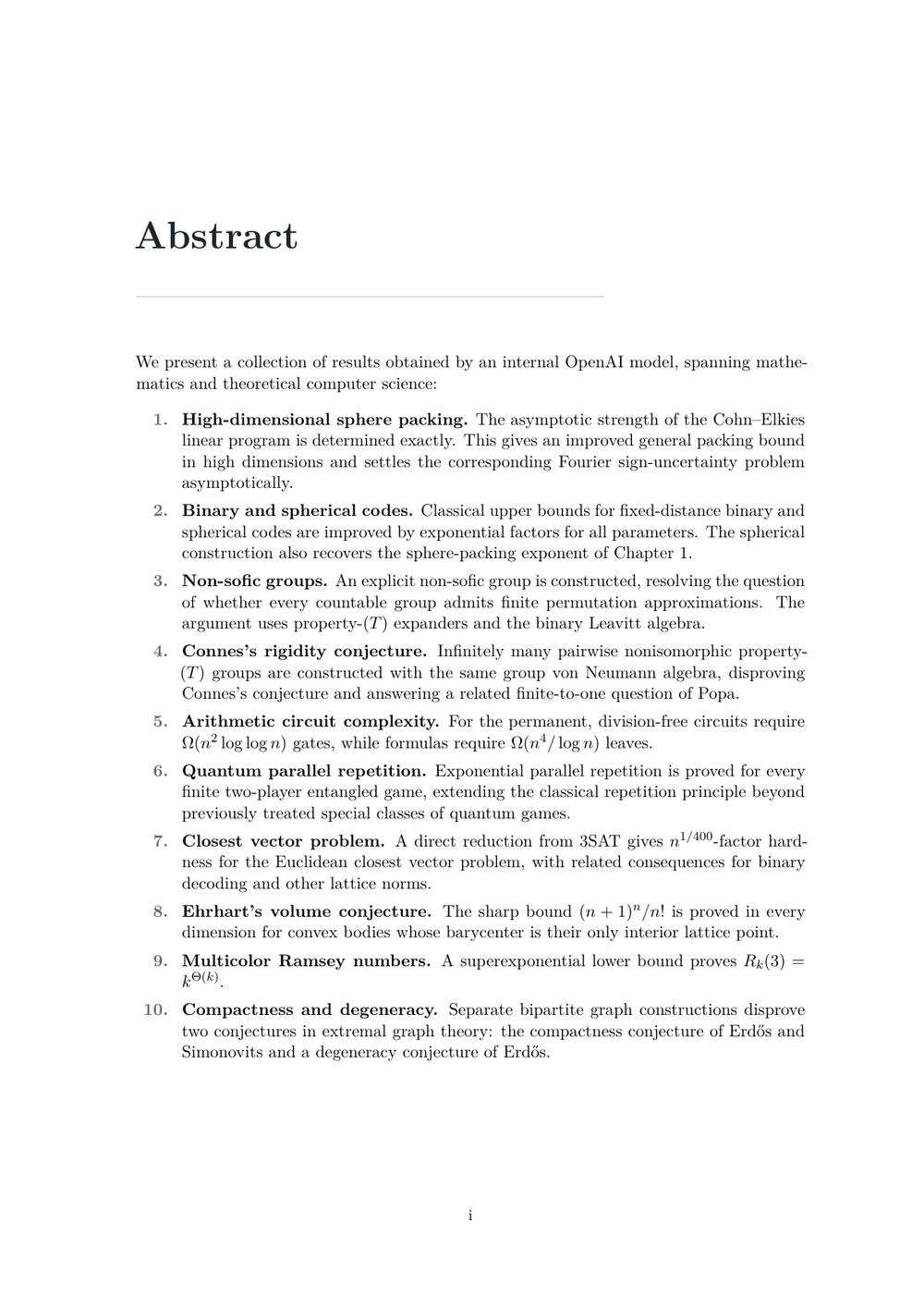
Source: OpenAI primary manuscript, abstract page. It lists the ten claimed results and is not an independent review.
OpenAI's paper abstract lists all ten results, from sphere packing and coding theory to non-sofic groups, quantum parallel repetition, lattice problems, and extremal graph theory. This is primary technical material, not an independent verdict on correctness or importance.
The release also gives developers something concrete to inspect. The repository README pins Lean 4.32.0, uses mathlib and Lake, and documents lake build All. It separately points to Comparator instructions for independent proof checking.
How does Lean change what “verified” means?
Lean can check whether a formal proof term follows from the definitions and axioms encoded in a project. That is a much stronger artifact than a prose claim, because a verifier can rebuild the repository and ask the kernel to accept or reject each module.
But a successful Lean build answers a narrower question than most headlines imply. It does not automatically prove that the formal theorem perfectly matches the informal problem, that every imported assumption captures the intended mathematics, that the result is important, or that Astra produced the argument without meaningful human steering.
The Leiden Declaration makes the distinction explicit: formalization helps, while transparent attribution, human-readable central arguments, independent scrutiny, and appropriate publication still matter. For this release, “machine-checkable” and “independently accepted” should remain separate labels.
The developer view
The most actionable artifact today is the repository, not the Astra name. A developer working on theorem-proving agents can clone the project, reproduce the pinned environment, build individual modules, and inspect the Comparator path. That supports concrete questions about proof generation, formalization, and verification workflows.
Do not treat the reported roughly $2,000 in successful-solution tokens as a reproducible project budget. OpenAI compares only the tokens used to find the published solutions with Sol API rates. The announcement does not disclose failed searches, human labor, infrastructure, or Astra access.
The product enthusiast view
For a normal AI user, Astra is not a product recommendation yet. There is no public model page, API name, price, access tier, or release date in the announcement.
The real signal is a change in evidence quality. Instead of asking readers to trust a demo, OpenAI has published manuscripts and code that specialists can inspect. The remaining work now shifts to independent mathematicians, proof engineers, and peer review.
Who should pay attention now, and who should wait?
Pay attention now if you build formal-math tools, scientific agents, proof infrastructure, or research-evaluation systems. The public repository gives you an immediate object to reproduce and critique without needing Astra access.
Study the papers now if one of the ten areas is your specialty. The broad announcement cannot substitute for field-specific judgment, but the complete manuscripts make that judgment possible.
Wait for product access if your question is whether Astra should replace a current model. OpenAI has not released it, published pricing, or documented a general API.
Wait for broader scientific claims if your question is whether Astra is a universal research agent. Ten selected successes, even if all hold, do not reveal the distribution of failures or performance outside formal mathematics.
My call: this is a major research-capability signal with unusually strong public artifacts. It is not yet a buying decision or a license to skip independent review.
What remains unclear?
The biggest gap is independent acceptance. OpenAI says it takes responsibility for correctness, but the announcement arrived before normal community review could finish. The Lean repository makes checking easier; it does not report the outcome of that review.
The second gap is process reproducibility. We do not know how problems were selected, how many unsuccessful attempts ran, how prompts evolved, or where human mathematical judgment entered the discovery loop.
The third gap is model generalization. Formal mathematics has precise feedback and machine-checkable targets. Success there may not transfer cleanly to experimental science, product research, or open-ended engineering where evidence is noisy and outcomes are harder to verify.
Finally, Astra itself is unavailable. The announcement offers no public release date, API contract, model card, price, or safety documentation.
Quick Take
- What is actually new?: Evidence-backed answer: OpenAI published ten manuscripts, ten Lean formalization modules, and a clear attribution claim for an internal Astra model.
- Who can use it now?: Evidence-backed answer: Anyone can inspect the paper and repository; no one outside approved internal access can be assumed to use Astra.
- What is the strongest evidence?: Evidence-backed answer: The 249-page primary manuscript and buildable Lean repository.
- What should developers verify?: Evidence-backed answer: Toolchain reproducibility, theorem statements, assumptions, imports, and independent Comparator checks.
- What is still unknown?: Evidence-backed answer: Community acceptance, failed-attempt costs, human intervention, public access, and transfer beyond formal math.
The responsible takeaway is neither “just marketing” nor “science is solved.” It is that the public evidence is now strong enough for serious checking—and still incomplete enough to require it.
FAQ
What is OpenAI Astra?
Astra is the name OpenAI uses for its next major model family. The math work used an internal version. As of August 2, 2026, OpenAI has not published a public API, price, access tier, model card, or release date for Astra.
Did OpenAI Astra solve ten math problems?
OpenAI says Astra generated arguments for ten long-open problems and takes responsibility for their correctness. It published manuscripts and formal certificates. The accurate current wording is that OpenAI released ten claimed advances for expert checking; broad independent acceptance is still pending.
What does a Lean certificate prove?
A Lean certificate lets a trusted kernel check a formal theorem against encoded definitions and assumptions. It is strong evidence that the formal statement follows inside that system. It does not by itself settle whether the formal statement perfectly matches the informal problem or whether the result is significant.
Can developers use OpenAI Astra now?
Not from the information OpenAI published on August 1. Developers can use the open paper and Lean repository, but the Astra model itself has no announced public API or release path. Avoid treating internal-model token estimates as a purchasable service.
Who should wait before acting on the announcement?
Teams choosing a production model should wait for actual access, documentation, pricing, and evaluation on their work. Non-specialists should also wait for field experts to assess each proof's correctness and importance rather than treating one launch headline as a final scientific verdict.
Discover practical AI products and emerging tools at AIToolHunt.
Sources
- OpenAI announcement: Ten advances in mathematics and theoretical computer science
- OpenAI primary manuscript: Ten Advances in Mathematics and Theoretical Computer Science
- OpenAI primary repository: Lean certificates for the ten proofs
- Leiden Declaration on Artificial Intelligence and Mathematics
- Nature editorial: Mathematicians are developing rules for AI use