Newsletter
Join the Community
Subscribe to our newsletter for the latest news and updates
Official Auto Router launch artwork. Source: OpenRouter's announcement.
OpenRouter's new Auto Router asks developers to stop treating model choice as a permanent configuration decision. It now uses recent platform-wide demand signals to choose among models for each request. That is an interesting default for mixed workloads, but the evidence does not justify deleting your model picker yet.
This is an evidence review, not a hands-on production test. OpenRouter documents the release, routing process, pricing, conversation behavior, and original comparison chart. Independent RouteLLM research and its paper support the general idea that routing can trade model quality against cost. They do not independently validate OpenRouter's new classifier, traffic signals, or benchmark.
OpenRouter Auto Router is a model-selection layer that chooses an available AI model for each request instead of making a developer name one in advance. OpenRouter deployed the new version to all Auto Router users on August 10, 2026. Its launch post says the system classifies a prompt into roughly 30 task categories, ranks models using recent spend share for the predicted category, applies one of five cost tiers, and returns a primary model with fallbacks. The documentation says there is no extra routing fee; users pay the selected model's normal price. This is useful for teams whose requests vary widely, but it is not proof that automatic selection beats a carefully chosen model. OpenRouter's performance comparison is vendor-reported and time-sensitive, while independent routing research supports the broader quality-cost tradeoff rather than this specific implementation. Test it against a fixed baseline before changing production defaults.
cost_tier settings range from free to max; Practical consequence: Teams can state a budget posture without naming a modelOpenRouter says its ranking signal looks at the previous seven days and more than 55 trillion tokens of weekly spend. That is a large demand signal, but demand is not the same thing as quality. Popular models can reflect availability, price, promotions, defaults, or customer mix as well as task performance.
The launch post also includes a new-versus-old benchmark across MMLU Pro, tau-cubed-bench Banking, WideSearch, DSQA, and SWE-Atlas QnA. The result is mixed: some scores rise, some costs fall, and the max tier sometimes buys large score gains at sharply higher cost.
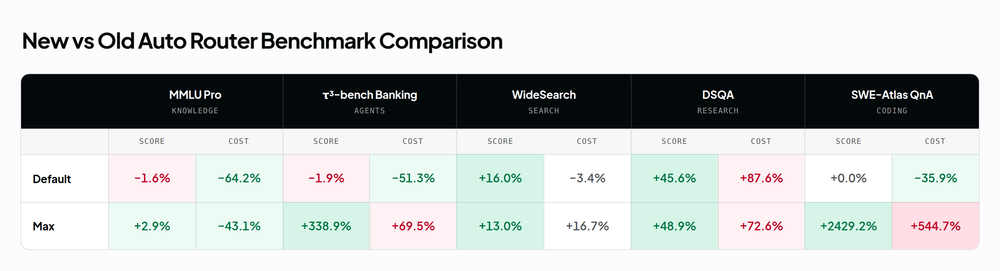
OpenRouter's original comparison chart. Source: the official Auto Router launch post. These are vendor-reported, point-in-time results; the task setup, candidate pool, and results were not independently reproduced in this review.
The heatmap is useful because it prevents a simple “better and cheaper” headline. It is not a reproducible leaderboard. A routing system changes when its eligible models, prices, traffic mix, classifier, or fallback policy changes, so teams should treat this image as launch evidence rather than a standing performance guarantee.
The process has four visible stages. First, a lightweight classifier assigns the request to roughly one of 30 task categories. Second, the router ranks eligible models by their recent spend share inside that category. Third, the chosen cost_tier narrows the list. Finally, it sends the request to a primary model with fallbacks if the preferred route is unavailable.
Conversation stickiness softens a common routing problem. OpenRouter says each turn recalculates the candidate set, but the prior model is preferred when it still qualifies. That may preserve tone, tool behavior, and context interpretation better than switching blindly on every turn. It is still not the same as pinning one model for an entire workflow.
The API change is deliberately small: use openrouter/auto and optionally set a cost tier. There is no extra router fee; OpenRouter bills the selected model at its normal rate. The hidden work is observability. Log the routed model, task family, latency, retries, fallback use, token cost, and whether the final output passed your own acceptance test.
For tool calling, structured output, long contexts, or regulated data paths, keep an allowlist. A model that is broadly popular for “coding” may still violate a schema, lack a required modality, or behave differently around tools. The Auto Router documentation should be the contract you test, not an assumption that every eligible model is interchangeable.
For ordinary users, the appealing idea is simple: ask for research, code, translation, or brainstorming without learning a model catalog first. The router can make a multi-model service feel like one product rather than a shelf of confusing names.
The risk is invisible variance. Two similar requests may land on different models as the market signal changes. That can be fine for casual chat and frustrating for repeatable creative or technical work. Users who value a stable voice, known privacy terms, or predictable tool behavior should still prefer a pinned model.
Independent routing work such as RouteLLM offers the right evaluation frame: a router is useful when it preserves enough quality while sending appropriate work to cheaper models. The technical paper also makes clear that results depend on the routing method, preference data, and evaluation distribution. That is context for how to test OpenRouter, not proof of OpenRouter's results.
My decision rule: test Auto Router now for heterogeneous, non-critical traffic; wait or keep explicit routing for workflows with strict schemas, model-specific prompts, stable voice, contractual data rules, or costly failures.
OpenRouter has provided more mechanism detail than a black-box “smart routing” label. The remaining gap is independent, repeatable production evidence.
My take: Auto Router is a sensible default candidate for varied traffic, but not a reason to give up explicit model control where repeatability matters.
What is OpenRouter Auto Router?
OpenRouter Auto Router is an API routing layer that selects a model for each request. The new version classifies the task, ranks eligible models using recent platform spend signals, applies a cost tier, and provides fallbacks instead of requiring a developer to name one model.
Is the new Auto Router available now?
Yes. OpenRouter says it deployed the new system to all Auto Router users on August 10, 2026. Developers can call openrouter/auto through the existing API and optionally select one of five cost tiers. Normal model pricing still applies.
Does Auto Router always choose the best model?
No public evidence supports that universal claim. The router uses task classification and recent spend share, which is a market signal rather than a direct quality score. OpenRouter reports benchmark improvements, but the results are vendor-reported, point-in-time, and not independently reproduced here.
What should developers test before enabling it?
Use a fixed task set and compare Auto Router with your pinned baseline. Record the chosen model, acceptance-test pass rate, latency, retries, fallback use, and total cost. Include structured output, tool calls, long context, and failure cases that matter to production.
Who should keep choosing models manually?
Keep explicit model selection for strict schemas, model-specific prompts, stable creative voice, regulated data paths, contractual model restrictions, or tasks where a subtle failure is expensive. Auto routing is better suited to varied traffic where model identity is not itself a requirement.
Discover practical AI products and emerging tools at AIToolHunt.