

Qwen-Image-2.1 is unusually practical for a new image model: the weights are downloadable, the implementation is public, and it can generate transparent assets or edit with up to ten references. The catch is not hidden in a benchmark. It is in the license. You can evaluate the model locally, but ordinary commercial use requires a separate deal with Qwen.
Quick Navigation
- What is Qwen-Image-2.1? An open-weight image generator and editor with native RGBA output
- What changed? Ten-reference composition, local editing, transparency, and day-zero framework support
- How does it work? A compact visual generator reuses condition-image context across denoising steps
- Why should builders care? Better asset workflows, but meaningful hardware and licensing limits
- Who should try it now? Researchers, hobbyists, and teams running a controlled non-commercial evaluation
- FAQ: Five practical questions before downloading the weights
What is Qwen-Image-2.1?
Qwen-Image-2.1 is an open-weight image model released on September 20, 2026 for both generation and editing. Its pinned official README documents a 7-billion-parameter visual generator, native RGBA transparency, local edits, and composition from as many as ten reference images. The same repository provides Diffusers code, weights links, and CPU-offload guidance, so developers can inspect and run the model rather than wait for a closed preview. Two boundaries matter. First, Qwen's favorable comparison chart is vendor-reported; The Decoder says independent benchmarks are still pending. Second, the Qwen Research License allows non-commercial research and evaluation, not ordinary commercial deployment. That makes Qwen-Image-2.1 a strong local evaluation candidate for researchers, hobbyists, and tool builders testing transparent assets or multi-image composition, while production teams should secure a commercial license and validate memory, latency, identity preservation, and output rights before shipping.
What We Know So Far
This is a source-based release analysis, not an AIToolHunt hands-on test. The confirmed layer comes from Qwen's pinned repository, the exact license text, the merged Hugging Face Diffusers integration, and independent release coverage. Those sources establish that the weights and code are real, the model supports generation plus editing, and the published license is non-commercial.
Performance is a different layer. Qwen's README includes a favorable comparison chart, but the team chose the models, prompts, metrics, and evaluation setup. No independent reproduction was available for this review. The chart is useful for understanding Qwen's claim; it is not enough to declare Qwen-Image-2.1 the best image model.
What changed with Qwen-Image-2.1?
The useful change is not simply “another open image model.” Qwen has combined several workflows that normally require separate tools: text-to-image generation, image-conditioned editing, transparent output, multi-reference composition, and marked local edits.
- Remove a generated background in a second tool: Qwen-Image-2.1's public capability: Native RGBA generation and editing; Practical consequence: Sticker, game-asset, and compositing experiments can keep an alpha channel from the model
- Merge people, products, or style references one at a time: Qwen-Image-2.1's public capability: Up to ten reference images; Practical consequence: Teams can test group composition, virtual try-on, and layout transfer in one request
- Re-encode the same conditions during every denoising step: Qwen-Image-2.1's public capability: Prefix KV cache reuse; Practical consequence: Text and condition-image context can be computed once and reused
- Wait for third-party inference support: Qwen-Image-2.1's public capability: Diffusers, ComfyUI, vLLM-Omni, and SGLang support at launch; Practical consequence: Developers have several integration paths instead of one vendor demo
- Treat “open” as permission to ship: Qwen-Image-2.1's public capability: Research-only license; Practical consequence: Commercial teams must pause before product deployment
The last row is the decision-changing one. Open weights give you technical access. They do not automatically give you commercial rights.
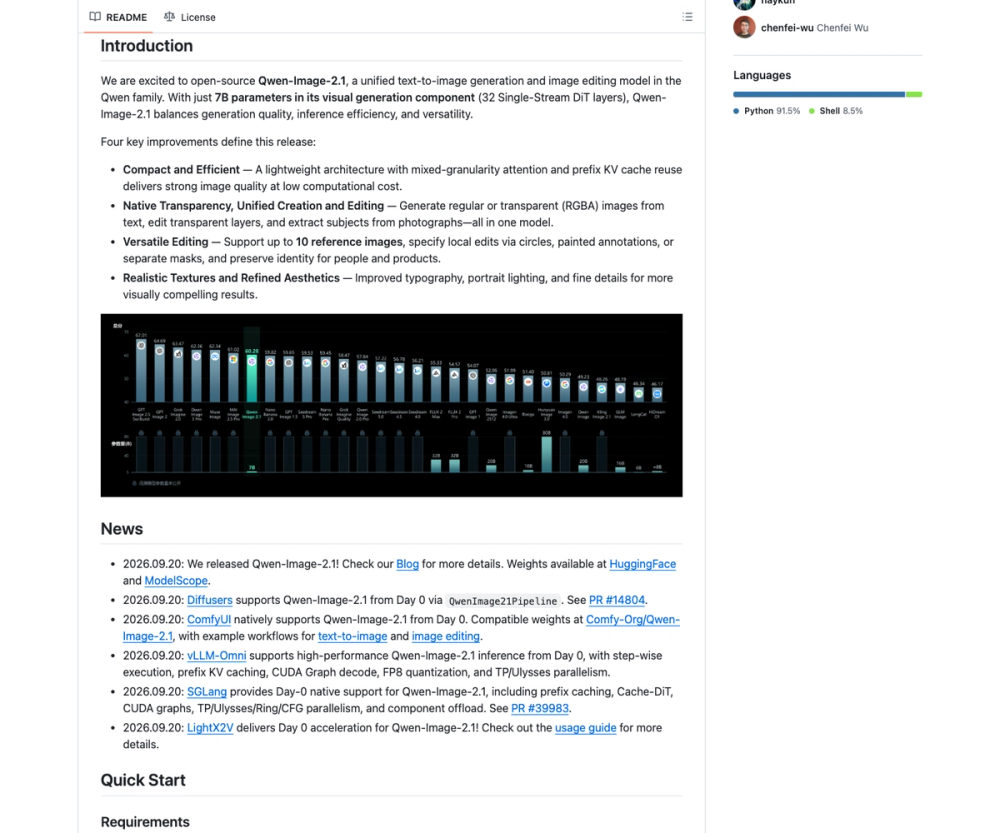
Source: Qwen's pinned official README. This unmodified capture shows the documented 7B visual generator, RGBA support, ten-reference editing, release links, and Qwen's own comparison chart. The chart is vendor-reported and was not independently reproduced for this article.
The screenshot also exposes a useful tension. Qwen markets a 7B visual component as compact, but the complete pipeline includes a Qwen3-VL 8B text-and-image encoder plus a 64-channel VAE. Parameter count is not the same as memory footprint, and neither number predicts end-to-end latency on your hardware.
How does Qwen-Image-2.1 work?
Qwen describes the core as a 32-layer, single-stream diffusion transformer. “Single-stream” means text instructions, reference-image information, and the target image participate in one coordinated denoising process instead of being handled by entirely separate models.
The attention pattern is block-causal. Text is read causally, while tokens inside each image block can see one another. More importantly for editing, the text and condition-image prefix stays fixed across denoising steps. Qwen and the merged Diffusers implementation cache that prefix after the first pass, so later steps recompute the changing target-image tokens instead of repeating all condition work.
Native transparency comes from a 64-channel RGBA autoencoder. In plain English, the model is designed to carry red, green, blue, and alpha information through the image pipeline. That is more direct than generating a flat image and guessing the background boundary afterward.
The developer view
The easiest starting point is the merged Diffusers pipeline, but “easy API” should not be confused with “light workload.” Qwen's default examples target 2K output with 40 denoising steps. In the Diffusers pull request, one tested 2048×2048 H100 path peaked at 56.5 GiB of device memory after a cache fix. That is one engineering measurement, not a universal requirement, but it is enough to reject the idea that every 24 GB consumer card will run the default workflow comfortably.
The official README includes CPU offload, lower-resolution serving, and multiple optimized runtimes. A sensible evaluation should pin the model and framework commit, then record resolution, reference count, steps, peak memory, wall-clock time, and failure mode for every test. If those numbers are missing, a beautiful sample is not a deployment plan.
The product enthusiast view
The most interesting capability is transparent output. If it works reliably, a creator could ask for a sticker, icon-like object, product cutout, or layered element without making background removal a separate step. Multi-reference editing is equally promising for combining a person, outfit, prop, and setting.
But the official examples remain curated vendor demos. Identity preservation, small text, hands, occlusion, and exact product details can fail even when the overall image looks polished. Ordinary users should try the hosted demo or a reputable integration before downloading a large local stack just to see whether the workflow suits them.
Why should builders care?
- Transparency is a workflow feature, not a beauty score. Alpha-aware output can remove a whole cleanup stage when the asset boundary is correct. 2. Ten references expand product design space. A single request can coordinate several people, objects, or visual constraints, though fidelity must be measured per reference. 3. The integration surface is real. Diffusers merged support before the public release, and Qwen documents ComfyUI, vLLM-Omni, and SGLang paths. 4. The license can stop a launch. The research agreement allows non-commercial evaluation; it does not grant a normal commercial product license.
The decision rule is simple: test the model if its workflow advantage is measurable, but do not let downloadable weights turn a licensing question into an assumption.
Who should try Qwen-Image-2.1 now?
Researchers, hobbyists, educators, and internal evaluation teams have the clearest reason to test now. They can compare transparent edges, multi-reference fidelity, local edits, text rendering, and memory use without pretending the model is ready for a paid product.
Commercial builders should first ask whether their planned use is covered by a separate written license. If the answer is unclear, keep the evaluation isolated from production and do not train a revenue plan around the public repository.
For an engineering pilot, start with three repeatable tasks: one transparent product cutout, one three-reference composition, and one circle-guided edit. Run each at two resolutions, save seeds and prompts, and score edge quality, reference fidelity, unwanted changes, peak memory, and latency. That small matrix will answer more than the launch chart.
What remains unclear?
- Qwen's comparison chart has not been independently reproduced with the same prompts, seeds, or evaluation protocol.
- The independent report says the model can run on capable consumer hardware, but practical memory and speed vary sharply with resolution, offload, reference count, and runtime.
- The public research license is not a commercial grant; the price and terms of a separate commercial license are not published in the repository.
- Native RGBA support does not guarantee clean edges or semantically correct transparency on every subject.
- Multi-reference support does not guarantee that every identity, logo-free object, garment, or spatial constraint survives a complex composition.
These are not reasons to dismiss the model. They are the checklist that turns a launch-day demo into a responsible evaluation.
Quick Take
- What is actually new?: Evidence-backed answer: A public image model combines generation, editing, native RGBA, local marks, and up to ten references.
- Who can use it now?: Evidence-backed answer: Anyone can inspect and evaluate the public materials, subject to the research license and hardware requirements.
- What is the strongest evidence?: Evidence-backed answer: The pinned repository, exact license, and merged Diffusers implementation are directly inspectable.
- What should developers verify?: Evidence-backed answer: Peak memory, latency, alpha quality, reference fidelity, unwanted edits, and license coverage.
- What is still unknown?: Evidence-backed answer: Independent quality rankings, broad consumer-GPU performance, and public commercial-license terms.
My take: Qwen-Image-2.1 earns a serious evaluation because it attacks real image-workflow friction. It does not earn an automatic production launch.
FAQ
Is Qwen-Image-2.1 available now?
Yes. Qwen's repository says the weights were released on September 20, 2026, with links to Hugging Face and ModelScope. The code and license are also public. Availability does not remove the need to check hardware capacity and license terms.
Can Qwen-Image-2.1 generate transparent images?
Yes. The official implementation uses an RGBA autoencoder and documents both transparent generation and transparent-image editing. Treat that as a supported capability, then test edge quality, holes, shadows, and semi-transparent regions on your own asset types.
Can Qwen-Image-2.1 use multiple reference images?
Yes. Qwen documents support for up to ten reference images and shows workflows for group composition, outfits, local editing, and storyboards. The limit describes accepted inputs, not guaranteed identity or product fidelity across all ten references.
Can I use Qwen-Image-2.1 commercially?
Not under the public research license alone. The license grants non-commercial research and evaluation rights and says commercial users must obtain a separate license from Qwen. Product teams should get written terms before deployment.
Will Qwen-Image-2.1 run on a consumer GPU?
Possibly with reduced resolution, offloading, quantization, or an optimized runtime, but do not assume the 2K default is lightweight. A merged Diffusers test reported 56.5 GiB peak device memory for one 2048×2048 H100 workflow. Measure your exact setup.
Discover practical AI products and emerging tools at AIToolHunt.