Newsletter
Join the Community
Subscribe to our newsletter for the latest news and updates
Qwen has delivered the part of its Qwen3.8 launch that developers could not verify two weeks ago: actual downloadable weights. The smaller Qwen3.8-27B release is more actionable than the 2.4-trillion-parameter flagship for most teams, but “open” does not mean “easy to run” or “already proven.”
Qwen3.8-27B open weights are the downloadable parameters and configuration files for Qwen’s 27-billion-parameter dense vision-language model, released under Apache 2.0. The official ModelScope model card exposes 18 BF16 weight shards and reports a repository size of about 55.59GB, so this is a real package rather than another availability promise. Qwen documents a native 262,144-token context, optional YaRN scaling toward one million tokens, image and video input, configurable reasoning effort, and recipes for vLLM, SGLang, and TokenSpeed. Those details make local evaluation possible, but they do not make it cheap or production-ready. Hardware memory, quantization quality, multimodal preprocessing, throughput, and task accuracy still depend on your serving stack. The practical answer is to download or rent capacity only for a measured pilot first; treat Qwen’s published performance tables as vendor evidence until independent reproductions appear.
The official release post on X announces that the promised Qwen3.8 weights are available. The live ModelScope repository supplies the stronger technical proof: license metadata, model files, configuration, serving examples, and benchmark notes are all present.
Qwen’s original Qwen3.8 article remains useful for the vendor’s architecture and product framing. The Decoder independently confirms the release, license, dense 27B design, and context claims. Its report is release corroboration, not an independent benchmark run.
AIToolHunt did not run the model or reproduce its scores. Every performance statement below is labeled by evidence type.
The critical change is control. A hosted API lets you send requests to someone else’s model service. Open weights let you run the model in infrastructure you choose, examine its configuration, decide how to quantize it, and keep data inside your own boundary.
That control also transfers operational work to you. You now own GPU sizing, downloads, inference versions, monitoring, prompt-template compatibility, multimodal preprocessing, and upgrades. Apache 2.0 removes many licensing obstacles, but it does not remove engineering cost.
Qwen3.8-27B is a dense model, meaning all 27 billion parameters participate in inference rather than routing each token through a smaller active subset of a mixture-of-experts model. It is also a native vision-language model: the documented inputs include text, images, and video.
The model thinks before answering by default. Its card documents reasoning_effort levels of xhigh, medium, and low, plus preserve_thinking for keeping reasoning blocks across turns. These are operating controls, not guarantees. A lower per-turn effort can be faster, yet the card warns it may cause more retries and higher total task cost in multi-step agent work.
Context deserves the same caution. The native limit is 262,144 tokens. Qwen documents YaRN scaling for longer work, including configurations toward one million tokens, but also says static YaRN can affect performance on shorter text. Do not enable the largest context merely because the configuration accepts it. Test retrieval quality, attention failures, latency, and memory use at the lengths your application actually needs.
A sensible evaluation begins with one workload and one serving stack. Start with the exact chat template from the model card. Record the model revision, dtype or quantization, GPU type, inference engine version, context length, concurrency, and sampling settings. Without that record, a faster or better result cannot be reproduced later.
Then compare end-to-end outcomes rather than isolated prompts. For a coding agent, measure successful repository tasks, retries, tool-call validity, wall-clock time, and total generated tokens. For document or video work, test the preprocessing path and verify that the model is seeing the intended frames or pages. A benchmark headline cannot answer those system questions.
Most people should not download 55GB of BF16 files just to chat with a new model. If your goal is simply to experience Qwen3.8, use an official hosted route or wait for reputable applications to add it. The open-weight release matters because it allows more providers, local tools, and privacy-sensitive products to support the same model—not because every laptop owner should become an inference operator.
Local use becomes interesting if you already run quantized models, need offline processing, want to keep sensitive inputs within a controlled environment, or are building a repeatable product. Even then, wait for tested quantizations and hardware reports instead of assuming the full BF16 package fits your machine.
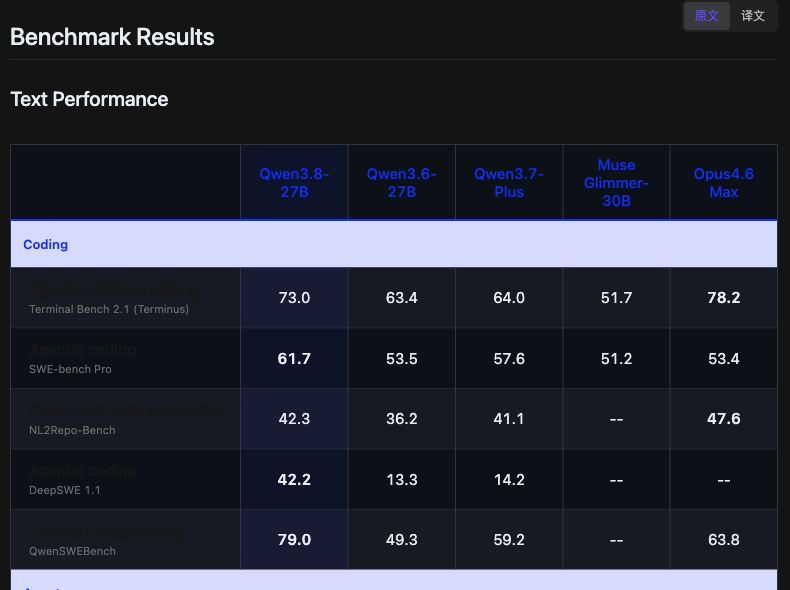
Source: Qwen’s official ModelScope model card. This is an unredrawn capture of the vendor’s coding table, not an independent AIToolHunt test.
No. The table is useful evidence about what Qwen measured, not proof of universal superiority. It reports Qwen3.8-27B at 61.7 on SWE-bench Pro versus 57.6 for Qwen3.7-Plus. It also includes higher and lower outcomes across other coding tasks, so even the vendor table does not support a blanket “best model” claim.
The model card documents important boundaries: some evaluations use particular harnesses, some comparisons use prompt variants, and some benchmarks are in-house. Results are point-in-time and can change with inference engines, scaffolds, prompts, judges, and model revisions. No independent reproduction was available in the selected window. Use the table to choose tests, not to skip them.
The right first milestone is not “Qwen3.8 is deployed.” It is “we can reproduce one useful workload, with known cost and failure modes, on a pinned model and serving stack.”
My take: Qwen3.8-27B has crossed the line from announcement to credible self-hosting candidate. It has not crossed the line from candidate to default production model. The open files earn a pilot; your own outcomes must earn the migration.
Are the Qwen3.8-27B weights available now?
Yes. Qwen announced the release on August 14, 2026, and the official ModelScope repository exposes the Apache 2.0 license, configuration, and downloadable BF16 weight shards. This is different from the earlier Qwen3.8 announcement, when open weights were still a future commitment.
Can Qwen3.8-27B run on a consumer GPU?
The full BF16 repository is about 55.59GB before runtime overhead, so a single typical consumer GPU should not be assumed to fit it. Quantized versions may reduce memory needs, but quality, speed, KV-cache use, and multimodal support vary. Wait for hardware-specific reports or test a pinned quantization yourself.
Does Qwen3.8-27B support a one-million-token context?
Its native context is 262,144 tokens. Qwen documents YaRN configuration for extending the limit toward one million tokens, but warns that static scaling can affect shorter-text performance. Treat long-context configuration and long-context quality as separate questions.
Can I use Qwen3.8-27B commercially?
The official repository labels the model Apache 2.0, a permissive license commonly used for commercial software. You still need to review the license, third-party components, your deployment jurisdiction, and the risks of your specific application rather than treating this article as legal advice.
Should I replace my current coding model with Qwen3.8-27B?
Only after a controlled comparison. Measure complete task success, retries, tool-call validity, wall-clock time, token use, infrastructure cost, and failure recovery on your repositories. Qwen’s coding table is useful for choosing evaluation tasks, but it is not a substitute for your workload.
Discover practical AI products and emerging tools at AIToolHunt.