
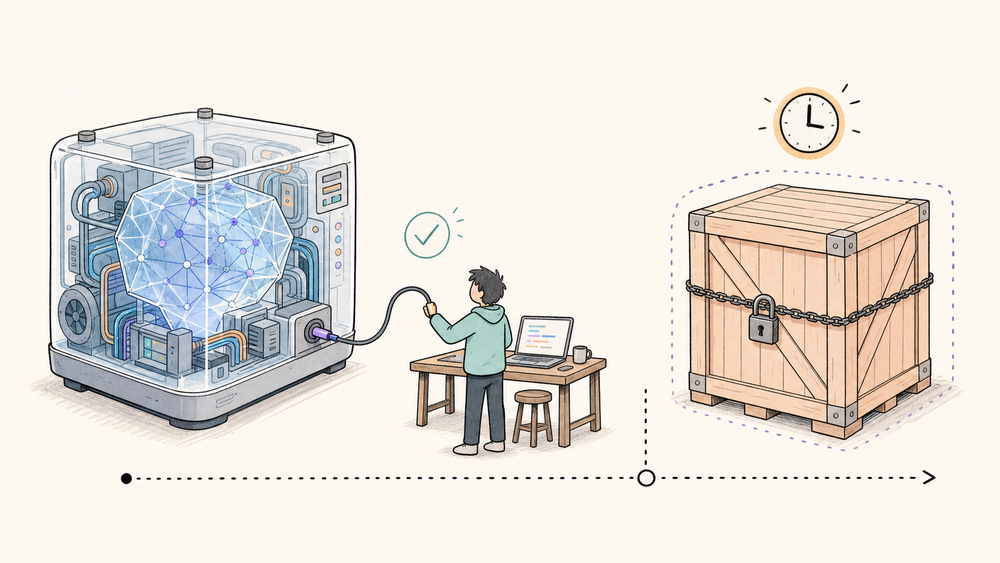
Qwen3.8-Max has finally moved beyond a vague preview, but the launch comes with an important split. You can call the hosted model today; you still cannot download the announced open weights.
That distinction decides who should act now. API builders have enough concrete information to run a bounded trial. Self-hosters, researchers, and teams that need a license file should wait for the repository rather than planning around a promise.
Quick Navigation
- What is Qwen3.8-Max? The hosted release, the promised weights, and the current evidence boundary.
- What changed from the preview? Model ID, public pricing, context, and a dated weight commitment.
- How does Qwen3.8-Max work? The mixture-of-experts design and multimodal API surface.
- Who should test it now, and who should wait? A practical adoption rule.
- What remains unclear? Versioning, licensing, hardware, and independent reproduction.
- FAQ: Five direct answers about access, price, weights, local use, and migration.
What We Know So Far
Qwen's official release article and official X announcement describe Qwen3.8-Max as the team's new flagship for coding and professional work. Those capability statements are vendor claims, not hands-on findings from AIToolHunt.
The firmer evidence is the QwenCloud model contract: it publishes a callable model ID, supported inputs, context limits, prices, and API examples. Independent coverage from MarkTechPost confirms the public release, while its earlier preview analysis provides the useful baseline: two weeks ago, the weights, license, and detailed public evidence had not landed.
What is Qwen3.8-Max?
Qwen3.8-Max is Qwen's 2.4-trillion-parameter mixture-of-experts flagship for coding, agent work, documents, and multimodal understanding. As of August 3, 2026, the official QwenCloud page lists the callable model ID qwen3.8-max, image, text, and video input, a one-million-token context window, a 131,000-token maximum output, and prices of $2 per million input tokens and $6 per million output tokens. Qwen's official announcement says the Qwen3.8-Max weights and a smaller Qwen3.8-27B release will arrive next week. That means the model is usable now as a hosted API, but it is not yet an open-weight download. The Token Plan documentation still labels its covered Qwen3.8-Max version as a preview, so builders should verify the exact endpoint and product surface before moving production traffic. The practical answer: test the API now if you can measure results; wait if your decision depends on weights, license, or self-hosting.
What changed from the Qwen3.8-Max preview?
- A hosted preview with sparse public details: August 3 public information: A named
qwen3.8-maxAPI page with documented modalities and limits; Why it matters: Developers can build a repeatable evaluation against a stable-looking model ID - Open weights promised “soon”: August 3 public information: Official announcement says next week; Why it matters: The commitment is more specific, but the repository and license are still absent
- Pricing depended heavily on Token Plan credits: August 3 public information: The official model page lists $2 input and $6 output per million tokens; Why it matters: Teams can estimate API trial cost without translating every workload into credits
- Preview positioning dominated the product story: August 3 public information: Qwen publishes a release article and a production-style API reference; Why it matters: There is more to verify, but the vendor still controls most capability evidence
The release is strongest where it is boring: a real endpoint, explicit limits, and explicit prices. Those are operational facts a developer can test today.
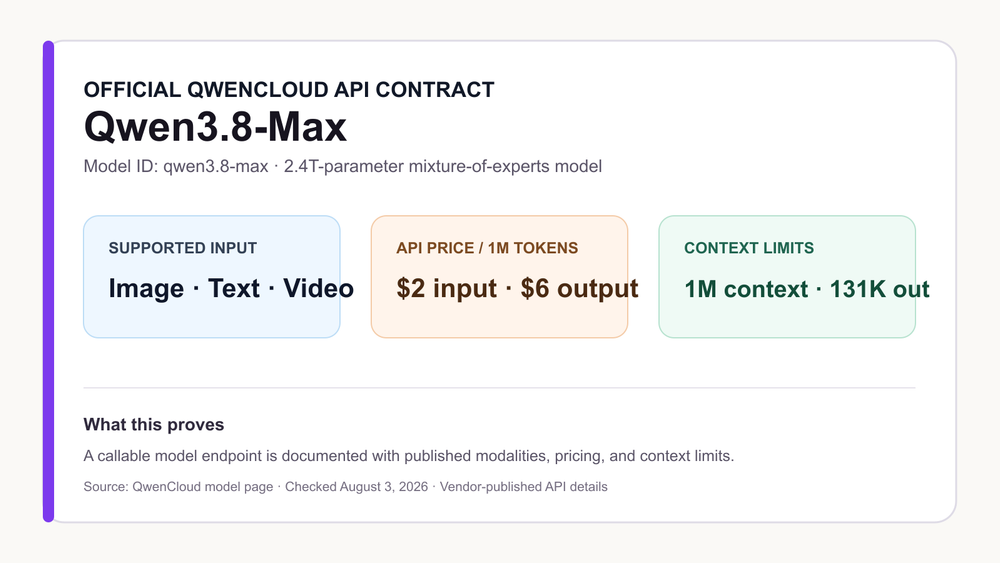
Source: QwenCloud's official Qwen3.8-Max model page, checked August 3, 2026. This card transcribes the published API contract; it is not a Qwen-designed interface or a performance result.
The transition is not perfectly clean. The model marketplace presents qwen3.8-max, while the Token Plan page still discusses qwen3.8-max-preview and warns that the preview can be replaced or taken offline. That could be normal documentation lag, but it is enough reason to pin the model string and record observed behavior during evaluation.
How does Qwen3.8-Max work?
Qwen3.8-Max uses a mixture-of-experts, or MoE, architecture. Instead of running every parameter for every token, an MoE routes each token through a subset of specialized parts of the model. Qwen says the model has 2.4 trillion total parameters and 95 billion active parameters. Treat the active figure as vendor-reported until the weights and configuration files can be inspected.
The hosted API accepts text, images, and video and returns text. Its official page also lists function calling, structured outputs, prefix completion, context caching, web search, and code-interpreter support. Those features matter because an agent is rarely just a chatbot: it needs predictable output shapes, tool calls, and a way to process large working sets.
The one-million-token context window sounds enormous, but it does not remove the need for context discipline. Large inputs cost money, increase latency, and make it harder to see why an agent made a bad decision. Retrieval, compression, and acceptance tests still matter.
The developer view
Start with the hosted API and one measurable job. Good trials include repairing a failing test, extracting obligations from a long contract set, or turning a design brief plus screenshots into an implementation plan. Record completion rate, retries, tool-call errors, human corrections, latency, and total token cost.
Use the official OpenAI-compatible or DashScope example as the integration baseline, then verify structured output, cancellation, context caching, and failure recovery. Do not assume the Token Plan preview and the pay-as-you-go API behave identically merely because both carry the Qwen3.8 name.
If your real goal is self-hosting, wait for the weight repository. Without files, a license, supported runtimes, quantizations, and memory requirements, there is no honest infrastructure estimate.
The product enthusiast view
Normal users do not need to care about 2.4 trillion parameters. The useful change is that Qwen3.8-Max can now be tried through an official hosted product with published capabilities and costs.
The most interesting promise is not “bigger model.” It is a single system that can read long documents, understand images or video, call tools, and keep working across professional tasks. But the launch material is still vendor-produced, so judge it by one workflow you already understand rather than a polished demo.
Who should test Qwen3.8-Max now, and who should wait?
Test now if you already have an API-based agent harness, a small evaluation set, and a fallback model. The price is clear enough for a bounded trial, and the multimodal plus long-context surface creates genuinely different workflows to test.
Wait for the weights if local control, data residency, fine-tuning, quantization, or vendor independence is the reason you care. The official post says next week. Waiting a few days is cheaper than designing hardware and compliance plans around files that do not yet exist.
Wait for more evidence if your workload is high-risk or hard to grade. Legal, financial, security, and autonomous code changes need task-specific acceptance checks, not a general flagship label.
My call: Qwen3.8-Max earns an API trial today. It has not earned a production migration or a self-hosting plan until the exact weights, license, and independent results are public.
What remains unclear?
The biggest gap is the open-weight package itself. The official announcement provides a near-term date, but there is no repository to inspect for license terms, architecture configuration, inference requirements, or the relationship between downloadable weights and the hosted endpoint.
The second gap is independent reproduction. The release article describes ambitious long-running coding and professional workflows, but vendor-controlled demonstrations cannot separate model quality from the surrounding harness, tools, retries, and graders.
The third gap is product naming. QwenCloud's model page uses qwen3.8-max; Token Plan documentation still uses qwen3.8-max-preview. Builders should log the model ID returned by the service and repeat critical tests after any silent replacement.
Quick Take
- What is actually new?: Evidence-backed answer: A documented
qwen3.8-maxhosted API plus a dated promise for Max and 27B open weights next week. - Who can use it now?: Evidence-backed answer: Developers and users with access to QwenCloud, Token Plan, or Qwen's hosted products.
- What is the strongest evidence?: Evidence-backed answer: The official QwenCloud model page with API ID, modalities, pricing, and context limits.
- What should developers verify?: Evidence-backed answer: Exact model version, tool-call reliability, long-context cost, structured output, and fallback behavior.
- What is still unknown?: Evidence-backed answer: The weight files, license, serving requirements, hosted-to-open parity, and independent reproduction.
The useful release is the endpoint you can measure today. The exciting release is the weight package that has not arrived yet.
FAQ
Is Qwen3.8-Max available now?
Yes, as a hosted model. QwenCloud lists the qwen3.8-max API with image, text, and video input, published prices, and a one-million-token context window. Availability may differ between QwenCloud, Token Plan, Qoder, and regional Alibaba Cloud services, so verify your target product.
How much does the Qwen3.8-Max API cost?
As of August 3, 2026, QwenCloud lists $2 per million input tokens, $6 per million output tokens, $0.25 per million implicit-cache input tokens, and $0.17 per million explicit-cache reads. Promotions and Token Plan credit consumption follow separate rules.
Are the Qwen3.8-Max weights open now?
No. Qwen's official August 3 announcement says the Qwen3.8-Max weights will be released next week, alongside an open-weight Qwen3.8-27B model. Until the repository and license appear, “open weight” is a dated commitment, not a downloadable artifact.
Can Qwen3.8-Max run locally?
Not yet, because the announced files are not public. Even after release, 2.4 trillion total parameters and 95 billion active parameters imply serious serving requirements. Wait for official configuration, precision, runtime, and license details before estimating hardware or relying on community quantizations.
Should I replace my current coding or agent model with Qwen3.8-Max?
Run a bounded comparison first. Use representative tasks with objective acceptance checks and measure completion rate, human corrections, retries, latency, tool errors, and total cost. Keep your current model as a fallback until the Qwen endpoint proves reliable on your own workflow.
Discover practical AI products and emerging tools at AIToolHunt.