
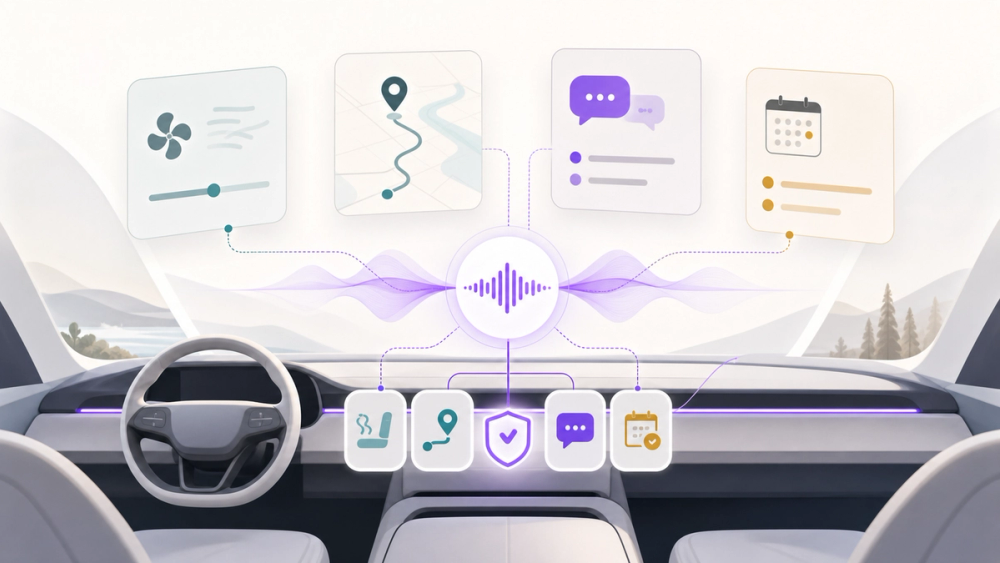
AI-generated editorial illustration for this article. Not an official Rivian asset or product screenshot.
Rivian Assistant is not just another voice command feature with a shinier name.
On May 12, 2026, Rivian introduced Rivian Assistant as part of its 2026.15 software update. The headline is simple: "Hey Rivian" is rolling out to compatible Gen 1 and Gen 2 R1 owners with Connect+ or an active trial. The real story is sharper: Rivian is trying to make the car itself the AI surface.
If you follow AI News, this is the launch to watch because it sits at the messy intersection of voice AI, subscriptions, vehicle control, third-party agents, privacy, and driver trust.
I would not file this under "nice infotainment upgrade." I would file it under: automakers are becoming AI platform companies, whether drivers asked for that language or not.
Quick Navigation
- What is Rivian Assistant? The new AI-powered, in-vehicle assistant and what it actually controls.
- Timeline: How Rivian moved from AI Day preview to the 2026.15 rollout.
- What We Know So Far: Public docs, subscription limits, privacy controls, and AI terms.
- Why It Matters: Five signals for AI builders, automakers, and software operators.
- Quick Take: The practical takeaway in one scan.
- FAQ: Short answers for search-driven questions.
What is Rivian Assistant?
Rivian Assistant is Rivian's AI-powered, in-vehicle voice assistant. According to Rivian's launch post, it is designed to understand the driver, the vehicle, and the context around a request. Unlike phone-mirroring assistants, it is built directly into Rivian's vehicle hardware and software.
That difference matters.
A phone assistant can answer questions, start navigation, and read messages when permissions line up. Rivian Assistant is positioned as a car-native layer that can talk to vehicle systems. Rivian's 2026.15 release notes say it can help control vehicle settings, climate control, navigation, media, messaging, calling, Owner's Guide questions, general knowledge, alerts, and troubleshooting.
In plain English: this is not just "ask the car a question." It is "ask the car to do something."
The assistant is activated by long-pressing the left thumbwheel, tapping the assistant icon on the center display, or saying "Hey, Rivian" or "Okay, Rivian." Rivian says full cloud-connected capabilities are currently English-only and available to Gen 1 and Gen 2 owners who subscribe to Connect+ or are in a trial period.
As of May 2026, Rivian's Connect+ page lists Connect+ at $14.99 per month or $149.99 per year. Rivian Assistant is listed as a Connect+ feature, not a standard included feature.
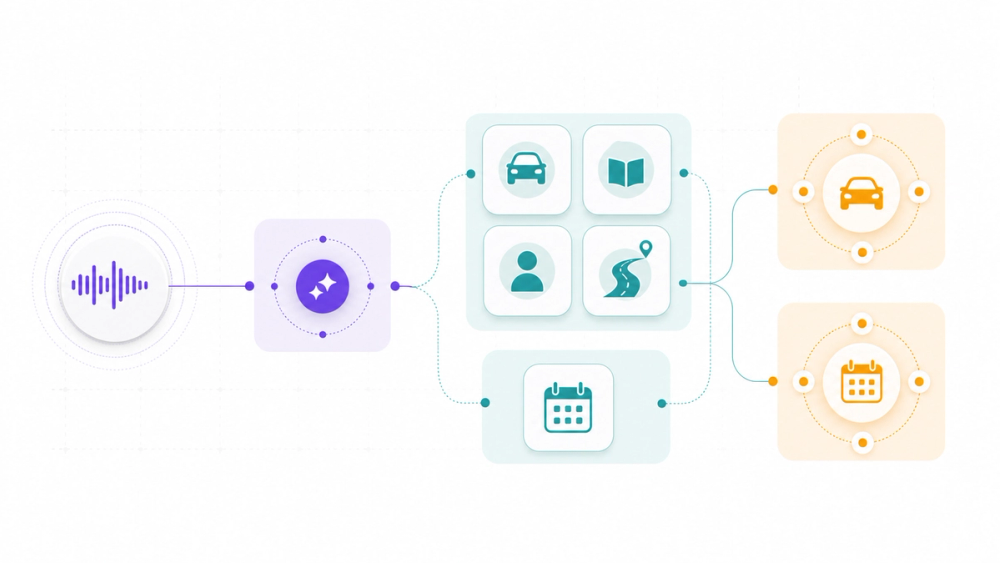
AI-generated workflow illustration. It explains the Rivian Assistant concept without showing a real product UI.
Timeline: How Rivian Assistant Became Real
- December 11, 2025: Rivian used its Autonomy and AI Day to preview Rivian Unified Intelligence, its in-house agentic framework, and an assistant that would connect vehicle control with third-party apps like Google Calendar.
- December 2025: TechCrunch reported that Rivian's AI assistant had been a two-year effort and would launch in early 2026 across existing Rivian EVs, not only next-generation vehicles.
- April 30, 2026: Google announced that Gemini would begin rolling out to cars with Google built-in, giving the broader market a clearer signal that conversational AI is moving into the dashboard.
- May 12, 2026: Rivian published its Rivian Assistant launch story and released 2026.15 update details for Gen 1 and Gen 2 R1 vehicles.
- May 12, 2026: Rivian's AI Use Terms were updated, spelling out important caveats around automated outputs, accuracy, user input, third-party providers, and sensitive data.
The important pattern is not one company doing a voice upgrade. It is the dashboard becoming an AI battleground.
What We Know So Far
The public evidence supports a narrow but meaningful claim: Rivian Assistant is a car-native AI assistant that can control vehicle functions and connect to at least one outside service, Google Calendar, through Rivian's agentic framework.
Rivian says the assistant can change drive modes, adjust ride height, open the front trunk, change climate settings, answer Owner's Guide questions, explain vehicle alerts, search for places, answer media questions, summarize or draft messages, and handle general knowledge requests like weather or local news.
The first external agentic integration is Google Calendar. Rivian's example flow is more than a single voice command: the assistant can check a schedule, find a coffee stop on a route, and text a contact an ETA. That is the part AI builders should pay attention to. The workflow is not "voice search." It is orchestration across vehicle context, personal context, and third-party services.
There are also real limits.
Rivian says Google Calendar and Memory are turned off by default. Users can opt into them through the Rivian mobile app. Rivian says Memory can learn preferences like music genres, restaurants, and regular destinations, and can be turned off or deleted at any time.
Rivian also says turning on Rivian Assistant automatically turns off Alexa and Alexa integrations. That is a small line in the release notes, but strategically it is huge. A car can only have so many primary assistants before the experience becomes weird.
The AI Terms add the sober part. Rivian says AI output may be inaccurate, incomplete, outdated, biased, or not official. Users are told to rely on official Rivian-published materials for verified product, feature, capability, warranty, or pricing information.
That is the right disclaimer. It is also the product challenge.
If an assistant can touch the car, the calendar, messages, memory, location, and vehicle troubleshooting, the trust bar is higher than it is for a chatbot inside a browser tab.
Why It Matters
1. Vehicle control is the moat, not the voice model
Most AI assistant demos still over-index on the conversation. The model sounds natural. The answer is smoother. The latency is lower. Fine.
But in a vehicle, the winning feature is not eloquence. It is access.
Rivian Assistant matters because it is embedded into the car's own systems. It can reach things a phone-mirroring assistant may not be allowed to touch: ride height, drive modes, climate, front trunk, vehicle alerts, and EV-specific information like range-on-arrival estimates.
That is the product lesson: the best AI assistant is usually the one closest to the real controls.
For AI teams outside automotive, this is the same reason agents that connect to your actual CRM, inbox, calendar, billing system, or codebase are more valuable than generic chat. Natural language is the interface. Permissioned action is the product.
Related pattern: tools like Linear Agent, Venn.ai, and Cekura all point at the same broader shift: AI gets more useful when it is allowed to operate inside a real workflow, with guardrails.
2. "Agentic" only matters if the chain is useful
Everyone uses the word agentic now. A lot of it is hand-waving.
Rivian's Google Calendar example is interesting because it is concrete. The assistant can check your schedule, find a stop along the way, and message someone with an ETA in one flow. That is a simple chain, but it maps to a real driving moment.
This is where most AI products lose me. They show a multi-step workflow that technically works but nobody actually needs. Rivian is starting with a scenario where the user is time-constrained, hands-busy, and context-rich.
That is exactly where agents should live.
3. Connect+ now has a clearer AI value proposition
Subscriptions in cars are a trust minefield.
Drivers hate feeling like they bought hardware and then got charged again for the useful part. Rivian has to be careful here because Rivian Assistant is listed as a Connect+ feature. As of May 2026, the public price is $14.99 per month or $149.99 per year.
The flip side is that Rivian Assistant gives Connect+ a much clearer story than "streaming apps and hotspot." A useful assistant could make the subscription feel less like a toll and more like a continuously improving software service.
The bet is obvious: if the assistant genuinely saves friction on road trips, errands, meetings, messages, and vehicle questions, Connect+ becomes easier to justify.
If it behaves like a beta voice bot that occasionally misunderstands high-stakes requests, the subscription backlash writes itself.
4. Privacy controls are now part of the feature, not the footer
Rivian says users can turn off the wake phrase, limit location sharing, disable Memory, and delete stored details. The release notes also say Google Calendar and Memory are off by default.
That is good product hygiene.
But the bigger point is that privacy controls are not a secondary legal detail anymore. In a car-native assistant, personal context is the feature. Calendar, location, routines, destinations, messages, profile preferences, and vehicle telemetry are exactly what make the assistant useful.
That creates a product tension every AI builder should recognize: the more context an assistant has, the more useful it becomes, and the more carefully it needs to be governed.
The AI Terms are blunt for a reason. Rivian says outputs may be wrong, users should independently evaluate them, and users should avoid entering sensitive or confidential information. For a consumer chatbot, that is familiar. For a vehicle assistant, it lands differently.
The product has to make the safe path the easy path.
5. The dashboard is becoming an AI platform layer
Google is rolling Gemini into cars with Google built-in. Rivian is now saying, effectively: we want our own assistant, our own orchestration layer, and our own vehicle-aware intelligence stack.
That is the correct strategic read.
Car companies do not want the dashboard to become a passive screen for someone else's assistant. They want the software layer, the customer relationship, the data controls, the subscription bundle, and the future app integrations.
Rivian Assistant is the consumer-facing piece of that strategy. Rivian Unified Intelligence is the infrastructure story underneath it.
The launch is not proof that every driver will suddenly love talking to their car. It is proof that automakers now see AI as part of the core operating system, not just a third-party add-on.
Quick Take
- Rivian Assistant controls vehicle functions: The useful AI layer is moving closer to hardware and system permissions.
- Google Calendar is the first external integration: Rivian is testing agentic workflows, not only voice Q&A.
- Connect+ gates the full experience: AI may become a key justification for automotive subscriptions.
- Memory and Calendar are opt-in: Personalization is valuable, but trust controls are now part of the product surface.
- AI Terms warn about inaccurate output: Car-native assistants need stronger accuracy, safety, and disclosure patterns than casual chatbots.
The clean takeaway: Rivian Assistant is less interesting as a chatbot and more interesting as a permissioned action layer inside the vehicle.
That is where consumer AI is heading. Not more windows to chat with. More places where the software already knows the context and can actually do the job.
FAQ
What is Rivian Assistant? Rivian Assistant is Rivian's AI-powered, in-vehicle voice assistant. It can respond to voice requests, control supported vehicle settings, answer Owner's Guide questions, help with navigation and media, summarize or draft messages, and connect with Google Calendar when the user opts in.
When did Rivian Assistant launch? Rivian announced Rivian Assistant on May 12, 2026, alongside the 2026.15 software update. The feature is rolling out to compatible Gen 1 and Gen 2 R1 owners who have Connect+ or an active trial.
Does Rivian Assistant require Connect+? Yes. Rivian's launch post and release notes say full cloud-connected Rivian Assistant capabilities are available to Gen 1 and Gen 2 owners subscribed to Connect+ or within a trial period. Rivian's Connect+ page lists Rivian Assistant as a Connect+ feature.
Can Rivian Assistant control the vehicle? According to Rivian's release notes, Rivian Assistant can help control vehicle settings, climate, navigation, media, messaging, and calling. Rivian's launch examples include changing drive modes, adjusting ride height, opening the front trunk, changing climate, and checking EV-specific information.
Is Rivian Assistant safe to rely on for critical information? Rivian's own AI Use Terms say AI outputs may be inaccurate, incomplete, outdated, or biased, and that users should rely on official Rivian materials for verified product, feature, warranty, and pricing information. Treat it as a helpful interface, not the final authority for critical decisions.
Discover more AI tools, experiments, and product trends at AIToolHunt.
Sources
- Rivian: New Software - Introducing Rivian Assistant and Rivian Unified Intelligence
- Rivian: 2026.15 R1S Gen 2 release notes PDF
- Rivian: 2026.15 R1S Gen 1 release notes PDF
- Rivian: Rivian Autonomy and AI Day
- Rivian: Connect+
- Rivian: AI Use Terms
- TechCrunch: Rivian's AI assistant is coming to its EVs in early 2026
- Google: Gemini is coming to cars with Google built-in