

Source: Runway's official Solaris report. Unmodified official launch artwork; this is not a recreated interface.
Runway Solaris is an interface world model that generates a user interface as a live stream of video frames. Instead of producing React components or a fixed mockup, it watches clicks, drags, and typing, then renders the next state. That is a striking product idea. It is not yet evidence that generated video can replace production software.
Quick Navigation
- What is it? A research system that makes the rendered frame itself interactive.
- What changed? Runway combined real-time video generation with language-model control.
- How does it work? User actions condition future frames while an LLM plans behavior.
- Who should try it? Experimental designers, creative developers, and agent researchers.
- Who should wait? Teams that need reliable text, data, accessibility, or long sessions.
- What remains unknown? Public access, latency, cost, integrations, and independent testing.
What is the Runway Solaris interface world model?
The Runway Solaris interface world model is an early-access research system that renders an interactive application as continuously generated video rather than assembling a conventional coded interface. In Runway's official Solaris report, a language model decides how the experience should evolve, while a video world model generates each visible state and conditions later frames on clicks, drags, typing, and prior frames. Runway says the system targets 720p output, interactive speed, and coherence across a session. That makes Solaris interesting for expressive product scenes, adaptive storefronts, creative tools, and research on agents facing changing interfaces. It does not make Solaris a production UI framework. Public pricing, latency, APIs, state management, database integration, accessibility behavior, and long-session reliability remain undisclosed or unresolved. The practical decision today is narrow: apply for early access if those unknowns are part of your experiment; wait if your product depends on deterministic behavior.
What We Know So Far
The evidence supports a new research direction, not a finished replacement for apps or websites.
- Confirmed release: Runway published Solaris on August 31 and is accepting early-access requests.
- Official mechanism: Solaris builds on Gen-4.5, treats user actions as conditioning signals, generates frames autoregressively, and uses a language model to steer behavior.
- Vendor-run study: Runway compared Solaris with a Claude Opus 5 coded-interface workflow across 30 examples and nearly 7,500 pairwise judgments from 250 participants.
- Independent context: RuntimeWire's report describes the product and its open questions but does not independently reproduce the study.
- Community boundary: Reddit discussion surfaced questions about cherry-picked demos, state, data, cost, and consistency. Those questions shape this guide; they do not verify or disprove Solaris.
- Our judgment: the near-term opportunity is visual, exploratory interaction. Deterministic application work still belongs in code.
What changed when the interface became video?
Most AI interface tools still translate a request into code, components, or a design file. Solaris removes that intermediate representation from the visible interaction loop. A starting image becomes the first state, and every new frame becomes the interface.
That changes the design space. An object can respond to a click without a developer predefining a component state. A product scene can move continuously instead of switching between fixed screens. A language model can reinterpret the meaning of a drag or click based on the current scene.
It also changes the failure mode. With coded UI, a broken state can often be traced to data, logic, or layout. With generated video, text, geometry, and behavior can drift together. A beautiful response is not necessarily a correct one, and a visually coherent scene may still have no reliable connection to the underlying application state.
How does Solaris turn clicks into frames?
Runway describes four linked steps.
- Learn interaction: clicks, drags, and other actions condition the next frame, just as text or images condition a generative model. 2. Generate autoregressively: each frame depends only on what came before, so the system can respond without generating a whole clip first. 3. Distill the video model: Runway compresses many diffusion steps into a few and trains the faster model on its own outputs to improve stability. 4. Separate reasoning from rendering: an LLM decides what should happen, while Solaris determines how that behavior looks frame by frame.
The architecture is closer to an interactive simulation than a code generator. That makes visual continuity central. It also means developers need answers about memory, data binding, event guarantees, and recovery before they can treat it like an application runtime.
The developer view
Developers should test Solaris as a presentation layer with a hostile boundary around it. Give the experiment a narrow task, a known starting state, and an external source of truth. Record the requested action, rendered response, latency, state drift, text errors, and any mismatch with the real data.
Do not start with checkout, account settings, medical instructions, or other flows where a convincing wrong state can cause harm. Better pilots are branded product exploration, interactive storytelling, playful data tours, and non-destructive prototypes. The central engineering question is not “Can it render this?” but “Can the experience remain grounded, observable, accessible, and recoverable?”
The product enthusiast view
Solaris suggests a product can feel less like a stack of pages and more like a scene that adapts while you use it. That could make creative software and shopping experiences more expressive. It could also make interfaces unpredictable: familiar buttons, text, and layouts are valuable because users know what will happen.
Early access is worthwhile for people who enjoy testing new interaction models and can tolerate failure. Anyone looking for a polished no-code app builder should wait for public demos, pricing, and evidence of reliable state and text.
Did Solaris beat a coded interface?
Runway reports a user study with 250 participants, 30 interaction examples, and nearly 7,500 pairwise judgments. Both Solaris and a Claude Opus 5 coding workflow started from the same image and received the same requested interaction. Participants rated instruction following and natural behavior.
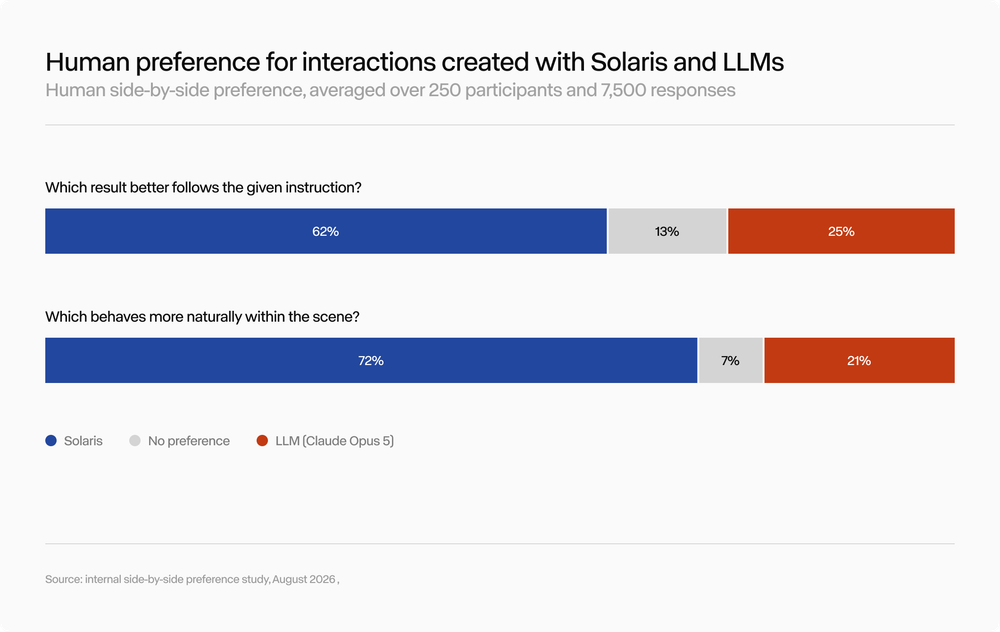
Source: Runway's official Solaris study. This is Runway's original chart from a vendor-run study, not an independent benchmark or an AI recreation.
The official prose says Solaris was preferred 61% to 24%, with 13% equivalent, for following the requested interaction. For natural behavior, the prose reports 71% to 21%, with 6% equivalent. The original chart rounds those values differently: 62%/25%/13% and 72%/21%/7%. Because both versions come from the same Runway page and underlying internal study, this article does not choose the more favorable set. It records the discrepancy and treats the result as directional vendor evidence.
The study asks whether the generated result looked more responsive and natural in selected examples. It does not measure production correctness, accessibility, database consistency, security, cost, or long-session reliability. The prompts, full sample set, code, and independent reproduction are not public, so outsiders cannot yet audit how representative the comparison is.
Why does Runway argue that code loses visual information?
Runway separately tested multimodal language models on reconstructing 30 interfaces from screenshots. It scored both same-position similarity and whether visual content survived when it moved. The official result shows reconstruction quality falling as scenes become more visually complex.
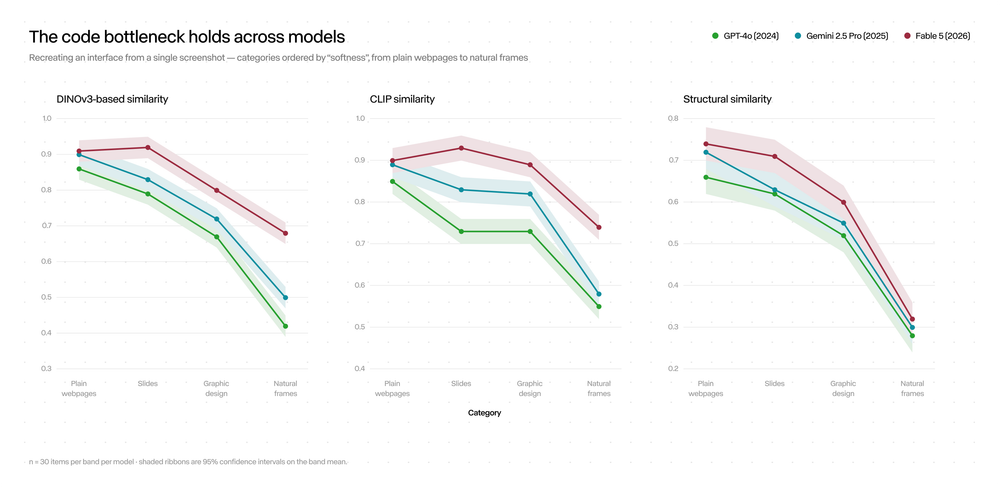
Source: Runway's official reconstruction evaluation. Original vendor chart; the dataset, full outputs, and independent reproduction are not public.
This supports a limited point: translating a rich image through language and code can lose visual detail. It does not prove that continuous video is the better general software representation. Code brings semantics, testability, keyboard behavior, screen-reader structure, durable state, and precise integration. A useful hybrid may keep those deterministic foundations while using generation for visual regions where variation is the product.
Who should try Solaris now, and who should wait?
Try early access now if you build experimental creative tools, interactive campaigns, product visualization, adaptive entertainment, or agent research. Use it to learn where a generated scene creates value that conventional UI does not. Keep the test non-destructive and preserve an external record of the real state.
Wait if you need a public SDK, predictable pricing, exact text, accessible semantics, durable data binding, audit logs, or long-session consistency. Runway itself lists text, trust, long sessions, accessibility, and integration as open challenges.
Before moving beyond a demo, ask for five things: a latency distribution rather than a highlight clip; pricing per useful session; a state and data integration model; accessibility and keyboard behavior; and evaluations that include failures, not only preferences.
What could stop video interfaces from working?
- Text: Runway says stable, legible real-time text remains open.
- Trust: a plausible visual answer can be wrong even when it looks coherent.
- Long sessions: visual and semantic state can drift over extended interaction.
- Accessibility: generated pixels do not automatically expose screen-reader semantics or reliable focus order.
- Integration: production software needs authentication, databases, permissions, analytics, tests, and recovery paths.
- Economics: Runway has not published pricing or resource requirements for Solaris.
- Evaluation: the available preference study is internal and not independently reproducible.
Quick Take
- What is actually new?: Evidence-backed answer: Runway is generating the interactive visual layer frame by frame instead of translating every response into code
- What is the strongest evidence?: Evidence-backed answer: An official mechanism description and a vendor-run preference study with 250 participants
- Who should try it now?: Evidence-backed answer: Creative developers and researchers with narrow, non-destructive experiments
- Who should wait?: Evidence-backed answer: Teams that require deterministic state, exact text, accessibility, integrations, or predictable cost
- What is still unknown?: Evidence-backed answer: Public access, latency distribution, pricing, APIs, full evaluation data, and independent reproduction
Bottom line: Solaris is a serious experiment in treating interface generation as an ongoing visual process. It is worth testing where expressive interaction matters more than exact state. It is not evidence that production UI should abandon code.
FAQ
What is Runway Solaris?
Solaris is Runway's first interface world model. It generates an interactive visual scene one frame at a time, using user actions and prior frames as conditioning while a language model guides how the experience changes.
Is Solaris a no-code app builder?
Not in the conventional sense. It does not primarily generate a component tree or application source code. It renders the interface as live video. Runway has not published a production SDK, pricing, or a complete integration model.
Did Solaris outperform Claude Opus 5?
Runway reports higher participant preference for Solaris in its own 30-example study. That is a vendor-run interaction comparison, not a general model ranking. The full evaluation materials and independent reproduction are not public.
Can developers connect Solaris to real databases and APIs?
Runway says integration remains a challenge and has not documented a public data-binding or API contract. Developers should assume an external source of truth is required until public technical details show otherwise.
Who should apply for Solaris early access?
Creative developers, interaction designers, brand-experience teams, and agent researchers with a narrow, reversible experiment are the clearest fit. Teams building high-stakes or accessibility-critical flows should wait for stronger guarantees.
Discover more practical AI products and emerging developer tools at AIToolHunt.