
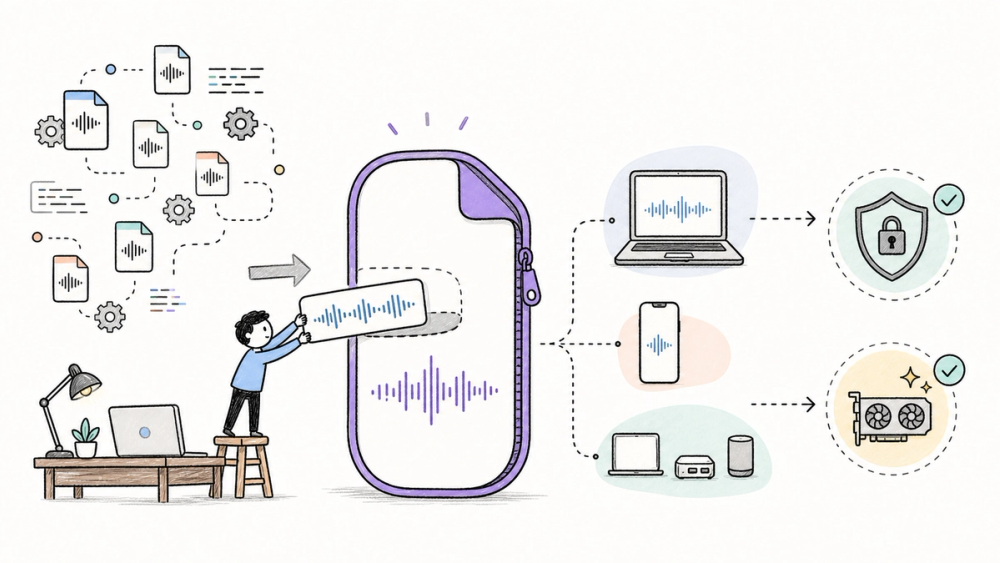
Transcribefile is interesting because it attacks the boring part of local AI: distribution. Mozilla's latest llamafile release says it now includes the first version of a transcribe.cpp-based speech-to-text utility, which could make local transcription easier to ship across machines without dragging a full Python stack behind it.
That does not mean every user should download it tonight. The public evidence supports a narrower claim: a serious open-source STT library is being wrapped in a portable distribution format. The practical question is who benefits now, and who should wait for clearer docs, installers, and third-party testing.
Quick Navigation
- What is Transcribefile? The direct definition and evidence boundary
- What changed in llamafile v0.10.4? The new packaging layer
- How does transcribe.cpp work? The ggml, GGUF, and acceleration story
- Who should try it now? Developers versus ordinary users
- What remains unclear? Availability, quality, and production fit
- FAQ: Five direct answers for searchers
What We Know So Far
This is a public-source product explainer, not a hands-on test. The strongest evidence is Mozilla's llamafile v0.10.4 release, CJ Pais' transcribe.cpp project page, Mozilla.ai's June 30 announcement, and Phoronix's independent coverage. I am treating vendor and maintainer claims as source-backed claims, not independent quality proof.
What is Transcribefile?
Transcribefile is the new single-file speech-to-text utility introduced in Mozilla's llamafile v0.10.4 release. It packages CJ Pais' transcribe.cpp, a ggml-based C/C++ inference library for local automatic speech recognition, into the llamafile distribution model: one portable executable instead of a Python stack plus separate model runtime. Mozilla's June 30 announcement says transcribe.cpp supports multiple STT model families through GGUF and can use Metal, Vulkan, and CUDA backends. The maintainer's project page says the library targets 16 ASR families, streaming and batch transcription, first-party bindings, and WER-tested model conversions. The practical change is narrower than "voice AI solved": developers get a more portable local transcription building block, while ordinary users should wait for wrapped apps or clear instructions unless they already like command-line tools. That is why the honest use case is evaluation and packaging first, not replacing every transcription app this week.
What changed in llamafile v0.10.4?
- Local STT often required separate runtimes, bindings, and model conversion work: New public information: Mozilla says llamafile 0.10.4 brings the first version of
transcribefile; Why it matters: Local transcription can move closer to the "download one file and run it" pattern - transcribe.cpp was already a standalone open-source library: New public information: The release notes describe transcribefile as a cosmocc build of the transcribe.cpp CLI; Why it matters: Developers get a distribution path tied to llamafile, not just a library repo
- The project page made broad maintainer claims about model families and acceleration: New public information: Mozilla's release connected that work to a wider portable executable ecosystem; Why it matters: The story becomes product-shaped instead of only library-shaped
- Public availability still needed checking: New public information: The release notes mention transcribefile, while the visible 0.10.4 asset list emphasizes llamafile, diffusionfile, whisperfile, and zipalign; Why it matters: Users should verify the current release files and docs before assuming a polished one-click binary
The useful part is the distribution layer. Mozilla's release notes say transcribefile is "nothing more than" a cosmocc build of the transcribe.cpp CLI. That phrasing is modest, but it matters. A portable executable is often the difference between a local AI tool people can try and a GitHub repo only maintainers can build.
The release also includes adjacent infrastructure changes: a sync with upstream llama.cpp, Vulkan and ROCm improvements, HTTPS support, and sandboxing. Phoronix focused on that wider llamafile 0.10.4 package, which is helpful independent confirmation that this was not just a stale project page resurfacing.

Mozilla.ai used this image in its official transcribe.cpp announcement. It supports the announcement context, not any performance or quality claim.
How does transcribe.cpp work?
transcribe.cpp is trying to do for speech-to-text what llama.cpp did for many local language-model workflows: make inference more portable, embeddable, and hardware-aware. The project uses ggml and GGUF so different STT model families can share a more consistent inference path.
CJ Pais' project page says the library supports 16 ASR families, more than 60 models, streaming transcription, batch transcription, and bindings for Python, JavaScript/TypeScript, Rust, and ObjC/Swift. It also says each Handy-published model has been numerically validated and WER tested against the reference implementation.
Read that carefully. Those are maintainer claims, not an independent benchmark suite published by AIToolHunt. They are still useful because they tell you what to verify: model coverage, conversion quality, GPU behavior, bindings, and whether the generated transcript matches the reference implementation closely enough for your use case.
The developer view
If you build desktop apps, mobile apps, note tools, podcast workflows, support-call review systems, or offline-first voice features, Transcribefile is worth watching. The design goal is not a new speech model. It is a smaller integration surface for running local ASR across platforms.
The first test should be boring and specific: take one known audio file, run the same model through your current path and through transcribe.cpp or transcribefile, then compare transcript quality, wall-clock time, memory use, GPU backend behavior, and packaging pain. If the packaging is easier but the transcript is worse, that is not a win.
The product enthusiast view
For normal AI users, the story is privacy and convenience. Local transcription means your audio does not necessarily need to leave your device, and a single-file tool could make offline transcription less fragile.
But this is not yet the same as a polished consumer app. If you just want meeting notes, Handy, MacWhisper, Whisper.cpp wrappers, or cloud transcription tools may still be easier. Transcribefile becomes exciting when a product wraps it cleanly, not when users have to understand build flags.
Who should try Transcribefile now?
- Local-first app builders - try it if your current ASR stack is hard to package across Mac, Windows, and Linux. 2. Tool makers already using whisper.cpp - compare compatibility and model coverage before replacing anything. 3. Privacy-sensitive teams - evaluate it for workflows where local audio processing matters, but still check security, logging, and model storage. 4. Everyday users - wait unless you are comfortable with command-line tools and fast-changing open-source releases.
My read: this is not a flashy model launch, but it may matter more than a flashy demo for people shipping real local AI software. Speech-to-text is only useful when it fits into the product without turning installation into a weekend project.
What remains unclear?
The largest gap is availability and documentation. As of July 19, 2026, the GitHub release notes clearly mention the first version of transcribefile, but the visible 0.10.4 release assets I checked did not show a separate asset named transcribefile. That may mean it is bundled, build-oriented, renamed, or still settling. Users should check the current release page before planning around a specific binary.
The second gap is independent quality data. The maintainer says models are numerically verified and WER tested, and Mozilla.ai describes GPU-accelerated support for multiple models. That is encouraging, but the public article should not convert those statements into a universal accuracy claim.
The third gap is product packaging. A local STT engine is useful, but ordinary users still need recording controls, transcript editing, file import, diarization expectations, privacy settings, and export formats. Transcribefile can reduce the distribution problem; it does not solve the entire product.
Quick Take
- What is actually new?: Evidence-backed answer: Mozilla's
llamafile v0.10.4release introduces the first version oftranscribefile, built from transcribe.cpp. - Who can use it now?: Evidence-backed answer: Developers can inspect the release, source, and build path now; casual users should verify current binaries and docs first.
- What is the strongest evidence?: Evidence-backed answer: Mozilla's GitHub release notes and Mozilla.ai's official transcribe.cpp announcement.
- What should developers verify?: Evidence-backed answer: Transcript quality, GPU backend behavior, packaging, memory use, bindings, and whether a separate binary is available.
- What is still unknown?: Evidence-backed answer: Independent quality results, consumer readiness, and the exact best path for non-technical users.
The practical verdict: try Transcribefile if local speech-to-text packaging is already painful for you. If your only question is "which app records my meetings?", wait for the wrapper ecosystem to catch up.
FAQ
What is Transcribefile?
Transcribefile is Mozilla's new llamafile-based packaging path for transcribe.cpp, a local speech-to-text inference library. The goal is to make local transcription more portable by wrapping the transcribe.cpp CLI into a self-contained executable style rather than requiring a larger runtime stack.
Is Transcribefile the same as transcribe.cpp?
No. transcribe.cpp is the underlying ggml-based C/C++ speech-to-text library. Transcribefile is Mozilla's distribution wrapper for that CLI inside the llamafile ecosystem. In plain English: transcribe.cpp is the engine, while Transcribefile is the portable packaging idea around it.
Can ordinary users run Transcribefile today?
Maybe, but do not assume it is a polished consumer download yet. Mozilla's release notes mention the first version, while the visible 0.10.4 release assets should be checked before use. If you are not comfortable with GitHub releases or command-line tools, wait.
What models does transcribe.cpp support?
The maintainer says transcribe.cpp targets 16 ASR families and 60+ models, with Metal, Vulkan, CUDA, and TinyBLAS acceleration. Treat that as a source-backed project claim and verify your exact model, hardware backend, and transcript quality before shipping it in a product.
Why should developers care about local speech-to-text?
Local speech-to-text can reduce cloud dependency, improve privacy posture, and make voice features work offline. The hard part is packaging and validation across devices. Transcribefile matters because it points at a simpler distribution path, not because it magically proves every model is accurate.
Discover more practical AI tools and local AI products at AIToolHunt.