Newsletter
Join the Community
Subscribe to our newsletter for the latest news and updates
Most AI products ask a language model to write text, then spend more code parsing, validating, and repairing it. TypeSafe Jev flips that workflow: the model returns typed decisions and probabilities directly. That is a genuinely different interface, but the smart question is not whether Jev replaces LLMs. It is which narrow decisions are bounded enough to deserve a specialized model.
TypeSafe Jev is an early-access AI model built for bounded software decisions, not open-ended text generation. A developer sends unstructured state plus typed questions; Jev returns values, probability distributions, and confidence that application code can branch on directly. TypeSafe's September 18 release calls this a System One model, while its technical introduction documents Choice, Score, and Noul question types evaluated in parallel. That interface can remove free-form schema drift, but it does not make every answer correct. A valid enum with 82% confidence can still be the wrong decision, so thresholds, abstention paths, and domain-specific evaluation remain the developer's responsibility. As of September 20, 2026, access was still early rather than universal. The practical distinction is simple: use Jev for fast classification, scoring, routing, or guardrails; keep a general-purpose LLM for writing, coding, research, and multi-step reasoning.
This is a source-based product analysis, not a hands-on benchmark. The confirmed layer comes from TypeSafe's launch post, current API documentation, and TechCrunch's independent reporting. Those sources establish Jev's output contract, early-access status, and intended use cases.
Performance is a different layer. TypeSafe published its own workflow evaluation and disclosed useful caveats, including that team members created the workflows and that the reference answers favor particular frontier models. The chart below is therefore evidence of what the vendor measured, not independent proof that Jev wins across production workloads.
The normal LLM integration path is awkward for a binary or categorical decision. You ask for JSON, wait for tokens, validate the schema, retry malformed output, and still need a confidence policy. Jev makes the decision object the native response.
That last row matters most. Type safety narrows one failure surface; it does not erase model error. Jev can make an automation easier to compose, but the surrounding system still decides when to trust, review, or reject its output.
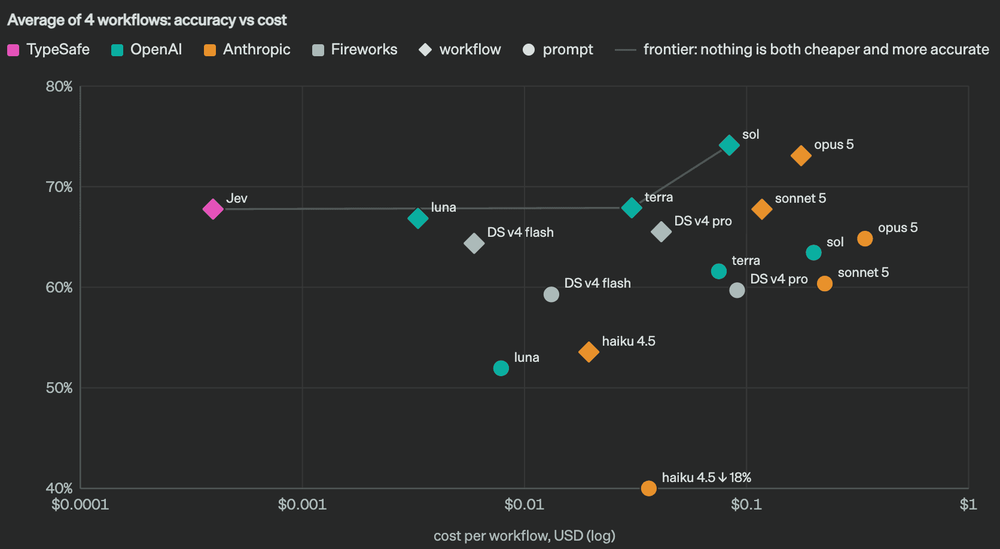
Source: TypeSafe's official release and workflow evaluation. The chart averages four vendor-authored workflows. TypeSafe discloses possible author bias and reference-model bias; these results have not been independently reproduced.
TypeSafe says Jev sits on a favorable accuracy-cost frontier in this evaluation. That is interesting enough to test, not strong enough to generalize. A team should rebuild the comparison on its own labels, error costs, latency budget, and fallback policy before moving a production classifier.
Jev receives two things: a state and a set of typed questions. The state can contain the messy context—a support ticket, command trace, email, or product record. Each question defines the decision shape the application expects.
The documentation describes three primitives. Choice selects among named options. Score returns a value on a developer-defined scale. Noul expresses a probabilistic yes-or-no judgment. Multiple questions can be evaluated in parallel against the same state, producing values, probability distributions, and confidence fields without generating an explanatory essay first.
That design trades generality for control. It cannot draft the customer reply or write the remediation code. It can help decide which queue receives the ticket, how risky a command appears, or whether an expensive reasoning model should handle the next step.
The integration win is not “no prompts.” Developers still have to define the state, labels, score legend, and policy. The win is that the contract is explicit enough to test.
A serious pilot needs four checks. First, build a held-out dataset from the actual workflow. Second, measure calibration rather than accuracy alone: an 80% bucket should be right about 80% of the time. Third, define an abstention band that routes uncertain cases to a person or a stronger model. Fourth, calculate the cost of false positives and false negatives separately; one blended accuracy number can hide an unsafe decision rule.
Jev is less flashy than a chatbot because it gives up prose. That is precisely why it is interesting. Many useful product decisions are not conversations: choose a route, assign a risk level, rank a candidate, or decide whether more expensive inference is justified.
The catch is that a probability can look scientific even when the underlying task is poorly specified. If the labels are vague, the training examples do not match production, or the cost of an error changes by case, confidence numbers can create false comfort. The product experience needs a visible “not sure” path, not just a more polished score.
The practical decision rule is narrow: test Jev where the output space is known in advance and mistakes can be measured. Do not use it merely because a specialized model sounds cheaper.
Teams with an existing LLM classifier are the clearest early testers. They already have prompts, labels, failure examples, latency data, and a baseline bill. That makes an A/B evaluation possible without inventing a benchmark after seeing the result.
Good candidates include command-risk checks, support routing, content triage, model routing, record matching, and other repeatable decisions with an explicit review path. Wait if your task depends on generating explanations, synthesizing new information, using tools over several steps, or changing its label set every week.
Early access is another reason to keep the blast radius small. Put Jev behind a feature flag, log the full decision context, retain the old classifier as a fallback, and start in shadow mode before allowing its output to trigger real actions.
These are normal gaps for a new model class. They are also exactly why a reversible, measured pilot is more rational than a wholesale replacement.
Jev is worth testing as a decision component, not treating as a smaller universal LLM.
What is TypeSafe Jev?
TypeSafe Jev is an early-access System One model that takes unstructured state plus typed questions and returns values, probability distributions, and confidence. It is designed for bounded software decisions such as classification, scoring, routing, and guardrails rather than open-ended text generation.
Is TypeSafe Jev available now?
TypeSafe opened early access with the September 18, 2026 release and was bringing developers off a waitlist. That is not the same as universal production availability. Check the current console and documentation for account access, limits, supported models, and pricing before designing around it.
Does Jev eliminate hallucinations?
It can eliminate free-form output and schema mismatch when the response type is defined in advance. That does not guarantee a correct decision. A valid category or probability may still be wrong, so applications need evaluation data, confidence thresholds, abstention, monitoring, and a fallback path.
How is Jev different from structured output from an LLM?
A general-purpose LLM still generates tokens and is then constrained or parsed into a schema. Jev is optimized to return typed decisions and probabilities directly. The tradeoff is scope: the LLM can explain, write, code, and reason broadly; Jev targets bounded judgments.
What should developers test before adopting Jev?
Compare it with the current classifier on held-out production examples. Measure class-specific precision and recall, calibration, latency, total cost, and the effect of an abstention band. Run in shadow mode first, then enable only low-impact decisions with a logged fallback.
Discover practical AI products and emerging tools at AIToolHunt.