
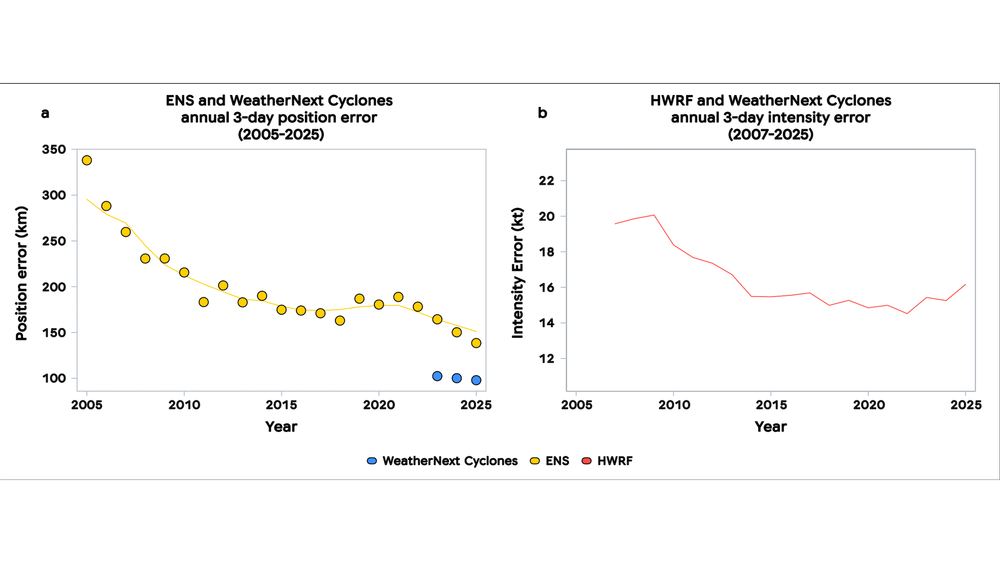
Google's original long-term comparison places the model's three-day errors beside ENS and HWRF historical trends. Source: Google DeepMind's WeatherNext Cyclones announcement.
WeatherNext Cyclones is worth paying attention to, but not because an AI can now call every hurricane one day earlier. Google DeepMind published the model, code, weights, and a Nature evaluation on August 6, 2026. The evidence supports a narrower, more useful conclusion: its average three-day cyclone forecast matched the accuracy older systems reached at two days.
Quick Navigation
- What is WeatherNext Cyclones? The model and the 24-hour claim
- What changed? Open code, weights, and reproducible checkpoints
- How does it work? Global weather plus cyclone-specific training
- Why should builders care? A realistic first experiment
- What remains unclear? Operational and safety boundaries
- FAQ: Five practical questions
What We Know So Far
This is an evidence review, not a hands-on forecast test. The public record includes the peer-reviewed evaluation, paper-matching checkpoints, operational model notes, and NHC verification. It does not yet include broad outside reproduction of the August 2026 release, so vendor-reported research results and independent operational evidence stay separate below.
What is WeatherNext Cyclones?
WeatherNext Cyclones is Google DeepMind and Google Research's open model for predicting a tropical cyclone's track, intensity, and wind structure in one system. On August 6, 2026, Google released its code and pretrained weights alongside a Nature paper and a technical announcement. The headline result is an average lead-time gain of more than 24 hours: a three-day WeatherNext forecast had roughly the accuracy that earlier leading models reached at two days. That result comes from historical cyclone evaluations covering 2023 and 2024, with a partial 2025 operational analysis, so it is not a promise for every storm. The released repository includes the larger research checkpoints and a lower-resolution Mini model that can run in a free Colab TPU environment. Google and the National Hurricane Center both treat the output as guidance for expert forecasters, not a replacement for official alerts.
What changed with the open-source release?
- Forecasts and selected operational results were visible: What is public now: Code, pretrained weights, checkpoints, and a Colab path are public; Why it matters: Researchers can inspect and reproduce more of the workflow
- The 24-hour advantage was a research claim: What is public now: Nature publishes the evaluation design and Google publishes paper-matching checkpoints; Why it matters: The claim has a testable boundary rather than only a launch graphic
- Most outsiders consumed forecast feeds: What is public now: Builders can run the Mini model or provision larger accelerators; Why it matters: Experimentation is easier, but production deployment remains demanding
The most important change is auditability. The repository identifies which checkpoints reproduce the paper, which model ran during the 2025 Atlantic hurricane season, and which Mini checkpoint trades accuracy for lower hardware requirements.
The 24-hour number still needs careful wording. Google reports an average advantage across track, intensity, and wind-extent evaluations for historical storms. It does not mean the system detects every cyclone 24 hours sooner, and it does not erase false alarms or difficult rapid-intensification cases.
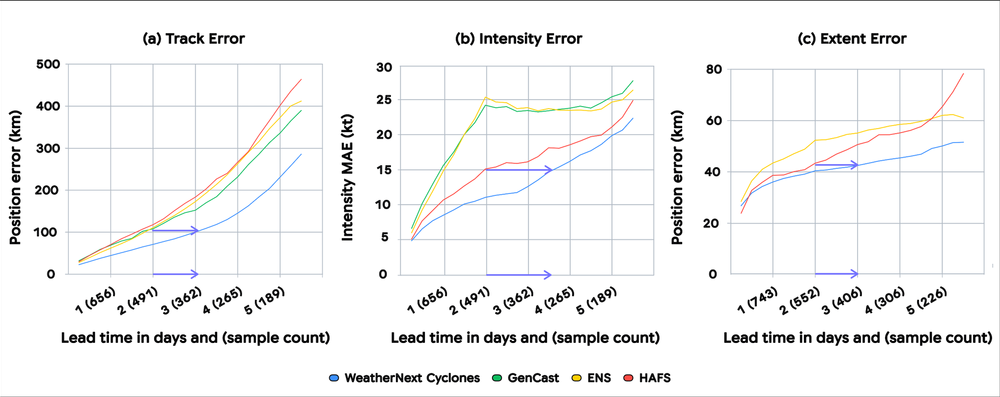
Google's original evaluation figure shows the reported lead-time advantage across three error measures; lower error is better. Source: Google DeepMind's WeatherNext Cyclones announcement. The curves are model evaluations, not a guarantee for a specific live storm.
How does WeatherNext Cyclones work?
WeatherNext combines two scales that hurricane forecasting usually separates. Large atmospheric currents steer a storm's track, while small, local processes around the eye drive intensity. The model trains on global atmospheric data plus the IBTrACS archive of expert-curated cyclone observations, then predicts both the broad weather field and the storm-specific variables.
Its Functional Generative Network produces an ensemble: many plausible futures rather than one confident line. Google says the current operational workflow can generate 1,000 scenarios for a cyclone, which helps surface low-probability outcomes. The paper result, however, should be read against its stated historical evaluation and tracker setup rather than generalized to every future basin and storm.
The developer view
The sensible first test is the Mini checkpoint in the official Colab. It runs at 1-degree resolution and Google explicitly says it should not match the larger models. If your workflow needs paper-level reproduction, the non-Mini checkpoints are optimized for TPU and require substantially more memory; the repository says an H100 is needed for the GPU path.
Code and notebooks use Apache 2.0, while other released materials use CC BY 4.0. Initial-condition and training datasets can have separate terms. Pin the documented release, record the exact checkpoint and initialization data, and compare output against an official forecast archive before building any alerting feature.
The product enthusiast view
The exciting part is not an AI weather app with a prettier cone. It is that an operationally tested scientific model is becoming inspectable by researchers, nonprofits, and weather-tool builders. That makes independent reproduction more plausible.
But do not treat the public Weather Lab or a local model run as an evacuation signal. Google labels the project experimental, and national meteorological agencies remain responsible for warnings. For a normal user, the right action is still to follow the National Weather Service or the relevant local agency.
Why should builders care now?
- The strongest claim is reproducible in principle — paper-matching checkpoints, code, and evaluation context are now public. 2. There is a realistic entry point — the Mini model lowers the hardware barrier for learning the pipeline, even though it sacrifices expected performance. 3. The safety boundary is unusually clear — model output can inform expert workflows, but it must not become an unsupervised public-warning system.
The independent operational evidence is promising. A Weather.com analysis of the NHC's 2025 report says the Google DeepMind ensemble average beat the NHC track forecast from 12 to 72 hours, while its intensity guidance was the best-performing model and roughly on par with the NHC. That supports real-world usefulness without proving the new open release will behave identically in every setting.
What remains unclear?
- How the released checkpoints perform when outside teams reproduce the complete paper evaluation.
- How much tracker choices, initialization data, and post-processing contribute to the 24-hour average.
- Whether performance holds across rare storms, new climate regimes, and regions with weaker observations.
- The operational cost of running large ensembles outside Google's TPU infrastructure.
- How teams should communicate model uncertainty without encouraging false confidence.
These are not footnotes. A forecast system can be better on average and still fail badly on the one storm a community cares about.
Quick Take
- What is actually new?: Evidence-backed answer: Google released WeatherNext 2 and Cyclones code, weights, and paper-matching checkpoints.
- Who can use it now?: Evidence-backed answer: Researchers can start with the Mini Colab; larger checkpoints need stronger accelerators.
- What is the strongest evidence?: Evidence-backed answer: The Nature evaluation plus NHC's 2025 operational verification.
- What should developers verify?: Evidence-backed answer: Checkpoint, initialization data, tracker, hardware, and error against an official archive.
- What is still unknown?: Evidence-backed answer: Independent reproduction and performance on future rare storms.
My take: this is a credible research release with operational evidence, not a consumer safety product. Try it to understand the pipeline; wait before trusting it for decisions that can put people at risk.
FAQ
What is WeatherNext Cyclones?
WeatherNext Cyclones is an open Google DeepMind model that predicts cyclone track, intensity, and wind structure within one global forecasting system. The August 2026 release includes code, weights, larger paper-matching checkpoints, and a lower-resolution Mini model for easier experimentation.
Does WeatherNext really forecast cyclones 24 hours earlier?
Not in every case. The Nature evaluation reports an average lead-time advantage of more than 24 hours across historical track, intensity, and wind-extent tests. The practical interpretation is that its three-day forecasts reached roughly the accuracy prior systems achieved at two days.
Can anyone run WeatherNext Cyclones now?
Yes, but hardware changes the answer. The official Mini Colab is the accessible learning path and can use a free TPU runtime. Larger checkpoints are optimized for TPU, and the repository says the GPU route needs an H100. Mini is not expected to match full-model performance.
What should developers test before using WeatherNext?
Pin the release and checkpoint, log initialization data and tracker settings, and score forecasts against an official archive. Test calibration and false alarms, not only average track error. Never turn an experimental model output directly into a public warning or safety instruction.
What is still unverified about the open release?
Independent teams have not yet had much time to reproduce the new checkpoints. Performance may change with hardware, data feeds, tracker choices, basin, or storm type. The largest unresolved question is how well the reported average advantage survives outside Google's operational setup.
Discover practical AI products and emerging tools at AIToolHunt.