
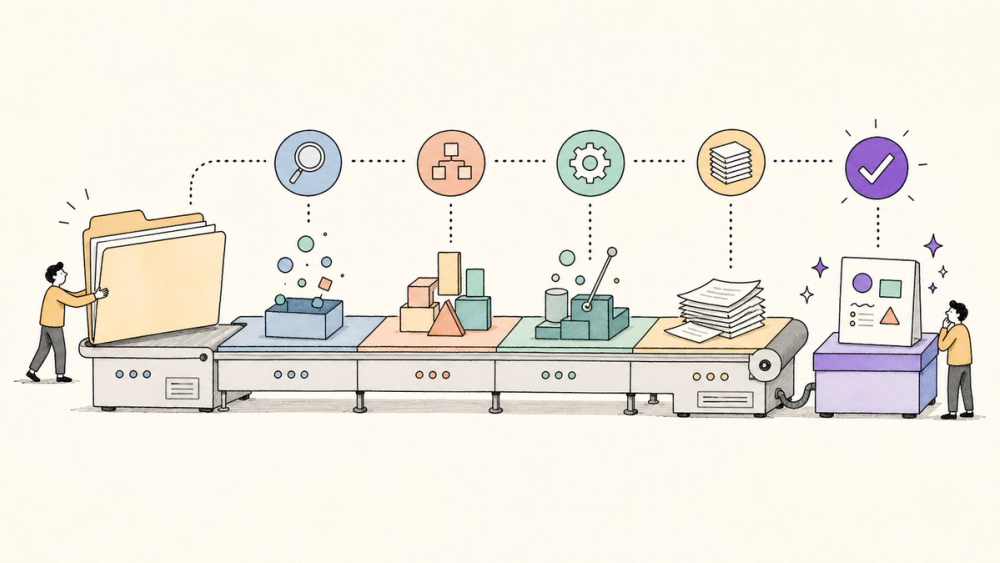
Claude Fable 5 in Claude Cowork is not the model you pick for a quick summary. Anthropic is positioning it for the assignments that sprawl across files, tools, decisions, and hours of work: due diligence, contract review, planning, research, and recurring operational jobs.
The useful question is not whether Fable 5 is smarter than another model. It is whether a job is valuable, complex, and verifiable enough to justify selecting a slower, more usage-intensive model and letting it work with less step-by-step prompting.
Quick Navigation
- What is Claude Fable 5 in Claude Cowork? The model, product surface, and current access boundary.
- What We Know So Far: Confirmed facts versus Anthropic's product claims.
- What changed? The shift from prompting each step to delegating a complete outcome.
- How does the workflow work? Context, planning, subagents, tools, and review.
- Why should users care? A practical model-selection rule for real work.
- What remains unclear? Reliability, cost, and rollout questions that public material cannot settle.
- FAQ: Five direct answers for prospective Cowork users.
What is Claude Fable 5 in Claude Cowork?
Claude Fable 5 in Cowork is Anthropic’s manually selected model option for long, complex, asynchronous knowledge work—not the default for everyday requests. Anthropic says it can plan multi-step jobs, split work among subagents, use connected files and tools, and check results while a task runs for hours or days. In its July 16, 2026 Cowork guide, Anthropic names workflows such as deep research followed by a memo, due diligence followed by a board presentation, contract redlining, budget construction, and recurring pipeline reviews. As of that publication date, Cowork still defaults to Claude Sonnet 5; users must choose Fable 5 and should expect it to consume more usage. Anthropic’s availability update says global Fable access returned July 1 and shifted to usage credits after July 7. The practical distinction is therefore workflow shape: Sonnet 5 for quick passes, Opus for defined deep work, and Fable 5 for important projects with many tools, judgment calls, and verifiable outputs.
This article covers the Cowork workflow, not another model benchmark review. For architecture, pricing, benchmark claims, and early developer reactions, read our separate Claude Fable 5 community review.
What We Know So Far
The strongest public evidence comes from Anthropic's own July 16 product guide, so the capability descriptions should be read as documented product behavior and vendor guidance, not independent proof of reliability. Anthropic says Fable 5 can maintain context across tasks that take days, plan before acting, use subagents, and check its output as it goes.
There is independent support for the broader Cowork product shape. TechRadar reported that Cowork can work inside designated local folders, queue several instructions, and keep the user in a supervisory role through approval prompts. That report predates this Fable-specific workflow guidance, so it validates the interface concept, not Fable 5's performance.
The model hierarchy also reflects a broader product strategy. Axios described Sonnet 5 as Anthropic's default model for everyday work and framed the company's direction as a move from chat toward delegated agent tasks. The Fable guidance sharpens that split: Sonnet handles the daily queue; Fable is reserved for the expensive mess.
What changed when Fable 5 entered Cowork?
- Prompt every intermediate step: Fable 5 workflow guidance: Describe the outcome and let Cowork propose the route; Why it matters: The model can adapt its approach to the material it finds
- Use one model for everything: Fable 5 workflow guidance: Keep Sonnet 5 for quick passes; manually choose Fable 5 for the hardest work; Why it matters: Users trade more usage for more planning and checking only where it may pay off
- Review only the final file: Fable 5 workflow guidance: Inspect the visible plan, files, tools, and skills during the run; Why it matters: A bad assumption can be corrected before it contaminates every downstream step
- Repeat a process manually: Fable 5 workflow guidance: Save the procedure as a Skill or scheduled task; Why it matters: A validated workflow can become repeatable, but every run still counts toward usage
The most important change is psychological: the unit of delegation becomes an outcome, not a prompt. Anthropic's examples start with a business question—why cancellations rose, what next year's budget should look like, or what an industry announcement changes—and end with a memo, deck, prototype, or scheduled review.
That does not mean “say less and trust more.” It means give Cowork the material, audience, deadline, quality bar, and constraints it needs to make decisions. If a metric must always use a specific formula, document the procedure; if only the outcome matters, leave room for the model to choose a route.
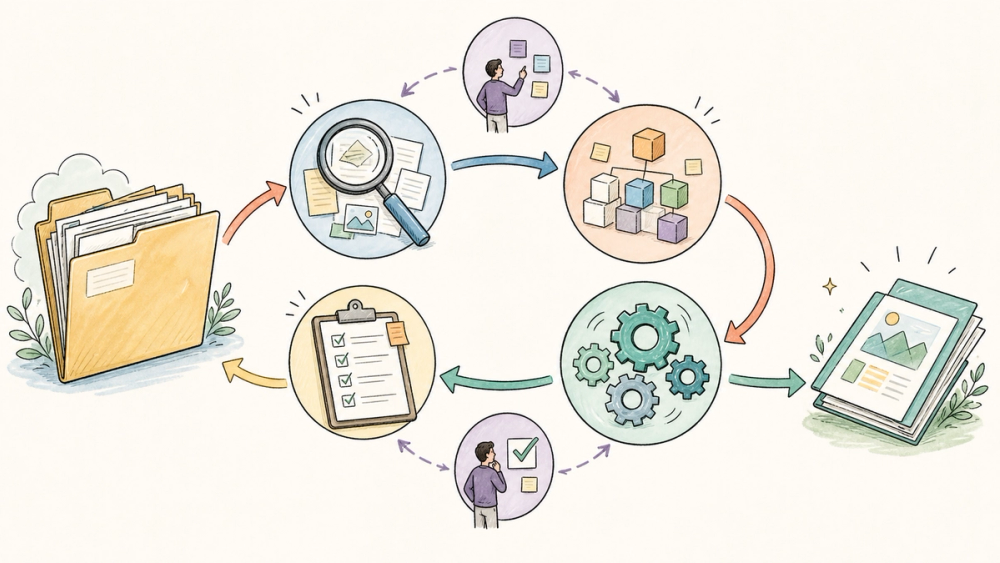
How does a long-running Claude Cowork workflow work?
1. Start with a decision, not a pile of micro-prompts
Anthropic recommends beginning with the outcome you own and the standard you will use to judge it. A useful brief might ask Cowork to explain why cancellations rose using a folder of customer feedback, then produce recommended changes with supporting evidence.
When the goal is still fuzzy, Fable 5 can interview the user or propose several directions before starting. The advantage of staying in the same conversation is continuity: the model carries forward the choices, constraints, and definition of success settled during brainstorming.
2. Give it context it can inspect
Cowork context can include shared files and folders plus connected tools such as Asana, HubSpot, Jira, and Slack. The point is not to dump every document you own into one conversation; it is to provide the sources that answer likely questions and examples that show what “good” looks like.
There is a real usage cost. Anthropic warns that Claude rereads a long conversation whenever a new message arrives, and scheduled tasks count toward limits too. Start unrelated work in a fresh conversation and retire recurring jobs that no longer earn their keep.
3. Let Cowork plan, parallelize, and check
Cowork breaks large jobs into parts and can assign those parts to separate subagents. It also presents a plan before or during execution and lists the files, tools, and Skills involved, giving the user a chance to redirect the work without restarting the entire job.
The budget example in Anthropic's guide shows why checking matters. If a run rate is misread at the start, every projection can inherit the error; the product claim is that Fable 5 is better at catching that upstream mistake while the job is still running.
4. Review evidence, not just polish
When the deliverable arrives, open the files and test the important numbers, citations, calculations, and decisions. Cowork keeps a record of its steps, so users can ask where a figure came from or inspect which file and tool informed a conclusion.
This is the right place to be conservative. Begin with work you already know how to verify, such as a first draft of a quarterly plan, before delegating a board deck or contract portfolio whose errors would be expensive.
Why should ordinary AI users care?
- The product surface is moving beyond chat. Cowork treats files, connected apps, a plan, and a final artifact as one workflow rather than separate prompts. 2. Model choice now follows task shape. Sonnet 5 remains the sensible default; Fable 5 earns its cost only when the job contains ambiguity, tools, judgment calls, and a high-value output. 3. Supervision becomes a product skill. The user needs to set a quality bar, inspect the plan, and verify the deliverable instead of micromanaging every action.
✅ Best for: paid Cowork users delegating high-value research, planning, document analysis, or recurring operations that have clear source material and an observable acceptance test.
🚫 Skip if: the task is a quick rewrite, a simple lookup, hard to verify, or risky to expose to connected tools. Sonnet 5 or a narrower manual workflow is the safer first choice.
What limits should users know before selecting Fable 5?
Fable 5 became globally available again across Claude surfaces on July 1, 2026. Anthropic's redeployment notice said included promotional access ended after July 7 and usage would continue through usage credits, so readers should check their current plan before starting a long job.
Anthropic also says Fable spends more time thinking and consumes more usage than Sonnet 5. Higher effort adds more planning and checking, while lower effort returns sooner; the public guide does not publish a universal time or credit estimate for the listed workflows.
There is one non-obvious routing limit. If Fable's cybersecurity or biology and chemistry classifiers trigger, Anthropic says the request is automatically handled by Opus 4.8, the user is notified, and that conversation remains on Opus until a new chat is started. This can also catch harmless adjacent language because the classifiers are intentionally conservative.
What remains unclear?
- Independent success rates: No independent evaluation yet shows how often Fable completes the published Cowork workflows correctly from end to end.
- Real credit consumption: The public guide says Fable uses more allowance but does not provide a typical cost for a memo, board deck, contract batch, or scheduled workflow.
- Failure recovery: Anthropic describes planning and self-checking, but public evidence does not quantify how often the model catches its own upstream mistakes.
- Connector boundaries: Availability and permissions vary by organization, plan, and administrator settings; a named connector in the guide is not proof that every reader can enable it.
- Sensitive-work suitability: Contract, finance, and due-diligence examples still require organizational security, retention, and human-review policies before adoption.
Quick Take
- What is actually new?: Evidence-backed answer: Anthropic published Fable-specific Cowork guidance for delegating long, multi-tool outcomes rather than prompting every step.
- Who can use it now?: Evidence-backed answer: Fable returned globally to Claude Cowork on July 1, with usage-credit access after July 7; users must select it manually.
- What is the strongest evidence?: Evidence-backed answer: Anthropic's July 16 Cowork guide documents the workflow, examples, model choice, usage cautions, and review controls.
- What should users verify?: Evidence-backed answer: Confirm the selected model, current credit terms, connected-tool permissions, source traceability, and the final deliverable.
- What is still unknown?: Evidence-backed answer: Independent end-to-end reliability and representative credit consumption for real Cowork projects.
My decision rule is simple: use Fable 5 when the cost of a wrong result justifies both a stronger model and a serious review. For everything else, the default exists for a reason.
FAQ
Is Claude Fable 5 the default model in Claude Cowork?
No. As of Anthropic's July 16, 2026 guide, Claude Sonnet 5 is the Cowork default and users must manually select Fable 5. Anthropic recommends Sonnet for quick everyday passes, Opus for defined deep work, and Fable for important, ambiguous projects involving multiple tools and judgment calls.
What work is Claude Fable 5 in Cowork designed for?
Anthropic lists deep research that becomes a memo, due diligence that becomes a board presentation, contract redlining, budget construction, customer-feedback diagnosis, dashboard prototyping, and recurring pipeline reviews. These are examples of intended workflows, not independent proof that every run will complete accurately.
Can Claude Fable 5 work for hours or days without supervision?
Anthropic says Fable 5 can carry complex tasks for hours or days, plan the work, use subagents, and check results. Users should still inspect the visible plan and verify the final files. No independent source currently establishes a general completion rate for multi-day Cowork jobs.
Does Claude Fable 5 use more of my Cowork allowance?
Yes. Anthropic explicitly says Fable spends more time thinking and uses more of a user's limit than the default model. Long conversations are reread when new messages arrive, and scheduled tasks also count. After July 7, 2026, Fable access moved to usage credits.
How should I review a Fable 5 Cowork result?
Start with a task whose correct answer you understand. Inspect Cowork's plan while it runs, redirect questionable steps early, then open every important output. Check figures, citations, formulas, source files, and tool actions. If the work cannot be independently verified, it is a poor first candidate for delegation.
Discover practical AI products and emerging tools at AIToolHunt.